Ask how acupuncture works and you will usually be offered a metaphor. This article offers a mechanism instead.
The starting point is this: acupuncture is a precise mechanical and sensory input that the nervous system uses to regulate the state of the body. The needle injects nothing. Its effect is carried by a signal: the needle stimulates tissue richly supplied with sensory nerves, and the body’s response to that signal is measurable. What follows is an account of what is well established, what is emerging, and what remains honest hypothesis.
The record and the explanation
Acupuncture carries more than two thousand years of clinical observation, and that observation is data — careful records of what was done, to whom, and what followed, accumulated across an enormous population over a very long time. Very little in medicine has been watched for that long.
What those records could not contain was a mechanism. The people compiling them had no microscope, no way to image a nerve, no concept of a fibroblast. They described what they could see and feel, in the language available to them. Explanation was not withheld; it was not yet possible.
This is why the record and the explanation can be treated as two separate things. The record — these locations, these techniques, these effects — was earned through centuries of consequence, and it is what modern trials now test. The explanation is a live scientific question, and answering it with current tools takes nothing away from the record. What it does close off is the temptation to re-translate old descriptions into impressive-sounding biology and call that progress. Better vocabulary is not mechanism.
So: what does the needle actually do?
1. The needle and the connective tissue
The first event is mechanical, and it happens in connective tissue — the continuous web that wraps and links every muscle, vessel and organ in the body.
When a needle enters, collagen fibres couple to its surface and the surrounding tissue is drawn towards it. Helene Langevin’s work at the University of Vermont characterised this precisely: the coupling mechanically links needle to tissue and transmits a pulling signal outward through the connective-tissue network, which the practitioner registers at the needle as a change in resistance [Emerging — human experimental + animal].1
The mechanical signal is then read by the cells. Fibroblasts — the resident connective-tissue cells — respond to stretch by remodelling their internal skeleton within minutes, spreading and reorganising, with the response measurable several centimetres from the needle [Theoretical — animal, ex vivo].2 A whorl of collagen can persist after the needle is withdrawn, prolonging the mechanical signal [Theoretical].
This is the structural basis for something clinicians observe constantly: a local input producing an effect some distance away. Connective tissue is continuous, so a mechanical signal applied at one point does not stop there — Langevin measured the cellular response centimetres from the insertion site [Theoretical].
2. The local chemistry
Around the needle, a local biochemical conversation also begins. Tissue disturbance releases signalling molecules; among the better-characterised is adenosine, which acts on local A1 receptors to dampen pain signalling at the site [Theoretical — animal].3 Local mast-cell activation and small changes in microcirculation also occur [Theoretical — animal, in vitro]. These effects are real, local and modest. They are not the whole story, because acupuncture’s most interesting effects are not local at all.
3. Talking to the nervous system
This is the centre of how I view and use acupuncture, and where the most important recent science sits.
The needle stimulates sensory nerve endings, particularly those in the fascia that wraps the muscles — the layer anatomists call deep fascia, a name for the layer rather than a needling depth. That sensory input travels to the spinal cord and brainstem, and from there the nervous system can mount an autonomic response: a shift in the relative activity of the sympathetic branch (“fight or flight”) and the parasympathetic branch (“rest, digest, repair”) [Theoretical — animal]. A peripheral input is being used by the nervous system to retune a systemic state.
The most rigorous demonstration comes from Qiufu Ma’s group at Harvard. In mice, low-intensity electroacupuncture at a specific hindlimb location activates a defined population of sensory neurons — marked by PROKR2 — that supply this fascia, and through them drives a vagal–adrenal pathway releasing catecholamines that suppress systemic inflammation induced by lipopolysaccharide (LPS) [Theoretical — animal].4 The effect depends on location, on intensity and on the needle reaching that layer, and it disappears when those specific sensory neurons are removed.
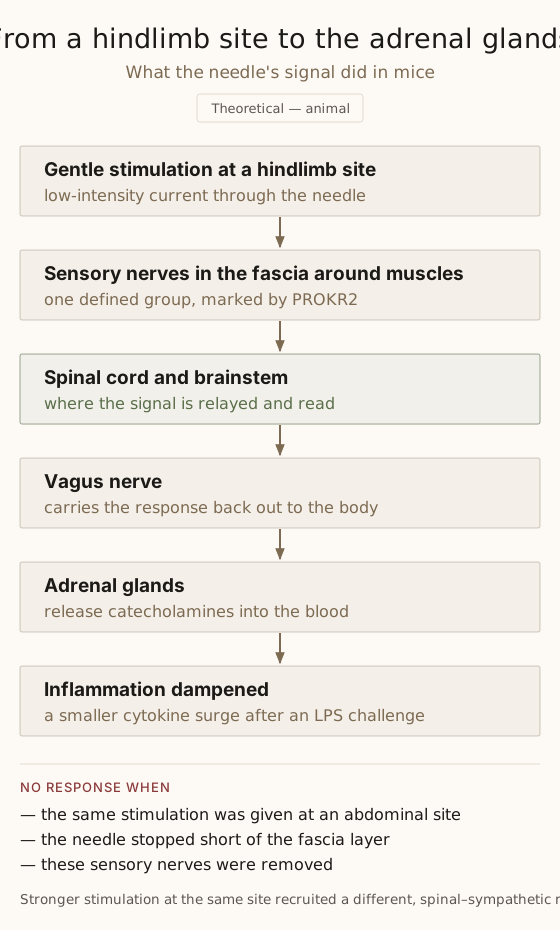
The work has clear limits: it was done in anaesthetised mice, with electrical stimulation and an experimental model of inflammation, and whether the same neural organisation operates in people has still to be tested.45 What it does show is that the target is a nerve-rich tissue layer rather than a fixed depth — how far that layer lies beneath the skin differs from one part of the body to another, and from one person to another — and that a stronger stimulus sends a different signal rather than more of the same one [Theoretical — animal].6
Alongside all this, two longer-studied pathways operate. Acupuncture engages the body’s own descending pain-control system and the release of endogenous opioids [Emerging — animal, and small human studies that have not all replicated].789 And the broader principle — that stimulating somatic sensory nerves can modulate autonomic output and circulating inflammatory cytokines — is consistent with what is now known about vagus-nerve signalling and inflammation in humans [Emerging — human RCT, vagus-nerve stimulation].10
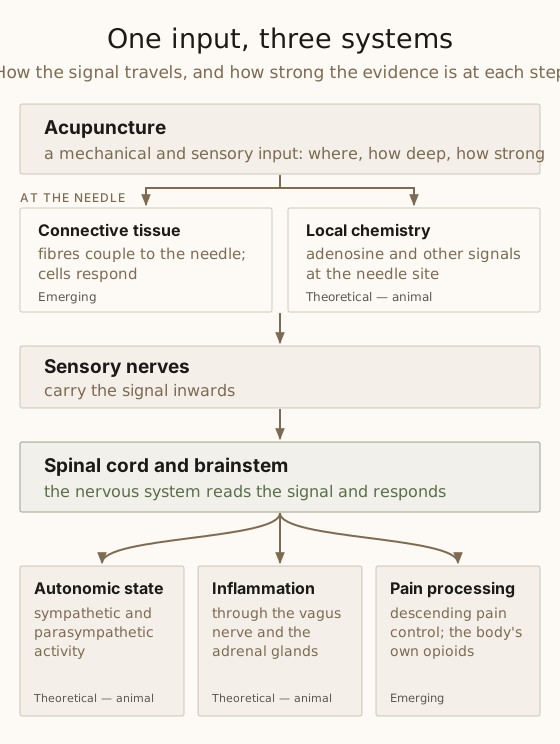
The unifying idea: acupuncture is somatosensory input that the nervous system uses to regulate autonomic, inflammatory and pain-processing state. [Theoretical] The effect travels as a signal rather than a substance: sensory nerves carry it to the spinal cord and brainstem, where the nervous system reads it and adjusts the body’s state in response.
This is also why the practitioner’s intelligent work matters: understanding the state of the patient is the skill that decides how each acupuncture treatment is designed and delivered.
4. Why some changes hold and others fade
One clinical observation deserves a mechanistic explanation, because it shapes how treatment has to be sequenced. Some changes in muscular and fascial guarding still hold at the next session; others release on the table and have returned by the next visit [Clinical Heuristic]. Why?
Part of the answer is that the nervous system’s immediate response — a release of protective muscular and fascial guarding once it registers an input as safe — is a neurological event: fast, and reversible. Consolidating a change, by contrast — actual remodelling of tissue, a genuinely re-patterned system — is a cellular process, and cellular processes cost ATP, the cell’s energy currency. Fibroblasts remodelling collagen, the active maintenance of tissue hydration and tone: all of it draws on the same metabolic budget. Where that budget is depleted, the immediate response may not hold, because the substrate needed to maintain the new state is not there [Theoretical].
This is why I do not treat structure in isolation from metabolism. The structural input and the biochemical terrain are not alternatives — they are sequential parts of one process, and both are energy-dependent.
What the evidence does and does not show
- The local mechanical and connective-tissue effects are demonstrated in human biomechanical studies and in animal tissue; their full link to clinical outcomes is still being worked out.
- The somatosensory–autonomic mechanism is elegantly demonstrated in animals and is the most promising current explanation, but awaits human confirmation.
- For some chronic pain conditions — chronic low back and neck pain, tension-type headache and migraine — pooled individual-patient data from randomised trials show short-term relief greater than sham needling by a small margin, and greater than no acupuncture by a moderate one [Established — human RCT, meta-analysis].11 NICE does not recommend acupuncture for low back pain.12
- For many other conditions, clinical-trial evidence is mixed or contested, complicated by the genuine difficulty that “sham” acupuncture is not an inert placebo — a needle placed anywhere produces some physiological signal, which narrows the measurable gap [contested].
In the room
Before any acupuncture, I assess your overall state and read your body by hand: palpation along the spine and across the abdomen, for tension in the organs, abdominal walls and surrounding soft tissue, the state of the fascia, and circulation patterns. The same examination judges how sensitive you are, which decides how the acupuncture is given. This reading is part of every session, so each treatment starts from how your body has responded since the last one. What to expect sets out the first appointment, and fertility acupuncture explains where acupuncture sits in fertility care.
Key takeaways
- An acupuncture needle injects nothing: it is a mechanical and sensory input, and the responses measured so far — in connective tissue, in local tissue chemistry and in the nervous system — are the body’s response to that signal [Theoretical — human experimental + animal].
- In mice, low-intensity electroacupuncture at a hindlimb site suppresses LPS-induced systemic inflammation through a vagal–adrenal pathway that depends on sensory neurons in the fascia around the muscles, and the effect is lost at an abdominal site, when the needle stops short of that layer, or when those neurons are removed [Theoretical — animal].
- In mice, high-intensity electroacupuncture recruits a spinal–sympathetic pathway that low intensity does not, so a stronger stimulus is a different signal, not a larger dose of the same one [Theoretical — animal].
- In chronic-pain trials, real acupuncture has differed from sham needling by only a small margin, and in a German trial of 1,162 patients with chronic low back pain, needling at traditional points did no better than shallow needling at other points, though both did better than conventional care; so it is not established that the precise site of the needle matters in people [Established — human RCT; null for real versus sham].
- When muscular and fascial guarding releases on the treatment table but has returned by the next session, the change has not been consolidated, and the next question is metabolic rather than structural [Clinical Heuristic].
Frequently asked questions
Is acupuncture just placebo?
The mechanisms studied — connective-tissue mechanotransduction, somatosensory–autonomic reflexes, endogenous opioid release — are physiological and measurable rather than psychological. The clearest evidence against a pure-expectation explanation is that the animal work uses objective molecular endpoints: cytokine concentrations, catecholamine release, the presence or absence of a specific neuron population. An anaesthetised mouse has no expectations to meet. Acupuncture is also used routinely in veterinary practice, on animals that hold no beliefs about it — though that observation is weaker than it first looks, because the owner’s expectations still shape how improvement gets reported. Veterinary use removes expectation from the animal’s physiology, not from the assessment of it; the molecular endpoints remove it from both. The harder scientific question is a separate one: how much of a person’s response in a trial exceeds a sham needle, given that a sham needle is not physiologically inert. Across chronic-pain trials, that margin is small [Established — human RCT, meta-analysis].11
Does it matter where the needle goes?
In animal studies, yes. In mice, the anti-inflammatory response to low-intensity electroacupuncture depends on the specific location stimulated, it disappears when the sensory neurons at that location are removed, and the distribution of those nerve fibres matches the body regions that respond [Theoretical — animal].4 What has changed is the reason: a location matters because of what is innervated there. In people this has not been shown: across chronic-pain trials, real acupuncture differs from sham needling by a small margin, and in a German trial of 1,162 patients with chronic low back pain, needling at traditional points did no better than shallow needling at other points, though both did better than conventional care (47.6% and 44.2% of patients responded, against 27.4%) [Established — human RCT; null for real versus sham].1113
Does acupuncture have to hurt to work?
No. My own technique is built the other way round: fine needles, precisely placed, with the aim that most are barely felt and the patient can actually relax. That is a craft position, but it also has a mechanistic rationale — in mice, low-intensity electrical stimulation drove the anti-inflammatory pathway while high intensity at the same site recruited a different, spinal–sympathetic one [Theoretical — animal].4 Strong sensation is not the mechanism, and it is not a measure of whether treatment is working. Judging how sensitive a particular person is forms part of the examination rather than an afterthought to it.
Is acupuncture safe?
Performed by a trained, registered practitioner using single-use sterile needles, acupuncture has a strong safety profile.14 Risks are real but mostly minor, and are discussed and consented before treatment.
References
-
Langevin HM, Churchill DL, Fox JR, Badger GJ, Garra BS, Krag MH. Biomechanical response to acupuncture needling in humans. J Appl Physiol. 2001;91(6):2471–2478. doi:10.1152/jappl.2001.91.6.2471. PMID: 11717207. [Emerging — human experimental] ↩︎
-
Langevin HM, Bouffard NA, Badger GJ, Churchill DL, Howe AK. Subcutaneous tissue fibroblast cytoskeletal remodeling induced by acupuncture: evidence for a mechanotransduction-based mechanism. J Cell Physiol. 2006;207(3):767–774. doi:10.1002/jcp.20623. PMID: 16511830. [Theoretical — animal, ex vivo] ↩︎
-
Goldman N, Chen M, Fujita T, et al. Adenosine A1 receptors mediate local anti-nociceptive effects of acupuncture. Nat Neurosci. 2010;13(7):883–888. doi:10.1038/nn.2562. PMID: 20512135. [Theoretical — animal] ↩︎
-
Liu S, Wang Z, Su Y, et al. A neuroanatomical basis for electroacupuncture to drive the vagal–adrenal axis. Nature. 2021;598(7882):641–645. doi:10.1038/s41586-021-04001-4. PMID: 34646018. [Theoretical — animal] ↩︎↩︎↩︎↩︎
-
Harvard Gazette. Researchers pinpoint how acupuncture targets inflammation. November 2021. https://news.harvard.edu/gazette/story/2021/11/researchers-pinpoint-how-acupuncture-targets-inflammation ↩︎
-
Liu S, Wang ZF, Su YS, et al. Somatotopic organization and intensity dependence in driving distinct NPY-expressing sympathetic pathways by electroacupuncture. Neuron. 2020;108(3):436–450.e7. doi:10.1016/j.neuron.2020.07.015. PMID: 32791039. [Theoretical — animal] ↩︎
-
Han JS. Acupuncture: neuropeptide release produced by electrical stimulation of different frequencies. Trends Neurosci. 2003;26(1):17–22. doi:10.1016/S0166-2236(02)00006-1. PMID: 12495858. [Theoretical — animal; review] ↩︎
-
Harris RE, Zubieta JK, Scott DJ, Napadow V, Gracely RH, Clauw DJ. Traditional Chinese acupuncture and placebo (sham) acupuncture are differentiated by their effects on μ-opioid receptors (MORs). NeuroImage. 2009;47(3):1077–1085. doi:10.1016/j.neuroimage.2009.05.083. PMID: 19501658. [Emerging — human RCT, small] ↩︎
-
Chapman CR, Benedetti C, Colpitts YH, Gerlach R. Naloxone fails to reverse pain thresholds elevated by acupuncture: acupuncture analgesia reconsidered. Pain. 1983;16(1):13–31. doi:10.1016/0304-3959(83)90082-9. PMID: 6866539. [Emerging — human RCT, small, null] ↩︎
-
Tesser JRP, Crowley AR, Box EJ, et al. Vagus nerve-mediated neuroimmune modulation for rheumatoid arthritis: a pivotal randomized controlled trial. Nat Med. 2026;32:369–378. doi:10.1038/s41591-025-04114-7. PMID: 41429981. [Emerging — human RCT] ↩︎
-
Vickers AJ, Vertosick EA, Lewith G, et al. Acupuncture for chronic pain: update of an individual patient data meta-analysis. J Pain. 2018;19(5):455–474. doi:10.1016/j.jpain.2017.11.005. PMID: 29198932. [Established — human RCT, meta-analysis] ↩︎↩︎↩︎
-
National Institute for Health and Care Excellence. Low back pain and sciatica in over 16s: assessment and management (NG59). Published 30 November 2016. Recommendation 1.2.8. https://www.nice.org.uk/guidance/ng59 [Established — clinical guideline] ↩︎
-
Haake M, Müller HH, Schade-Brittinger C, et al. German Acupuncture Trials (GERAC) for chronic low back pain: randomized, multicenter, blinded, parallel-group trial with 3 groups. Arch Intern Med. 2007;167(17):1892–1898. PMID: 17893311. [Established — human RCT, null for real versus sham] ↩︎
-
MacPherson H, Thomas K, Walters S, Fitter M. The York acupuncture safety study: prospective survey of 34 000 treatments by traditional acupuncturists. BMJ. 2001;323(7311):486–487. doi:10.1136/bmj.323.7311.486. PMID: 11532841. [Established — human observational] ↩︎
Related reading
- Fertility acupuncture — acupuncture in fertility care
- About Agnes Ryu — training, research background and registration