When fertility is the concern, attention almost always turns first to the sex hormones — oestrogen, progesterone, testosterone, AMH, the IVF protocol. These matter. But they sit downstream of something more fundamental, and one of the most common patterns I see in practice is a hormone problem that turns out not to be a sex-hormone problem at all [Clinical Heuristic].
The thyroid sets the pace of the body’s metabolism: its active form, T3, governs much of the body’s metabolic rate [Established — review],1 and an underactive or overactive thyroid consistently shifts SHBG and the sex steroids [Established — review].2 When that pace drops, the body does what it always does under constraint: it protects the essentials and defers what can wait. Reproduction is near the top of the “can wait” list [Theoretical].
That is why thyroid dysfunction can first show itself as a fertility, pregnancy or perimenopausal problem.
The one-line version
A great deal of what looks like a sex-hormone problem is an energy problem wearing a sex-hormone costume [Clinical Heuristic] — and thyroid hormone is one of the master regulators of energy production [Established — review].1 The cellular side of that story is in how the mitochondrion links energy and hormone production.
Thyroid and female fertility
Low thyroid function disturbs the female reproductive system at several points at once.
Ovulation. An underactive thyroid is linked with irregular cycles, mainly infrequent periods, and with reduced fertility [Established — review].2 In a study of 171 women with hypothyroidism, about one in four (23.4%) had irregular periods, against one in twelve (8.4%) of women without it [Established — human observational].3 Without ovulation there is no egg to fertilise and no corpus luteum to make progesterone [Established].
Progesterone and the luteal phase. Because ovulation quality determines the corpus luteum, and the corpus luteum makes progesterone, impaired thyroid function is one upstream contributor to a short or under-functioning luteal phase and the low progesterone that follows [Theoretical].
Prolactin. Low thyroid function can raise prolactin: in one clinic study it was raised in 36% of people with overt and 22% with subclinical hypothyroidism, and fell back to normal once thyroid function was treated [Established — human observational].4 Raised prolactin in turn suppresses ovulation — a second, indirect route to subfertility [Established].
IVF and miscarriage. Among 509 women having IVF, TSH was higher in those whose eggs failed to fertilise, though it did not predict the overall result [Emerging — human observational].5 In assisted reproduction, thyroid antibodies were linked to more miscarriages and fewer live births, in evidence of low quality [Emerging — human observational, meta-analysis],6 and, in cohort studies of pregnancy, to more than three times the odds of miscarriage [Established — human observational, meta-analysis].7
An honest word on antibodies and treatment
The association between thyroid antibodies and miscarriage is real and worth knowing. The leap from “antibodies present” to “medicate and the problem is solved” is not supported.
Small early trials suggested that levothyroxine lowered miscarriage in women with antibodies;7 two larger trials did not confirm it. In TABLET, 952 women with thyroid peroxidase antibodies, normal thyroid function and a history of miscarriage or infertility took levothyroxine or placebo from before conception: live births were 37.4% against 37.9% [Established — human RCT, null].8 T4LIFE, in 187 women with recurrent miscarriage and stopped early, found the same: 50% against 48% [Established — human RCT, null].9 The marker is useful for understanding and monitoring. It is not, on its own, a prescription.
I surface this null finding deliberately. The value lies in identifying genuine thyroid dysfunction and supporting the wider terrain — not in medicating a number.
Thyroid and male fertility
Men, understandably, tend to think in terms of testosterone, and the instinct when energy, libido or fertility flags is to raise it. But testosterone is built, and building requires a working metabolic engine [Theoretical].
In men, an underactive or overactive thyroid shifts SHBG and testosterone, erectile problems have been reported, and an underactive thyroid is associated with abnormally shaped sperm, which normalise once thyroid function is restored [Established — review].2
The clinically important consequence: a man can present with the picture of low testosterone when the actual problem sits upstream, in low thyroid function [Clinical Heuristic].
Across pregnancy, perimenopause and ageing
Thyroid demand does not stay still across a woman’s life.
Pregnancy raises thyroid hormone requirements from the first weeks, before many women know they are pregnant. In women already treated for an underactive thyroid, the dose needed rose by an average of 47% in the first half of pregnancy, beginning as early as the fifth week [Established — human observational, small].10 That is why thyroid status before conception matters.
The menopause transition overlaps with the years in which thyroid disease becomes more common. In a twenty-year follow-up of an English community, an underactive thyroid developed in 3.5 per 1,000 women a year against 0.6 per 1,000 men, and the risk rose with age [Established — human observational, cohort].11 The symptoms blur together: fatigue, weight change, low mood, brain fog, cold intolerance, thinning hair and irregular cycles get read as “just perimenopause” when an underactive thyroid may be contributing [Clinical Heuristic]. A review found that thyroid status does not significantly change menopausal symptoms themselves [Established — review],12 so the practical task is telling the two apart.
Ageing brings its own changes: the thyroid makes less T4 and T3, and reverse T3 rises, in men and women alike [Established — review],12 and thyroid hormone is one of the levers on the body’s slowing metabolic rate [Theoretical].
Most hypothyroidism is autoimmune
In iodine-sufficient countries, the most common cause of an underactive thyroid is autoimmune — Hashimoto’s thyroiditis, in which the immune system gradually attacks the thyroid [Established — review].13 This matters for two reasons.
First, autoimmunity can be present and progressing while TSH still reads within range, which is why antibodies (TPO and thyroglobulin) add information TSH alone cannot. Raised TPO antibodies are found in about 11% of the general population,13 and in the Whickham follow-up, women who had thyroid antibodies with a normal TSH at the start had eight times the odds of having developed an underactive thyroid twenty years later [Established — human observational, cohort].11
Second, thyroid autoimmunity travels with reproductive consequences, set out above for miscarriage and IVF. Whether it also lowers ovarian reserve is unsettled: one meta-analysis found AMH slightly lower in adult women with thyroid antibodies and normal thyroid function,14 while a larger one found no difference in the markers of egg numbers [contested].6
The likely thread is the one running through this whole article: autoimmune activity is metabolically expensive, and the reproductive system pays first [Theoretical]. That argument, for the body as a whole, is set out in fertility as a system consequence.
What an underactive thyroid can feel like
Hypothyroidism is a whole-body state, which is why its symptoms are so easy to dismiss individually. Commonly reported features include persistent fatigue and low stamina; cold intolerance, with cold hands and feet; weight gain or difficulty losing weight; brain fog, poor concentration and low mood; dry skin, brittle nails and thinning hair, including the outer eyebrow; constipation; heavier, irregular or more painful periods; low libido; fluid retention and puffiness; slow recovery and aching muscles; and raised cholesterol on a routine blood test [Established — review].13
No single symptom is diagnostic: about 15% of people with autoimmune hypothyroidism have no symptoms or only one, while 70% of people with normal thyroid function report at least one [Established — review].13 A cluster, especially alongside subfertility or a difficult perimenopause, is a reason to have thyroid function measured.
What each thyroid marker shows
In the UK the first test is usually TSH alone; free T4 is added when TSH is above its range, and free T4 and free T3 when it is below [Established — clinical guideline].15 TSH is the pituitary’s signal to the thyroid — useful, but not the same as knowing how much active hormone is reaching your tissues.
| Marker | What it is | What it adds |
|---|---|---|
| TSH | The pituitary’s message to the thyroid | High → underactive; low → overactive or suppressed. The first test, not the whole story. |
| Free T4 | The main hormone the thyroid releases | Largely a reservoir; converted to T3 to act. |
| Free T3 | The active hormone | About 80% of it is made from T4 outside the gland. |
| Reverse T3 | An inactive form made from T4 | Rises, as T3 falls, in fasting. |
| TPO & Tg antibodies | Autoimmune markers | Point to Hashimoto’s or Graves’ disease, often before TSH shifts. |
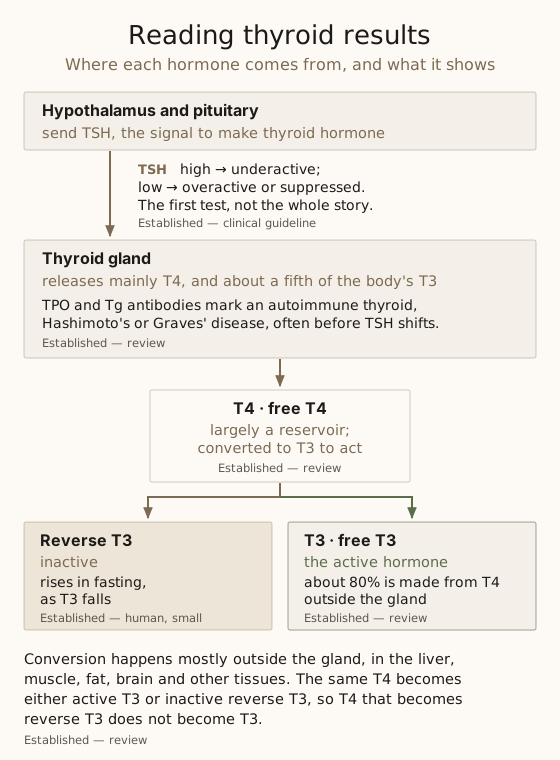
Guidance differs on testing in fertility: UK guidance offers thyroid tests only where there are symptoms of thyroid disease,16 while European thyroid guidance advises routine screening [contested].17
From T4 to T3 — the conversion step
The thyroid mainly makes T4, a relatively inactive precursor. About 20% of the body’s T3 comes from the gland itself; the rest is converted from T4 by enzymes called deiodinases, in the liver, muscle, fat, the brain and other tissues [Established — review].131 The same T4 can instead be converted to reverse T3, which is inactive [Established — review].13
This has a clinical edge. On levothyroxine, which is T4, all of a person’s T3 has to come from conversion, so the ratio of free T4 to T3 runs higher than in people whose own thyroid is working [Established — review].13 The ratio matters biologically whether or not it is measured routinely, because it shows how much of the T4 is becoming active hormone [Clinical Heuristic]. In 1,811 people without a thyroid gland whose TSH was normal on levothyroxine, 15% had a free T3 lower than that of healthy controls [Emerging — human observational];18 what that means for how a person feels is not known.13 About 5–10% of people well controlled on levothyroxine keep symptoms such as low mood; other causes, the perimenopause among them, are looked for first [Established — review].13
[contested] — combined T4/T3 therapy
Whether people who convert poorly would do better with added T3 is an active and genuinely contested area of endocrinology, not settled practice. Across 11 randomised trials with 1,216 patients, adding T3 to T4 did not improve fatigue, mood or quality of life on average [Established — human RCT, meta-analysis, null].19 The American, British and European thyroid associations agree that fourteen trials have not shown a consistent benefit, and that a better-designed trial is justified [Established — consensus statement].20 It is raised here as a live question, not a recommendation, and any prescribing decision belongs with your GP or endocrinologist.
The terrain that conversion depends on
Conversion of T4 to active T3 is not automatic. It depends on the state of the body — which is where assessment and support legitimately sit.
Energy availability. The body reads scarcity as a signal to slow the metabolic rate. In total fasting, T3 fell by about half and reverse T3 rose; on 800 calories a day without carbohydrate, T3 fell almost as far with no rise in reverse T3, but not when the same calories included at least 50 g of carbohydrate [Established — human interventional, small].21 This is an adaptive response, not a malfunction. A “clean” low-carbohydrate diet can, in some people, quietly lower active thyroid hormone: in a small randomised trial, three weeks of a ketogenic diet lowered T3 in healthy adults of normal weight [Emerging — human RCT, small].22
Protein. Adequate protein is needed for thyroid hormone production and transport, and chronic under-eating of protein is associated with reduced thyroid output [Clinical Heuristic].
Micronutrients. The enzymes that convert T4 to T3 contain selenium; making thyroid hormone needs iodine and the iron-dependent enzyme thyroid peroxidase; and zinc is among the minerals normal thyroid metabolism needs [Established — review].23 Iodine works within a careful range, since both too little and too much cause problems [Established — review].2313
Stress and inflammation. Illness and inflammation lower T3: in people admitted to hospital, lower T3 tracked higher levels of the inflammatory signal interleukin-6 [Established — human observational].24 A high dose of the steroid dexamethasone lowered T3 and raised reverse T3 within a day [Established — human interventional, small];25 everyday stress, acting through cortisol, travels the same route at a far smaller dose [Theoretical].
The practical takeaway
Conversion is rarely about the gland in isolation. It responds to how much energy is coming in, to the nutrients its enzymes need, and to the inflammatory and stress load — so that the T4 you make, or take, can actually become active T3 [Theoretical].
What this means in practice
None of this is a promise that addressing thyroid function resolves a fertility, pregnancy or perimenopausal difficulty. Bodies are multifactorial, and outcomes cannot be guaranteed.
What it means is narrower and more useful: the thyroid belongs in the assessment. Thyroid results, read in the context of symptoms and the wider hormonal picture, often explain things the sex hormones alone do not, and point to terrain that can be supported [Clinical Heuristic]. The thyroid tests available at the clinic are described under thyroid testing.
If you are working through fertility, recurrent loss, IVF that has not gone as hoped, or a perimenopause that feels heavier than it should, the thyroid is one of the first places worth looking. Not the last.
Key takeaways
- T3, the active thyroid hormone, sets much of the body’s metabolic rate, and about 80% of it is made from T4 outside the thyroid gland [Established — review].
- An underactive thyroid can disturb fertility through infrequent periods and raised prolactin in women, and through changes in SHBG, testosterone and sperm shape in men [Established — review and human observational].
- In the TABLET trial of 952 women with thyroid peroxidase antibodies and normal thyroid function, levothyroxine did not raise live births: 37.4% against 37.9% [Established — human RCT, null].
- Across 11 randomised trials with 1,216 patients, adding T3 to levothyroxine did not improve fatigue, mood or quality of life on average [Established — human RCT, meta-analysis, null].
- In total fasting, T3 fell by about half and reverse T3 rose by a similar proportion, an adaptive response to scarcity rather than a disease of the gland [Established — human interventional, small].
Frequently asked questions
Can thyroid problems cause infertility?
Low thyroid function is associated with infrequent periods and raised prolactin and, in men, with changes in SHBG, testosterone and sperm shape.24 It is a recognised contributor rather than a single cause, and in my view it belongs in any thorough fertility assessment [Clinical Heuristic]. Guidance differs: NICE offers the test only where there are symptoms of thyroid disease, while the European Thyroid Association advises routine screening.1617
My TSH was normal — could my thyroid still be part of the picture?
Possibly. TSH is the pituitary’s signal to the thyroid, not a measure of how much active hormone reaches your tissues. Thyroid antibodies add what TSH alone cannot, because autoimmunity can progress while TSH still reads within range.11 And in a small study, each person’s own range was about half as wide as the laboratory’s, so an in-range result can still be unusual for one person [Established — human observational, small].26
Should I take levothyroxine if I have thyroid antibodies but normal thyroid function?
That is a decision for your GP or endocrinologist, and the trial evidence is relevant to it: TABLET (2019) and T4LIFE (2022) both found that levothyroxine in women with thyroid antibodies and normal thyroid function did not raise live births.89 Antibodies are informative for understanding and monitoring rather than an automatic indication to treat.
What is reverse T3, and why does it matter?
Reverse T3 is an inactive form the body can make from T4 instead of active T3. In total fasting, T3 falls by about half and reverse T3 rises, as the body slows its metabolic rate [Established — human interventional, small].21 A single result is read beside the circumstances in which it was taken.
Can a low-carbohydrate diet affect thyroid function?
It can. In small randomised studies, both a carbohydrate-free low-calorie diet and three weeks of a ketogenic diet lowered T3 [Emerging — human RCT, small].2122 This is an adaptive response to perceived scarcity rather than a malfunction, but it is worth knowing about if you are eating this way while trying to conceive.
Is thyroid function relevant in perimenopause?
Yes, and the overlap is a genuine diagnostic trap. Thyroid disease becomes more common with age, and more so in women,11 and fatigue, weight change, low mood and irregular cycles belong to both. A review found that thyroid status does not significantly change menopausal symptoms themselves,12 so the task is telling the two apart: an underactive thyroid can be missed when its symptoms are put down to the perimenopause [Clinical Heuristic].
References
-
Mullur R, Liu YY, Brent GA. Thyroid hormone regulation of metabolism. Physiol Rev. 2014;94(2):355–382. doi:10.1152/physrev.00030.2013. PMID: 24692351. [Established — review] ↩︎↩︎↩︎
-
Krassas GE, Poppe K, Glinoer D. Thyroid function and human reproductive health. Endocr Rev. 2010;31(5):702–755. doi:10.1210/er.2009-0041. PMID: 20573783. [Established — review] ↩︎↩︎↩︎↩︎
-
Krassas GE, Pontikides N, Kaltsas T, Papadopoulou P, Paunkovic J, Paunkovic N, et al. Disturbances of menstruation in hypothyroidism. Clin Endocrinol (Oxf). 1999;50(5):655–659. doi:10.1046/j.1365-2265.1999.00719.x. PMID: 10468932. [Established — human observational] ↩︎
-
Hekimsoy Z, Kafesçiler S, Güçlü F, Ozmen B. The prevalence of hyperprolactinaemia in overt and subclinical hypothyroidism. Endocr J. 2010;57(12):1011–1015. doi:10.1507/endocrj.k10e-215. PMID: 20938100. [Established — human observational] ↩︎↩︎
-
Cramer DW, Sluss PM, Powers RD, McShane P, Ginsburgs ES, Hornstein MD, et al. Serum prolactin and TSH in an in vitro fertilization population: is there a link between fertilization and thyroid function? J Assist Reprod Genet. 2003;20(6):210–215. doi:10.1023/a:1024151210536. PMID: 12877251. [Emerging — human observational] ↩︎
-
Busnelli A, Beltratti C, Cirillo F, Bulfoni A, Lania A, Levi-Setti PE. Impact of thyroid autoimmunity on assisted reproductive technology outcomes and ovarian reserve markers: an updated systematic review and meta-analysis. Thyroid. 2022;32(9):1010–1028. doi:10.1089/thy.2021.0656. PMID: 35819278. [Emerging — human observational, meta-analysis] ↩︎↩︎
-
Thangaratinam S, Tan A, Knox E, Kilby MD, Franklyn J, Coomarasamy A. Association between thyroid autoantibodies and miscarriage and preterm birth: meta-analysis of evidence. BMJ. 2011;342:d2616. doi:10.1136/bmj.d2616. PMID: 21558126. [Established — human observational, meta-analysis] ↩︎↩︎
-
Dhillon-Smith RK, Middleton LJ, Sunner KK, Cheed V, Baker K, Farrell-Carver S, et al. Levothyroxine in women with thyroid peroxidase antibodies before conception. N Engl J Med. 2019;380(14):1316–1325. doi:10.1056/NEJMoa1812537. PMID: 30907987. [Established — human RCT, null] ↩︎↩︎
-
van Dijk MM, Vissenberg R, Fliers E, van der Post JAM, van der Hoorn MP, de Weerd S, et al. Levothyroxine in euthyroid thyroid peroxidase antibody positive women with recurrent pregnancy loss (T4LIFE trial): a multicentre, randomised, double-blind, placebo-controlled, phase 3 trial. Lancet Diabetes Endocrinol. 2022;10(5):322–329. doi:10.1016/S2213-8587(22)00045-6. PMID: 35298917. [Established — human RCT, null] ↩︎↩︎
-
Alexander EK, Marqusee E, Lawrence J, Jarolim P, Fischer GA, Larsen PR. Timing and magnitude of increases in levothyroxine requirements during pregnancy in women with hypothyroidism. N Engl J Med. 2004;351(3):241–249. doi:10.1056/NEJMoa040079. PMID: 15254282. [Established — human observational, small] ↩︎
-
Vanderpump MP, Tunbridge WM, French JM, Appleton D, Bates D, Clark F, et al. The incidence of thyroid disorders in the community: a twenty-year follow-up of the Whickham Survey. Clin Endocrinol (Oxf). 1995;43(1):55–68. doi:10.1111/j.1365-2265.1995.tb01894.x. PMID: 7641412. [Established — human observational, cohort] ↩︎↩︎↩︎↩︎
-
del Ghianda S, Tonacchera M, Vitti P. Thyroid and menopause. Climacteric. 2014;17(3):225–234. doi:10.3109/13697137.2013.838554. PMID: 23998691. [Established — review] ↩︎↩︎↩︎
-
Chaker L, Bianco AC, Jonklaas J, Peeters RP. Hypothyroidism. Lancet. 2017;390(10101):1550–1562. doi:10.1016/S0140-6736(17)30703-1. PMID: 28336049. [Established — review] ↩︎↩︎↩︎↩︎↩︎↩︎↩︎↩︎↩︎↩︎
-
Hasegawa Y, Kitahara Y, Osuka S, Tsukui Y, Kobayashi M, Iwase A. Effect of hypothyroidism and thyroid autoimmunity on the ovarian reserve: a systematic review and meta-analysis. Reprod Med Biol. 2022;21(1):e12427. doi:10.1002/rmb2.12427. PMID: 34934402. [Emerging — human observational, meta-analysis] ↩︎
-
National Institute for Health and Care Excellence. Thyroid disease: assessment and management (NG145). Published 20 November 2019. Recommendations 1.2.8 and 1.3.1. https://www.nice.org.uk/guidance/ng145 [Established — clinical guideline] ↩︎
-
National Institute for Health and Care Excellence. Fertility problems: assessment and treatment (NG257). Published 31 March 2026. Recommendation 1.18.12. https://www.nice.org.uk/guidance/ng257 [Established — clinical guideline] ↩︎↩︎
-
Poppe K, Bisschop P, Fugazzola L, Minziori G, Unuane D, Weghofer A. 2021 European Thyroid Association guideline on thyroid disorders prior to and during assisted reproduction. Eur Thyroid J. 2021;9(6):281–295. doi:10.1159/000512790. PMID: 33718252. [Established — clinical guideline] ↩︎↩︎
-
Gullo D, Latina A, Frasca F, Le Moli R, Pellegriti G, Vigneri R. Levothyroxine monotherapy cannot guarantee euthyroidism in all athyreotic patients. PLoS One. 2011;6(8):e22552. doi:10.1371/journal.pone.0022552. PMID: 21829633. [Emerging — human observational] ↩︎
-
Grozinsky-Glasberg S, Fraser A, Nahshoni E, Weizman A, Leibovici L. Thyroxine-triiodothyronine combination therapy versus thyroxine monotherapy for clinical hypothyroidism: meta-analysis of randomized controlled trials. J Clin Endocrinol Metab. 2006;91(7):2592–2599. doi:10.1210/jc.2006-0448. PMID: 16670166. [Established — human RCT, meta-analysis, null] ↩︎
-
Jonklaas J, Bianco AC, Cappola AR, Celi FS, Fliers E, Heuer H, et al. Evidence-based use of levothyroxine/liothyronine combinations in treating hypothyroidism: a consensus document. Thyroid. 2021;31(2):156–182. doi:10.1089/thy.2020.0720. PMID: 33276704. [Established — consensus statement] ↩︎
-
Spaulding SW, Chopra IJ, Sherwin RS, Lyall SS. Effect of caloric restriction and dietary composition of serum T3 and reverse T3 in man. J Clin Endocrinol Metab. 1976;42(1):197–200. doi:10.1210/jcem-42-1-197. PMID: 1249190. [Established — human interventional, small] ↩︎↩︎↩︎
-
Iacovides S, Maloney SK, Bhana S, Angamia Z, Meiring RM. Could the ketogenic diet induce a shift in thyroid function and support a metabolic advantage in healthy participants? A pilot randomized-controlled-crossover trial. PLoS One. 2022;17(6):e0269440. doi:10.1371/journal.pone.0269440. PMID: 35658056. [Emerging — human RCT, small] ↩︎↩︎
-
Zimmermann MB, Köhrle J. The impact of iron and selenium deficiencies on iodine and thyroid metabolism: biochemistry and relevance to public health. Thyroid. 2002;12(10):867–878. doi:10.1089/105072502761016494. PMID: 12487769. [Established — review] ↩︎↩︎
-
Boelen A, Platvoet-ter Schiphorst MC, Wiersinga WM. Association between serum interleukin-6 and serum 3,5,3′-triiodothyronine in nonthyroidal illness. J Clin Endocrinol Metab. 1993;77(6):1695–1699. doi:10.1210/jcem.77.6.8263160. PMID: 8263160. [Established — human observational] ↩︎
-
Chopra IJ, Williams DE, Orgiazzi J, Solomon DH. Opposite effects of dexamethasone on serum concentrations of 3,3′,5′-triiodothyronine (reverse T3) and 3,3′,5-triiodothyronine (T3). J Clin Endocrinol Metab. 1975;41(5):911–920. doi:10.1210/jcem-41-5-911. PMID: 1242390. [Established — human interventional, small] ↩︎
-
Andersen S, Pedersen KM, Bruun NH, Laurberg P. Narrow individual variations in serum T4 and T3 in normal subjects: a clue to the understanding of subclinical thyroid disease. J Clin Endocrinol Metab. 2002;87(3):1068–1072. doi:10.1210/jcem.87.3.8165. PMID: 11889165. [Established — human observational, small] ↩︎
Related reading
- The metabolic-bioenergetic approach to fertility — the framework this article sits in
- The mitochondrion — where energy meets hormones — why T3 sits beneath both energy and hormone production
- Fertility as system consequence — the systems argument this article draws on