Fertility is one of the most metabolically expensive sustained programmes the body runs — and therefore one of the first it quietly downgrades when the wider system is stretched. That single fact reframes most of what looks, from the outside, like a reproductive problem.
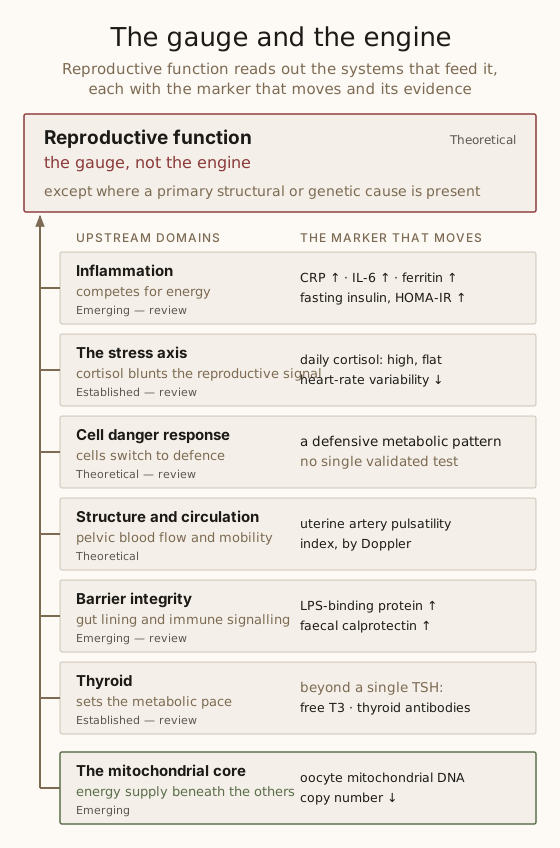
I began my career wanting mechanism, not ritual — bedside to bench, and bench back to bedside. That movement is still the shape of my medicine, and it is why, when someone arrives with months or years of unexplained difficulty, I don’t start at the ovaries or the sperm. I start with the system those cells are asking to reproduce inside. The argument of this article is simple to state and consequential in practice: except where there is a primary structural or genetic cause, reproductive difficulty is often the downstream readout of an upstream systemic problem — and the reproductive organs are the gauge, not the engine [Theoretical].
The gauge and the engine
Reproduction is biologically expensive, especially in women, across roughly three decades of cyclical activity. A single cycle is an investment of substrate, energy and regulatory precision; conception and a term pregnancy are a far larger commitment still — a precisely calibrated immune environment for implantation, sustained vascular remodelling for placentation, and continuous substrate provision for development.
Evolutionary logic makes a firm prediction here: reproduction is among the first functions downregulated when energy availability, immune regulation or metabolic sufficiency fall below what the body reads as adequate [Theoretical]. For energy, the prediction holds in people: with weight loss, heavy exercise, prolonged stress or a combination of them, the hypothalamus can slow the signal that drives ovulation until periods stop — functional hypothalamic amenorrhoea [Established — clinical guideline].1 This is not a fault in the machinery — it is the machinery making an accurate assessment. The system that makes that assessment is not the reproductive system in isolation; it is the whole organism, acting through metabolic, immune, neurological and endocrine channels that are all capable of suppressing reproduction under adverse conditions.
That is what makes fertility such a useful clinical signal. Because it is defended last and sacrificed early, reproductive function is among the most sensitive available readouts of whole-system sufficiency [Clinical Heuristic]. When it fails, the more useful question is usually not what is wrong with the reproductive organs? but what has the system detected that has led it to down-prioritise reproduction?
The clinical reframe
Reading the reproductive organs alone is reading the gauge. A technically perfect embryo still has to implant and develop inside a metabolic environment, and that environment is set upstream.
Why “unexplained” is often explicable
Reproductive endocrinology approaches difficulty through hormonal and structural pathology: are hormone levels in range, are the organs anatomically normal, are sperm parameters adequate, is the endometrium thick enough? These are necessary questions. But when the answers all read “normal” and conception still does not happen, the label applied, unexplained infertility, is a diagnosis of exclusion. It is given when the standard investigation — a semen analysis, a check that ovulation is happening and a test that the tubes are open — has found nothing to explain the difficulty, as happens in about 15 to 30% of infertile couples [Established — review].2 It marks the edge of what that framework examines, not the absence of a cause.
From a systems perspective, “unexplained” is often explicable at a level the standard workup does not assess [Clinical Heuristic]. None of the following is part of the standard investigation, yet each is measurable and each can bear on reproduction:
- chronic low-grade inflammation and its energy cost;
- the state of the stress axis and its effect on the reproductive signal;
- mitochondrial capacity at the cellular level;
- gut-barrier integrity and the immune activation it can drive;
- thyroid function beyond a single TSH, the conversion of T4 to active T3 included (see thyroid hormone and fertility);
- fasting insulin and HOMA-IR, as markers of how energy is being allocated.
None of these is yet a validated test for unexplained infertility: ESHRE’s 2023 guideline notes that most additional tests in this setting have not been robustly evaluated [Established — clinical guideline].3
Where the system actually strains: the upstream domains
These are not separate diseases; they interact, and in most people more than one is in play [Clinical Heuristic]. What follows keeps to a discipline I hold myself to throughout: every mechanism named must come with the marker that moves, in which direction — otherwise it is impressive language standing in for a testable claim.
Energy competition and inflammation
An activated immune system is metabolically expensive: in chronic inflammatory disease it can consume up to about 2,000 kJ a day [Emerging — review].4 In chronic low-grade inflammatory states it competes directly with other energy-demanding functions — including reproduction — for a finite substrate budget. The framework developed by Rainer Straub treats sex hormones partly as anabolic, energy-storing signals; when the body switches to a catabolic, defensive energy programme, reproductive signalling is suppressed as a consequence of the energy-allocation decision, not as a separate fault, and in chronic inflammatory disease androgen levels fall and cortisol runs mildly high [Emerging — review].4
The markers that move: CRP and IL-6 rise; fasting insulin and HOMA-IR rise as insulin resistance develops; and ferritin rises as an acute-phase protein, independently of iron stores [Established]. A hormonal signal sent to a system that lacks the energy to act on it may achieve little [Clinical Heuristic].
The stress axis
Stress — psychological or physiological — raises cortisol, and cortisol is directly antagonistic to the reproductive signal: it suppresses the hypothalamic pulse generator, whose GnRH release drives the whole downstream cascade; it blunts the pituitary’s LH and FSH signal; and it acts on the ovary and testis directly [Established — review, animal and human].5
The markers that move: under chronic, uncontrollable stress the daily cortisol curve runs high and flat rather than falling from morning to night, and cortisol output falls the longer the stress goes on [Established — human, meta-analysis];6 heart-rate variability falls, with lower parasympathetic activity [Emerging — human, review].7
The cellular danger response
When cells detect a threat — chemical, physical or biological — they shift from ordinary biosynthetic metabolism into a defensive programme. Robert Naviaux’s work describes how this response, protective in acute illness, is sustained by purinergic signalling and, when it persists after the threat has gone, disturbs whole-body metabolism [Theoretical — review].8 Since oocyte maturation and early embryonic development demand precisely the biosynthetic mode a defended cell has switched off, this matters for fertility [Theoretical].
The direction of interest: metabolomic and organic-acid patterns consistent with a defensive metabolic shift, rather than a single validated test [Theoretical].
Structure and circulation
The reproductive organs are suspended, perfused and innervated within a mechanical environment. Restriction in that environment — from prior inflammation, surgical adhesions, or chronic postural and diaphragmatic load — can compromise pelvic circulation and organ mobility independently of any hormonal signal [Theoretical — clinical observation, no trials].
The marker that moves: uterine artery impedance, the pulsatility index, measured by Doppler. In a small non-randomised study of ten infertile women with high impedance, it fell after eight sessions of electro-acupuncture and was still lower 10–14 days later [Emerging — human, small, non-randomised].9
Barrier integrity
Barrier tissues — the gut lining chief among them — maintain selective permeability through tight-junction complexes, regulated in part by the zonulin pathway [Emerging — review].10 When that regulation is disrupted, bacterial products such as lipopolysaccharide (LPS) can translocate, activate innate-immune (TLR4) signalling, and feed the same inflammatory energy competition described above — a mechanistically traceable chain from gut barrier to reproductive suppression [Emerging — review, mostly animal and in vitro].11
The markers that move: LPS-binding protein rises with LPS exposure, and faecal calprotectin rises with intestinal inflammation [Established].
The mitochondrial core
If one domain sits beneath the others, it is this. Egg quality is, to a substantial degree, a function of mitochondrial capacity [Emerging — review, human and animal] — and the oocyte is the richest cell in the body in mitochondria, because it must power meiotic spindle formation, fertilisation and the first days of embryonic division entirely from its own maternal mitochondrial inheritance [Established — review].12
The human evidence is specific. In 116 oocytes from 47 women, those from women with ovarian insufficiency — a reduced ovarian reserve — held about 100,000 copies of mitochondrial DNA on average, against 256,000 across all the oocytes studied [Emerging — human observational].13 In another study, of 113 unfertilised oocytes from 43 women, oocytes from IVF cycles in which fertilisation failed held fewer copies than those from cycles in which it went normally [Emerging — human observational].14 Mitochondrial capacity in the oocyte also tends to decline with age, which is one proposed contributor to the age-related fall in egg quality [Emerging — review].12
The marker that moves, and the direction: oocyte mitochondrial DNA copy number and ATP-generating capacity — lower goes with poorer fertilisation. This is exactly the kind of measurable, falsifiable claim the metabolic-bioenergetic framework rests on — ATP made by oxidative phosphorylation in the mitochondria — and why the mitochondrion, not the hormone panel, is where I anchor it. Energy production is set out in full in the mitochondrion, where energy meets hormones.
What the evidence does — and does not — support
A framework is only trustworthy if it publishes what fails as readily as what works. Two findings matter here, because they cut against common assumptions.
Antioxidants did not improve male-factor fertility in a placebo-controlled trial
It is intuitive that if oxidative stress harms sperm, antioxidants should help. The best evidence says otherwise. In the MOXI randomised, placebo-controlled trial of 174 men with male-factor infertility, an antioxidant formulation did not improve semen parameters or DNA fragmentation, and live births did not differ: 15% with antioxidants against 24% with placebo [Established — human RCT, null].15 A Cochrane review of 90 trials found only very low-certainty evidence of more live births, and none once the trials at high risk of bias were set aside [Established — systematic review].16 Supporting mitochondrial and redox biology is a reasonable mechanistic aim; a bottle of antioxidants is not a validated route to it.
The second concerns acupuncture, which I practise. The mechanism I work from is set out in how acupuncture works: a sensory input that the nervous system uses to adjust autonomic, inflammatory and pain-processing state [Theoretical]. The uterine blood-flow study above fits that account — its authors attributed the change to a central fall in sympathetic activity — but it measured blood flow, not births [Emerging — human, small, non-randomised].9 Where the trial evidence is mixed or null, I say so.
What a systemic approach involves
None of this promises that addressing the terrain resolves a given case: bodies are multifactorial, and outcomes cannot be guaranteed. What it changes is where you look and in what order. In practice that means:
- Assess the terrain, not only the organs — starting from your history and the results you already hold, alongside the standard reproductive investigations, to find which upstream domain is primary for this person. A test is added only where its answer would change the plan. How I use testing: functional lab testing.
- Sequence intervention to the primary driver — the same diagnostic label can have different primary drivers in different people; the intervention follows the driver, not the label. This is the terrain-before-protocol principle applied to fertility, and its clearest example is PMOS (polyendocrine metabolic ovarian syndrome, formerly PCOS).17
- Support the machinery that makes the outcome possible — mitochondrial substrate and cofactors, thyroid conversion, and the stress-and-inflammation load that diverts energy away from reproduction — with medication and diagnosis handled through the appropriate medical route.
Acupuncture, herbal medicine and nutritional therapy enter here where a specific mechanism supports them for a specific terrain — assessed individually, tiered by evidence, and never as a one-size protocol. This is the basis of natural fertility support as I practise it.
The bidirectional idea
One final implication, stated as a hypothesis. The biological conditions that support reproduction — mitochondrial competence, controlled inflammation, insulin sensitivity, autonomic regulation — overlap closely with those associated with long-term metabolic health [Theoretical]. If that overlap is real, then preparing the terrain for fertility and supporting long-term metabolic health are, to a large degree, the same work: a reasoned prediction, not a promise of disease prevention.
Key takeaways
- Outside primary structural or genetic causes, reproductive difficulty is often the downstream readout of strain elsewhere in the body, so the reproductive organs are the gauge rather than the engine [Theoretical].
- An activated immune system can consume up to about 2,000 kJ a day, and in chronic inflammatory disease androgen levels fall and cortisol runs mildly high [Emerging — review].
- A standard fertility investigation — semen analysis, a check of ovulation and a test of tubal patency — finds no cause in about 15–30% of infertile couples, and the label then given, unexplained infertility, is a diagnosis of exclusion [Established — review].
- In a study of 116 oocytes from 47 women, oocytes from women with ovarian insufficiency held about 100,000 copies of mitochondrial DNA on average, against 256,000 across all the oocytes studied [Emerging — human observational].
- In the MOXI randomised trial of 174 men with male-factor infertility, an antioxidant formulation did not improve semen parameters, DNA fragmentation or live births [Established — human RCT, null].
Frequently asked questions
Is “unexplained infertility” a real diagnosis?
It is a diagnosis of exclusion. It is given when the standard investigations — a semen analysis, a check that ovulation is happening and a test that the tubes are open — find nothing to explain the difficulty, as happens in about 15 to 30% of infertile couples.2 It marks the boundary of what that investigation assesses, not the absence of a cause. Many of the systemic factors that can bear on fertility — inflammatory load, mitochondrial capacity, thyroid conversion, gut-barrier and stress-axis state — are not part of it, so from a systems perspective “unexplained” often means “not yet examined at the right level” [Clinical Heuristic].
Can I just take supplements to improve egg or sperm quality?
This is where honesty matters more than optimism. The clearest test so far is in men: the idea that antioxidants should help, because oxidative stress harms sperm, was tested directly in the MOXI randomised trial, and an antioxidant formulation did not improve semen parameters, DNA fragmentation or live births.15 A Cochrane review found only very low-certainty evidence of benefit.16 Supporting mitochondrial and metabolic function is a reasonable aim, but it is pursued through the terrain — energy availability, thyroid function, controlled inflammation, sleep, nutrition — assessed individually, not through a generic bottle of pills.
Does thyroid function really affect fertility this much?
Thyroid hormone sets the metabolic pace of nearly every cell [Established — review],18 and thyroid dysfunction disturbs reproduction in both sexes: the menstrual cycle and fertility in women, sex-steroid levels and sperm in men [Established — review].19 A single “normal” TSH does not show free T3, or whether thyroid antibodies are present. Where antibodies are found with normal thyroid function, treatment has been tested: levothyroxine did not raise live births in the TABLET trial or, in women with recurrent miscarriage, in T4LIFE [Established — human RCT, null].2021 The full account is in thyroid hormone and fertility.
References
-
Gordon CM, Ackerman KE, Berga SL, Kaplan JR, Mastorakos G, Misra M, et al. Functional hypothalamic amenorrhea: an Endocrine Society clinical practice guideline. J Clin Endocrinol Metab. 2017;102(5):1413–1439. doi:10.1210/jc.2017-00131. PMID: 28368518. [Established — clinical guideline] ↩︎
-
Gelbaya TA, Potdar N, Jeve YB, Nardo LG. Definition and epidemiology of unexplained infertility. Obstet Gynecol Surv. 2014;69(2):109–115. doi:10.1097/OGX.0000000000000043. PMID: 25112489. [Established — review] ↩︎↩︎
-
Guideline Group on Unexplained Infertility; Romualdi D, Ata B, Bhattacharya S, Bosch E, Costello M, et al. Evidence-based guideline: unexplained infertility. Hum Reprod. 2023;38(10):1881–1890. doi:10.1093/humrep/dead150. PMID: 37599566. [Established — clinical guideline] ↩︎
-
Straub RH, Cutolo M, Buttgereit F, Pongratz G. Energy regulation and neuroendocrine-immune control in chronic inflammatory diseases. J Intern Med. 2010;267(6):543–560. doi:10.1111/j.1365-2796.2010.02218.x. PMID: 20210843. [Emerging — review] ↩︎↩︎
-
Whirledge S, Cidlowski JA. Glucocorticoids, stress, and fertility. Minerva Endocrinol. 2010;35(2):109–125. PMID: 20595939. [Established — review, animal and human] ↩︎
-
Miller GE, Chen E, Zhou ES. If it goes up, must it come down? Chronic stress and the hypothalamic-pituitary-adrenocortical axis in humans. Psychol Bull. 2007;133(1):25–45. doi:10.1037/0033-2909.133.1.25. PMID: 17201569. [Established — human, meta-analysis] ↩︎
-
Kim HG, Cheon EJ, Bai DS, Lee YH, Koo BH. Stress and heart rate variability: a meta-analysis and review of the literature. Psychiatry Investig. 2018;15(3):235–245. doi:10.30773/pi.2017.08.17. PMID: 29486547. [Emerging — human, review] ↩︎
-
Naviaux RK. Metabolic features of the cell danger response. Mitochondrion. 2014;16:7–17. doi:10.1016/j.mito.2013.08.006. PMID: 23981537. [Theoretical — review] ↩︎
-
Stener-Victorin E, Waldenström U, Andersson SA, Wikland M. Reduction of blood flow impedance in the uterine arteries of infertile women with electro-acupuncture. Hum Reprod. 1996;11(6):1314–1317. doi:10.1093/oxfordjournals.humrep.a019378. PMID: 8671446. [Emerging — human, small, non-randomised] ↩︎↩︎
-
Fasano A. Zonulin and its regulation of intestinal barrier function: the biological door to inflammation, autoimmunity, and cancer. Physiol Rev. 2011;91(1):151–175. doi:10.1152/physrev.00003.2008. PMID: 21248165. [Emerging — review] ↩︎
-
Qin X, Du J, He R, Li Y, Li H, Liang X. Potential mechanisms and therapeutic strategies for LPS-associated female fertility decline. J Assist Reprod Genet. 2024;41(10):2739–2758. doi:10.1007/s10815-024-03226-2. PMID: 39167249. [Emerging — review, mostly animal and in vitro] ↩︎
-
May-Panloup P, Boucret L, Chao de la Barca JM, Desquiret-Dumas V, Ferré-L’Hotellier V, Morinière C, et al. Ovarian ageing: the role of mitochondria in oocytes and follicles. Hum Reprod Update. 2016;22(6):725–743. doi:10.1093/humupd/dmw028. PMID: 27562289. [Established — review] ↩︎↩︎
-
May-Panloup P, Chrétien MF, Jacques C, Vasseur C, Malthièry Y, Reynier P. Low oocyte mitochondrial DNA content in ovarian insufficiency. Hum Reprod. 2005;20(3):593–597. doi:10.1093/humrep/deh667. PMID: 15608038. [Emerging — human observational] ↩︎
-
Reynier P, May-Panloup P, Chrétien MF, Morgan CJ, Jean M, Savagner F, et al. Mitochondrial DNA content affects the fertilizability of human oocytes. Mol Hum Reprod. 2001;7(5):425–429. doi:10.1093/molehr/7.5.425. PMID: 11331664. [Emerging — human observational] ↩︎
-
Steiner AZ, Hansen KR, Barnhart KT, Cedars MI, Legro RS, Diamond MP, et al. The effect of antioxidants on male factor infertility: the Males, Antioxidants, and Infertility (MOXI) randomized clinical trial. Fertil Steril. 2020;113(3):552–560.e3. doi:10.1016/j.fertnstert.2019.11.008. PMID: 32111479. [Established — human RCT, null] ↩︎↩︎
-
de Ligny W, Smits RM, Mackenzie-Proctor R, Jordan V, Fleischer K, de Bruin JP, et al. Antioxidants for male subfertility. Cochrane Database Syst Rev. 2022;5(5):CD007411. doi:10.1002/14651858.CD007411.pub5. PMID: 35506389. [Established — systematic review] ↩︎↩︎
-
Teede HJ, Bahri Khomami M, Morman R, Laven JSE, Joham AE, Costello MF, et al. Polyendocrine metabolic ovarian syndrome, the new name for polycystic ovary syndrome: a multistep global consensus process. Lancet. 2026;407(10545):2329–2339. doi:10.1016/S0140-6736(26)00717-8. PMID: 42119588. [Established — consensus statement] ↩︎
-
Mullur R, Liu YY, Brent GA. Thyroid hormone regulation of metabolism. Physiol Rev. 2014;94(2):355–382. doi:10.1152/physrev.00030.2013. PMID: 24692351. [Established — review] ↩︎
-
Krassas GE, Poppe K, Glinoer D. Thyroid function and human reproductive health. Endocr Rev. 2010;31(5):702–755. doi:10.1210/er.2009-0041. PMID: 20573783. [Established — review] ↩︎
-
Dhillon-Smith RK, Middleton LJ, Sunner KK, Cheed V, Baker K, Farrell-Carver S, et al. Levothyroxine in women with thyroid peroxidase antibodies before conception. N Engl J Med. 2019;380(14):1316–1325. doi:10.1056/NEJMoa1812537. PMID: 30907987. [Established — human RCT, null] ↩︎
-
van Dijk MM, Vissenberg R, Fliers E, van der Post JAM, van der Hoorn MP, de Weerd S, et al. Levothyroxine in euthyroid thyroid peroxidase antibody positive women with recurrent pregnancy loss (T4LIFE trial): a multicentre, randomised, double-blind, placebo-controlled, phase 3 trial. Lancet Diabetes Endocrinol. 2022;10(5):322–329. doi:10.1016/S2213-8587(22)00045-6. PMID: 35298917. [Established — human RCT, null] ↩︎
Related reading
- The metabolic-bioenergetic approach to fertility — the framework this article sits in
- The mitochondrion — where energy meets hormones — energy production in full
- The overlooked gland — thyroid hormone and fertility — thyroid function and conception