Most conversations about oestrogen are about how much of it is being made. That is one question, and it is the one a blood test answers. It is not the only question, and in the clinic it is often not the interesting one.
Oestrogen is not switched off when the ovary stops producing it. It is packaged by the liver, sent out through the bile into the intestine, and — depending on which bacteria are living there and how quickly the bowel moves — either leaves the body or is unpacked and sent back into circulation. The hormone that reaches your tissues this afternoon may not all be hormone you made this morning.
This article is about that second step: the enzyme that reopens the package, what is genuinely known about it, and what the measurement of it can and cannot tell you.
Conjugation is an exit, not an endpoint
Oestradiol and oestrone are fat-soluble molecules. That is what allows them to cross cell membranes and reach a receptor, and it is also what makes them difficult to excrete: a kidney cannot easily dispose of something that dissolves into fat.
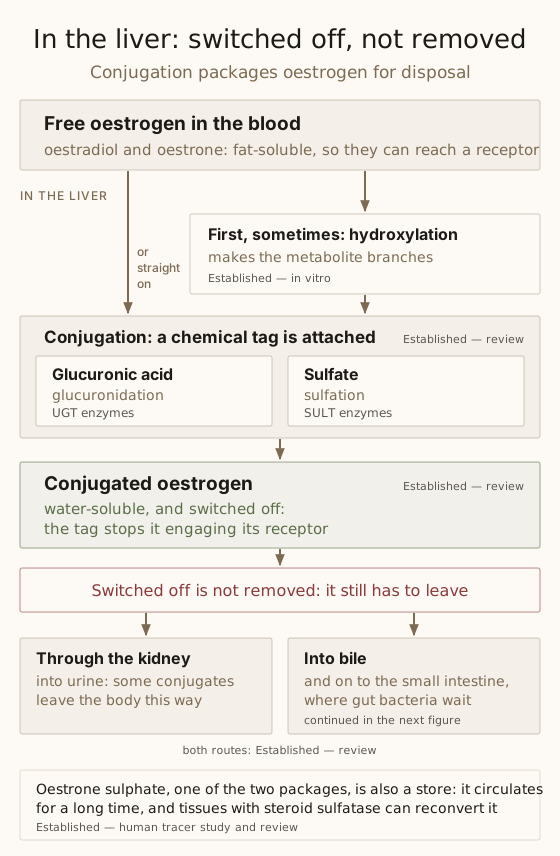
The liver solves this in two stages, though not every molecule passes through both. First it may hydroxylate the molecule, producing the metabolite branches that a urine steroid profile reports — which branch predominates is a separate clinical question, and it belongs to steroid hormone testing rather than here [Established — in vitro].1 Then it conjugates, either the hormone itself or its hydroxylated form: it attaches either a glucuronic acid group (glucuronidation, carried out by the UGT enzyme family)2 or a sulfate group (sulfation, by sulfotransferases such as SULT1E1). Either addition does two things at once. It makes the molecule water-soluble, and it blocks the part of the structure that engages the receptor [Established — review].3
That is the point most people assume is the end of the story. The hormone has been switched off and filed for disposal. And it has been switched off — but it has not left. The conjugated molecule now has to travel. Some conjugates go out through the kidney into urine. A substantial fraction is instead secreted into bile and delivered into the small intestine, which means the disposal route runs directly through the gut lumen [Established — review].4
It is worth noting that the two packages are not equivalent. Oestrone sulphate is a major circulating form of oestrogen, with a long half-life in the blood, and it is as much a store as a disposal form, since tissues carrying steroid sulfatase can reconvert it [Established — human tracer study and review].53 The glucuronide is the more definitively excretory package. It is also the one with a bacterial enzyme waiting for it.
The distinction this article rests on
Conjugation is when a hormone stops signalling. Excretion is when it leaves. These are two different events, separated in time and in anatomy, and a serum oestradiol measures neither of them. Most of what follows is about the gap between the two.
The enzyme that reopens the package
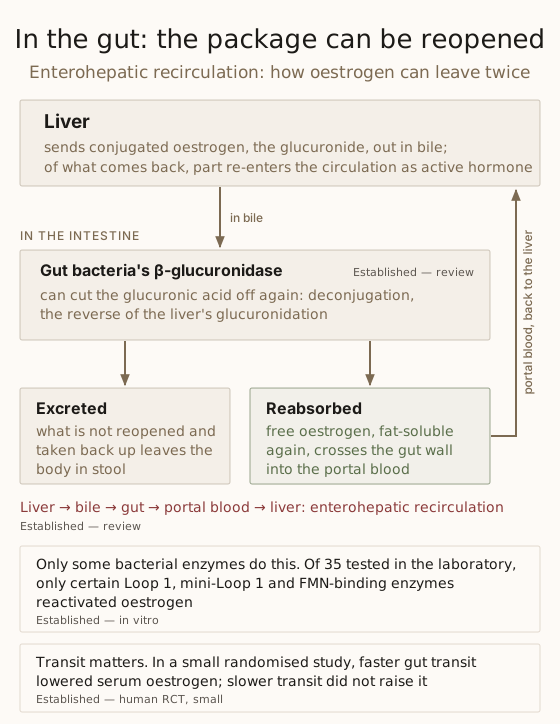
β-glucuronidase is the enzyme that hydrolyses the bond the liver just made, releasing free oestrogen from its glucuronide. Human tissues produce it. So do gut bacteria, in the one place the conjugate has to pass through on its way out.
The consequence is mechanical rather than mysterious. Bacterial β-glucuronidase cleaves the conjugate in the intestinal lumen. The liberated hormone is fat-soluble again, and fat-soluble molecules cross the intestinal wall readily. It enters the portal circulation, returns to the liver, and a proportion re-enters systemic circulation as active hormone. This loop — liver to bile to intestine to portal blood to liver — is enterohepatic recirculation, and it is the reason oestrogen has to leave twice [Established — review].42
Here the detail matters more than the headline. “Gut bacteria raise oestrogen” is not wrong, but it is far too coarse to act on.
A structural survey of the human gut microbiome identified 3,013 β-glucuronidase proteins, of which 279 were unique, falling into six distinct structural categories defined by the loops around the active site [Established — human metagenomic survey].2 These are not interchangeable enzymes that happen to share a name — they differ in what they will actually process. A subsequent study tested 35 gut bacterial enzymes directly against two oestrogen glucuronides and found that only certain members of the Loop 1 and mini-Loop 1 classes, and of a group that binds flavin mononucleotide (FMN), reactivated oestrogen from its conjugate [Established — in vitro].6 The others tested did not.
So the relevant variable is not how many bacteria are present, or even which species. It is which enzymes those species encode, and whether those enzymes are ones that recognise an oestrogen conjugate as a substrate [Theoretical]. That is a more demanding question than a measurement of total enzyme activity can answer, for reasons set out below.
Three separable quantities, not one vague state
This is the practical payoff, and it is why I think the subject is worth an article rather than a sentence.
The amount of oestrogen acting on your tissues at a given moment is set by three things that can fail independently:
| The quantity | Where it is set | What reports on it | |
|---|---|---|---|
| 1 | How much is produced | Ovarian output; aromatase activity in adipose tissue and elsewhere | Serum oestradiol, timed to the cycle |
| 2 | Which branch it is metabolised down | Hepatic Phase I hydroxylation | A steroid metabolite profile |
| 3 | How much of what was packaged actually leaves | Conjugation, biliary delivery, bacterial deconjugation, transit time | Bowel history; the gut community; a faecal enzyme activity measurement, with the limits below |
A single serum oestradiol answers the first question, at one moment, on one day, and it cannot separate the other two from it. Two women with identical oestradiol readings can be in genuinely different states if one is clearing efficiently and the other is recirculating a meaningful fraction of what she packaged for disposal — and they may not need the same clinical approach [Clinical Heuristic].
This is also why I avoid describing anyone as having “too much” oestrogen as though it were a single dial. Oestrogen is a signal whose timing and quantity both matter. Recirculation does not simply add hormone; it smears the signal across time, returning hormone during a phase of the cycle when the system had expected it to be falling [Theoretical]. Naming which of the three quantities is the problem is a more useful act than naming the hormone.
What actually moves the third quantity
The most informative human work on this is also the most sobering, and it is nearly thirty years old.
In a randomised study, forty healthy premenopausal women had their whole-gut transit time deliberately manipulated — accelerated with senna, slowed with loperamide, and separately compared against wheat bran supplementation — with serum oestrogens, whole-gut transit time, stool pH and faecal β-glucuronidase activity all measured across two menstrual cycles per intervention [Established — human RCT, small].7
Three findings, and all three are worth holding together:
- Speeding transit lowered circulating oestrogen. Serum oestrone sulphate fell with wheat bran and with senna; total and non-protein-bound oestrone fell with senna. The recirculation route is real, and shortening the time available for it measurably reduces what comes back.
- Slowing transit did not raise it. Loperamide produced no significant change in serum oestrogens. The plausible reading is that reabsorption is already near-maximal at ordinary transit times, so there is more to gain from speeding up than there is to lose from slowing down [Theoretical].
- Faecal β-glucuronidase activity did not significantly change in either direction, even while serum oestrogen did.
That third finding is the reason the next section exists.
Where the measurement stops
A faecal β-glucuronidase value on a stool test is a measurement of total hydrolytic activity in the sample against a synthetic laboratory substrate, a small glucuronide of the kind used as the standard test substrate for the enzyme [Established — in vitro].2 It is not a measurement of activity against an oestrogen glucuronide, and given that only some members of three enzyme classes reactivated oestrogen in laboratory testing,6 a total-activity figure is a coarse proxy for the fraction of the enzyme population that is actually relevant to oestrogen [Theoretical].
Set that alongside the transit study, in which serum oestrogen moved while the faecal enzyme activity did not, and the honest position is this: the mechanism is well characterised, the measurement is a proxy of uncertain resolution, and the number should not be treated as a dial to be driven down. I read a raised value as a reason to look at the community producing it and at how fast the bowel is moving — not as a finding in its own right [Clinical Heuristic].
The recirculation hypothesis that did not survive
There is a well-documented case in which exactly this reasoning was applied at national scale, and then withdrawn.
For years, women in the UK taking the combined oral contraceptive pill were advised to use additional contraceptive precautions while on a course of broad-spectrum antibiotics. The reasoning was precisely the mechanism described above: antibiotics reduce the gut bacteria that deconjugate ethinyloestradiol, less hormone is recirculated, and blood levels fall below the threshold for reliable contraception.
The evidence did not support it. A systematic review of 29 studies found no difference in pregnancy rates, ovulation suppression or breakthrough bleeding when the pill was taken with antibiotics other than the rifamycins, and no significant fall in progestogen levels; ethinyloestradiol exposure fell with one antibiotic, dirithromycin, and with no other [Established — systematic review, null].8 UK guidance from the Faculty of Sexual & Reproductive Healthcare (since renamed the College of Sexual and Reproductive Healthcare), in its May 2022 version, advises that no additional precaution is needed with an antibiotic that is not an enzyme inducer, unless it or the illness causes vomiting or diarrhoea. Its guidance notes that colonic bacteria cleave some ethinyloestradiol conjugates but not progestogen conjugates, and that this recirculation is not considered to contribute significantly to contraceptive effectiveness [Established — clinical guideline].9 The genuine interaction, with enzyme-inducing drugs such as rifampicin, works by a different route entirely: induction of hepatic metabolising enzymes, not disruption of gut deconjugation.
I include this because it calibrates everything above it. Enterohepatic recirculation is real, it is measurable, and its quantitative contribution varies enormously between molecules — sometimes to a degree that changes a clinical decision, and sometimes not nearly enough. A mechanism being true is not the same as a mechanism being large.
What I do with this in practice
This comes up when the story and the numbers disagree: cycle symptoms that intensify in the luteal phase without a serum reading that explains them, a metabolite profile that looks adequate against a clinical picture that does not, or a hormonal history in which the bowel has never once been asked about. In the perimenopausal transition it matters more rather than less, because production has become erratic — and a variable recirculated load arriving on top of an unpredictable baseline is a different problem from either one alone [Clinical Heuristic].
What I look at first is bowel frequency and stool form, read together with your cycle history and the results you already hold, and against how they have changed over time, rather than as separate numbers. Where a test would change the plan, two bear on this route: a stool panel, for the bacterial community and its enzyme activity (gut testing), and a urine steroid metabolite profile, for the branches oestrogen is metabolised down (steroid hormone testing) — read together and against the history, not reported as separate results. Whether either is worth running is decided at the consultation. Where clearance sits among the other endocrine questions is set out on Hormone Optimisation.
The scope of this
This is one mechanism among several that set circulating oestrogen, and it is the least examined of them rather than the most important. Nothing described here is a diagnosis, and no marker discussed here should be acted on in isolation; a hormonal picture that does not add up is a reason for a consultation, not for a purchase.
Key takeaways
- Conjugation in the liver switches oestrogen off without removing it: a substantial share of the conjugated hormone travels in bile to the intestine, where bacterial β-glucuronidase can free it to be reabsorbed, a loop called enterohepatic recirculation [Established — review].
- Of 35 human gut bacterial β-glucuronidases tested in the laboratory against two oestrogen glucuronides, only certain members of three enzyme classes reactivated the hormone [Established — in vitro].
- The oestrogen acting on tissues is set by three separable quantities — how much is produced, which metabolic branch it takes, and how much of what was packaged for disposal actually leaves — and a single serum oestradiol cannot tell them apart [Clinical Heuristic].
- In a randomised study of 40 premenopausal women, faster gut transit lowered serum oestrogen, slower transit did not raise it, and faecal β-glucuronidase activity did not change [Established — human RCT, small].
- The hypothesis that antibiotics weaken the combined contraceptive pill by reducing oestrogen recirculation was not supported for antibiotics that are not enzyme inducers: a systematic review found no change in ovulation suppression or progestogen levels [Established — systematic review, null].
Frequently asked questions
Does a high faecal β-glucuronidase result mean I have too much oestrogen?
No. It reports total enzyme activity in a stool sample against a laboratory substrate, not activity against oestrogen specifically, and not a circulating level. It is a prompt to look at the bacterial community producing it and at bowel transit, read with your cycle history, the results you already hold and, where it would change the plan, a steroid metabolite profile. On its own it is one number describing one step in a multi-step route.
Is constipation really relevant to a hormonal problem?
It is relevant enough to have been tested directly. In the transit study described above, accelerating whole-gut transit lowered serum oestrone sulphate and oestrone; slowing it produced no significant change.7 That asymmetry is why bowel frequency and stool form are part of a hormonal history in my consultations rather than a separate subject.
Do antibiotics change my oestrogen levels?
They change the bacterial population that performs deconjugation, so in principle yes. Whether the change is large enough to matter clinically depends heavily on the molecule. The best-studied case — the combined oral contraceptive pill — was investigated precisely on this reasoning, and no effect on contraception was found for antibiotics that are not enzyme inducers.8
Does this apply to men?
Yes. Men produce oestrogens through aromatisation of testosterone, conjugate them by the same hepatic routes, and excrete them through the same biliary and intestinal path [Established — review].4 The recirculation step is not sex-specific, and it is one of the reasons digestive function appears in a male hormonal assessment rather than being treated as an unrelated complaint.
Can this be looked at on the NHS?
Faecal calprotectin, stool culture and PCR for enteric organisms are all available through the NHS where there is a clinical indication, and where your GP has already run them I use those results. Faecal β-glucuronidase activity and commensal community profiling are not routine NHS investigations; as this article argues, they earn their place only as one input among several.
References
-
Lee AJ, Cai MX, Thomas PE, Conney AH, Zhu BT. Characterization of the oxidative metabolites of 17β-estradiol and estrone formed by 15 selectively expressed human cytochrome P450 isoforms. Endocrinology. 2003;144(8):3382–3398. doi:10.1210/en.2003-0192. PMID: 12865317. [Established — in vitro] ↩︎
-
Pollet RM, D’Agostino EH, Walton WG, Xu Y, Little MS, Biernat KA, et al. An atlas of β-glucuronidases in the human intestinal microbiome. Structure. 2017;25(7):967–977.e5. doi:10.1016/j.str.2017.05.003. PMID: 28578872. [Established — human metagenomic survey] ↩︎↩︎↩︎↩︎
-
Mueller JW, Gilligan LC, Idkowiak J, Arlt W, Foster PA. The regulation of steroid action by sulfation and desulfation. Endocr Rev. 2015;36(5):526–563. doi:10.1210/er.2015-1036. PMID: 26213785. [Established — review] ↩︎↩︎
-
Adlercreutz H, Martin F. Biliary excretion and intestinal metabolism of progesterone and estrogens in man. J Steroid Biochem. 1980;13(2):231–244. doi:10.1016/0022-4731(80)90196-x. PMID: 6991820. [Established — review] ↩︎↩︎↩︎
-
Ruder HJ, Loriaux L, Lipsett MB. Estrone sulfate: production rate and metabolism in man. J Clin Invest. 1972;51(4):1020–1033. doi:10.1172/JCI106862. PMID: 5014608. [Established — human tracer study] ↩︎
-
Ervin SM, Li H, Lim L, Roberts LR, Liang X, Mani S, et al. Gut microbial β-glucuronidases reactivate estrogens as components of the estrobolome that reactivate estrogens. J Biol Chem. 2019;294(49):18586–18599. doi:10.1074/jbc.RA119.010950. PMID: 31636122. [Established — in vitro] ↩︎↩︎
-
Lewis SJ, Heaton KW, Oakey RE, McGarrigle HH. Lower serum oestrogen concentrations associated with faster intestinal transit. Br J Cancer. 1997;76(3):395–400. doi:10.1038/bjc.1997.397. PMID: 9252210. [Established — human RCT, small] ↩︎↩︎
-
Simmons KB, Haddad LB, Nanda K, Curtis KM. Drug interactions between non-rifamycin antibiotics and hormonal contraception: a systematic review. Am J Obstet Gynecol. 2018;218(1):88–97.e14. doi:10.1016/j.ajog.2017.07.003. PMID: 28694152. [Established — systematic review, null] ↩︎↩︎
-
Faculty of Sexual & Reproductive Healthcare (since renamed the College of Sexual and Reproductive Healthcare), Clinical Effectiveness Unit. Clinical Guidance: Drug Interactions with Hormonal Contraception. London: FSRH; May 2022. [Established — clinical guideline] ↩︎
Related reading
- The metabolic-bioenergetic approach to fertility — the framework that clearance sits in
- Fertility as system consequence — why the gut appears in a reproductive work-up at all
- Gut testing — the stool panel, including β-glucuronidase activity
- Steroid hormone testing — the urine profile that reports the branches oestrogen is metabolised down