Hormones
HRT — What It Does, What It Does Not, and Where My Work Sits
Patients ask me what I think about hormone replacement, and I would rather answer plainly than leave it implied. Replacement is a legitimate prescribed medical treatment and many people do well on it. What I can offer is a physiological description of what administering a hormone does and does not do, because it explains why some people feel transformed on replacement, why others feel very little, and why my own work sits upstream of the prescription rather than in competition with it.
Before anything else
I do not prescribe HRT, testosterone, thyroid hormone or any other pharmaceutical, and nothing on this page is a reason to alter a prescription. If something here raises a question about your treatment, the person to take it to is the person who prescribed it. This work is designed to sit alongside your GP or endocrinologist, not to contest them.
What replacement actually does
Every hormonal axis is a loop. The hypothalamus signals the pituitary, the pituitary signals the gland, the gland produces the hormone, and the hormone reports back upstream — where its presence tells the signalling tissue to ease off. That feedback is not a design flaw. It is how the system holds a set point.
Administering a hormone from the downstream end of that loop supplies the product while the signalling above it responds to the product being present. In a feedback system, responding to a product being present means reducing your own output. This is not a controversial reading; it is the operating principle behind hormonal male contraception, where exogenous testosterone reliably suppresses gonadotrophins and, with them, sperm production [Established — human trial].1 The same logic applies wherever a downstream hormone is given, in different degrees depending on the hormone, the dose and the axis.
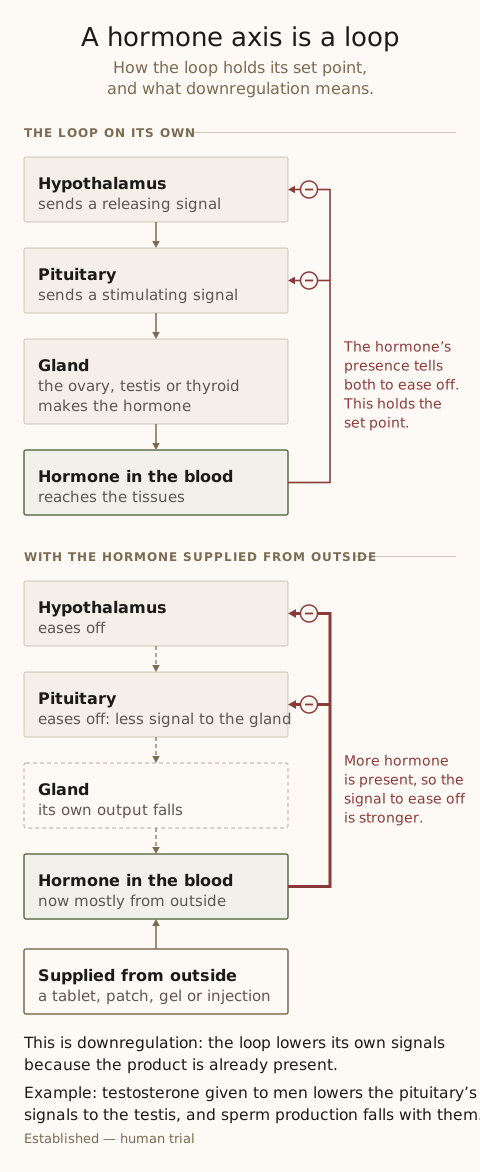
So replacement is supplementation of a product, not restoration of a system. That distinction is not a criticism. It is a description of what you should expect the treatment to deliver, and expecting the right thing from a treatment is most of what determines whether you are satisfied with it.
Why that is not an argument against taking it
Supplying a product rather than restoring a loop does not make a treatment inferior or unnatural. A great many treatments in medicine supply a product; insulin supplies a product. The question is never whether a treatment restores upstream signalling — it is whether it does what the patient needs, at acceptable risk, better than the alternatives. NICE treats hormone replacement as an effective treatment for vasomotor symptoms, to be offered and discussed on its merits with risks and benefits set out individually [Established — clinical guideline].2 Someone with disrupted sleep, disabling flushes and a collapsing quality of life who feels well on replacement has been treated correctly.
What the mechanism tells you is narrower and more useful: why replacement alone sometimes disappoints, and where to look when it does.
The same dose is not the same exposure
Two women prescribed the same oestradiol dose do not necessarily end up with the same hormonal exposure, and this is one of the more under-explained facts in the area.
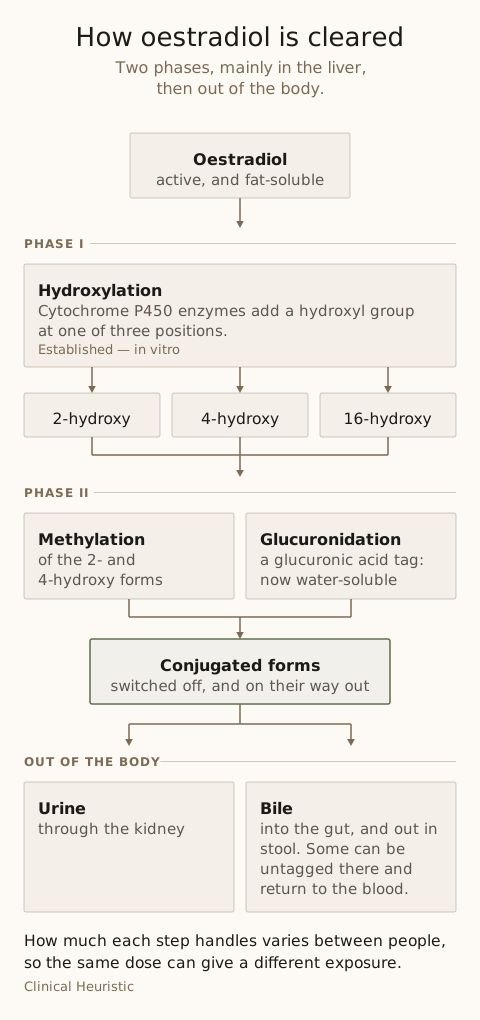
Route matters first. Oral oestradiol passes through the liver before reaching the circulation, where a substantial proportion is metabolised on the way and where it alters hepatic protein synthesis — sex hormone binding globulin, clotting factors, triglycerides. Transdermal delivery bypasses that first pass entirely. These are pharmacologically different exposures from the same nominal dose, which is why route is a real clinical decision rather than a matter of preference [Established — review].3
Clearance matters second. Oestradiol is metabolised in phase I along three hydroxylation routes — the 2-, 4- and 16-hydroxy pathways, catalysed by different cytochrome P450 enzymes with different tissue distributions [Established — in vitro]4 — and the resulting metabolites are then conjugated in phase II, by methylation and glucuronidation, before excretion. The capacity of those steps varies between people, and it is influenced by nutrient cofactor status, liver function, gut function and genetics [Clinical Heuristic]; the gut’s part is set out in Oestrogen Leaves Twice. A urine steroid profile can show which routes are carrying the load and how much of the hydroxylated hormone is being methylated, because each of those metabolites can be measured separately in urine [Established — analytical method].5
What this measurement is for
It shows that hormonal exposure varies between individuals on the same dose, and that some of that variation is measurable. No pattern here predicts disease. Its use is narrow: it can explain why someone responds unlike the average, and point at nutritional, gut or liver findings worth correcting on their own merits.
Why response varies — the thyroid example
Thyroid replacement is the best-documented case of individual response, so it is worth using as the worked example even though thyroid has its own page.
Levothyroxine is T4 — a prohormone. It must be converted to T3 by deiodinase enzymes before it does anything at the receptor, and that conversion varies between individuals and with metabolic state. Between 5 and 10 per cent of people on adequately dosed levothyroxine, with a TSH sitting comfortably in range, continue to have the symptoms they were treated for [Established — clinical guideline].6 A normalised TSH confirms that pituitary signalling has been satisfied. It does not confirm that tissue-level T3 is adequate: in some people treated with levothyroxine alone, free T3 runs low while TSH is normal [Emerging — human observational].7
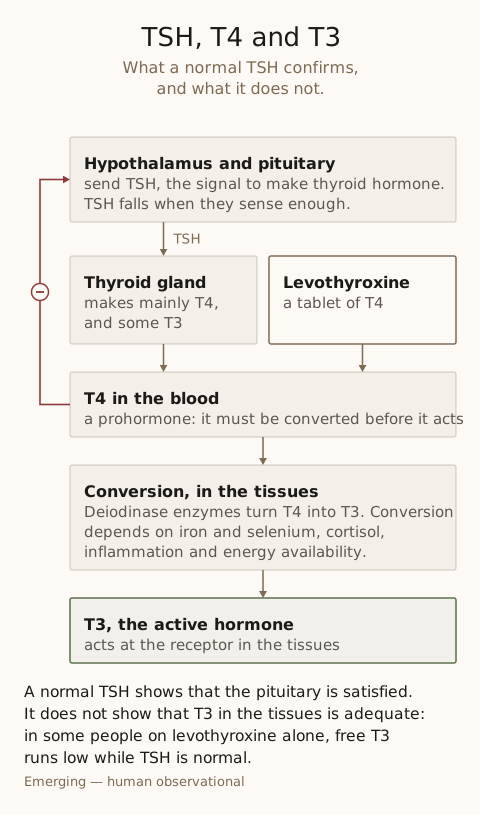
This is a genuinely unsettled area, and I will not pretend otherwise in either direction. Combination T4/T3 therapy is permitted by European Thyroid Association guidance as a supervised trial in selected patients who remain symptomatic [Established — clinical guideline],6 but in randomised comparison it has not, on average, outperformed T4 alone [Established — human RCT, meta-analysis, null],8 and in 2021 the American, British and European thyroid associations judged the question open and set out how a new trial should test it [Established — consensus statement].9 What it does justify is looking at conversion, and at what conversion depends on: iron and selenium status [Established — review],10 cortisol [Established — human interventional, small],11 inflammation [Established — human observational]12 and energy availability [Established — human interventional, small].13 Those are things I can assess and, where deficient, address.
What determines whether it does what it should
Here is the observation that organises everything I do in this area.
Hormones do not act in a vacuum. They act on tissue — tissue with a particular energy status, a particular inflammatory state, a particular receptor sensitivity, a particular capacity to clear what it is given. Replacement laid over a metabolic picture that is already struggling is being asked to run an anabolic programme the body does not currently have the capacity to fund. In my clinical experience, this is the single most common reason someone on a perfectly reasonable prescription tells me they still do not feel right [Clinical Heuristic].
That is an observation from practice, not a trial result, and I present it as such. But it is testable in the ordinary clinical sense: the things it points at — insulin regulation, thyroid conversion, nutrient status, inflammatory load, sleep and circadian timing, gut and liver function — can be measured or observed, and most of them can be changed; the cell’s capacity to make ATP is the one that is inferred rather than measured directly in routine practice. The reasoning behind treating energy production as upstream of hormone output is set out in The Mitochondrion — Where Energy Meets Hormones, and the pathway itself in Steroidogenesis — One Cholesterol Molecule, Every Hormone.
Testosterone in men — read this first
Most low testosterone readings in midlife men are secondary rather than a primary testicular problem: in a survey of 3,369 European men aged 40 to 79, low testosterone without a raised luteinising hormone was about six times as common as the primary form, and it was strongly associated with obesity [Established — human observational].14 Visceral adiposity, insulin resistance, poor sleep and sustained under-recovery all bear on it; that reasoning, and what to do about it, sits on the hormone optimisation page. One safety point belongs here, on the page about administered hormone, because this is where a man will look for it.
If you may want children, now or later
Exogenous testosterone suppresses the pituitary signals that drive sperm production. This is not a rare side effect — it is dependable enough that it was developed and trialled as a male contraceptive method: in a World Health Organization trial, about two-thirds of 271 healthy men had no sperm in the ejaculate within six months [Established — human trial].1 After stopping, sperm counts in contraceptive trials of healthy men recovered in a median of about three and a half months, and in all of them within two years [Established — pooled analysis].15 In men who had used testosterone before trying to conceive, recovery was slower with age and with longer use, and three in ten had not reached a total motile count of 5 million a year after stopping, despite treatment to restart the axis [Emerging — human observational, retrospective].16 Not every man recovers fully. This must be discussed with your prescriber before testosterone is started, not afterwards. If fertility is the concern, Sperm Is a System Readout sets out why.
Where the evidence stops
The mechanism sections are well established: feedback suppression of a gonadal axis, route-dependent pharmacokinetics, phase I and phase II oestrogen metabolism, and deiodinase-mediated T4 to T3 conversion are all textbook physiology with primary sources cited below. The clinical observation in What determines whether it does what it should is exactly that — a pattern I see, badged as a Clinical Heuristic, not a finding. And the measurement I offer describes your metabolism; it does not diagnose menopause, which NICE treats as a clinical judgement in otherwise healthy women aged 45 or over [Established — clinical guideline].2
What I actually do
If you are taking replacement, my work is on the terrain it acts on. If you are not taking it, or cannot take it, that terrain is where the available leverage sits. Either way the assessment is the same, and it starts with your history and whatever results you bring rather than a panel — testing is carefully selected after evaluation. What each panel covers is on the functional lab testing page, and its fee on the Fees page.
Key takeaways
- Replacement supplies a hormone at the downstream end of a feedback loop, and the signalling above it responds by reducing its own output, which describes the treatment rather than criticising it [Established — human trial].
- The same oestradiol dose does not give the same exposure: oral oestradiol passes through the liver and alters its protein synthesis, transdermal oestradiol does not, and clearance by hydroxylation and conjugation varies between people [Established — review].
- Combining T3 with levothyroxine has not, on average, outperformed levothyroxine alone in randomised trials, although 5 to 10 per cent of people on levothyroxine with a normal TSH remain symptomatic [Established — human RCT, meta-analysis, null].
- In my clinical experience, the most common reason someone on a reasonable prescription still does not feel right is a metabolic picture that cannot fund what the hormone asks of the tissue [Clinical Heuristic].
- Exogenous testosterone suppresses sperm production dependably, so any man who may want children should raise it with his prescriber before starting [Established — human trial].
Frequently asked questions
Should I be taking HRT?
That is a decision for you and your prescriber. What I can tell you is that my work is upstream of it and unchanged by the answer: whether or not you take replacement, the substrate, nutritional, gut, liver, circadian and energy questions are the same, and they are what I address.
Do you prescribe HRT or testosterone?
No. I do not prescribe pharmaceuticals of any kind. This work sits alongside your GP or endocrinologist and is designed to complement prescribing, not to replace or argue with it.
I am on HRT and I still do not feel well. What does that mean?
It usually means something other than the prescription needs attention, and it is worth saying that it does not mean you are imagining it. Three things account for most of what I see: the dose or route is not producing the exposure it is assumed to produce; a second axis — most often thyroid, cortisol or insulin — is contributing symptoms that look hormonal and is not being addressed; or the metabolic terrain is not currently able to fund what the hormone is asking the tissue to do.
Can what you do make my HRT work better?
That has not been tested in a trial, so I do not claim it. What I will say is that the factors I work on — nutrient status, thyroid conversion, insulin regulation, inflammation, sleep and circadian timing, gut and hepatic function — are the same factors that determine how any hormone behaves once it reaches tissue, and correcting a deficit is worth doing on its own merits regardless of what it does to your response to a prescription.
Is it safer to use body-identical or compounded preparations?
In the UK, regulated body-identical preparations are available on prescription and are what NICE guidance addresses; unregulated compounded products are a different category with a different evidence position.
Do I need testing before I see you?
Not always. Some pictures are clear enough from history and examination, and testing is recommended only when it will change what I do. If you already have results — including anything from your GP or menopause clinic — please upload them through the upload page at least 24 hours before your appointment, so that they are read before we meet.
References
-
World Health Organization Task Force on Methods for the Regulation of Male Fertility. Contraceptive efficacy of testosterone-induced azoospermia in normal men. Lancet. 1990;336(8721):955–959. doi:10.1016/0140-6736(90)92416-F. PMID: 1977002. [Established — human trial] ↩︎↩︎
-
National Institute for Health and Care Excellence. Menopause: identification and management (NG23), recommendations 1.3.1, 1.4.1 and 1.5.1. Published 12 November 2015; last updated 15 April 2026. https://www.nice.org.uk/guidance/ng23 [Established — clinical guideline] ↩︎↩︎
-
Kuhl H. Pharmacology of estrogens and progestogens: influence of different routes of administration. Climacteric. 2005;8(Suppl 1):3–63. doi:10.1080/13697130500148875. PMID: 16112947. [Established — review] ↩︎
-
Badawi AF, Cavalieri EL, Rogan EG. Role of human cytochrome P450 1A1, 1A2, 1B1, and 3A4 in the 2-, 4-, and 16α-hydroxylation of 17β-estradiol. Metabolism. 2001;50(9):1001–1003. doi:10.1053/meta.2001.25592. PMID: 11555828. [Established — in vitro] ↩︎
-
Xu X, Veenstra TD, Fox SD, Roman JM, Issaq HJ, Falk R, et al. Measuring fifteen endogenous estrogens simultaneously in human urine by high-performance liquid chromatography-mass spectrometry. Anal Chem. 2005;77(20):6646–6654. doi:10.1021/ac050697c. PMID: 16223252. [Established — analytical method] ↩︎
-
Wiersinga WM, Duntas L, Fadeyev V, Nygaard B, Vanderpump MPJ. 2012 ETA guidelines: the use of L-T4 + L-T3 in the treatment of hypothyroidism. Eur Thyroid J. 2012;1(2):55–71. doi:10.1159/000339444. PMID: 24782999. [Established — clinical guideline] ↩︎↩︎
-
Gullo D, Latina A, Frasca F, Le Moli R, Pellegriti G, Vigneri R. Levothyroxine monotherapy cannot guarantee euthyroidism in all athyreotic patients. PLoS One. 2011;6(8):e22552. doi:10.1371/journal.pone.0022552. PMID: 21829633. [Emerging — human observational] ↩︎
-
Grozinsky-Glasberg S, Fraser A, Nahshoni E, Weizman A, Leibovici L. Thyroxine-triiodothyronine combination therapy versus thyroxine monotherapy for clinical hypothyroidism: meta-analysis of randomized controlled trials. J Clin Endocrinol Metab. 2006;91(7):2592–2599. doi:10.1210/jc.2006-0448. PMID: 16670166. [Established — human RCT, meta-analysis, null] ↩︎
-
Jonklaas J, Bianco AC, Cappola AR, Celi FS, Fliers E, Heuer H, et al. Evidence-based use of levothyroxine/liothyronine combinations in treating hypothyroidism: a consensus document. Thyroid. 2021;31(2):156–182. doi:10.1089/thy.2020.0720. PMID: 33276704. [Established — consensus statement] ↩︎
-
Zimmermann MB, Köhrle J. The impact of iron and selenium deficiencies on iodine and thyroid metabolism: biochemistry and relevance to public health. Thyroid. 2002;12(10):867–878. doi:10.1089/105072502761016494. PMID: 12487769. [Established — review] ↩︎
-
Chopra IJ, Williams DE, Orgiazzi J, Solomon DH. Opposite effects of dexamethasone on serum concentrations of 3,3′,5′-triiodothyronine (reverse T3) and 3,3′,5-triiodothyronine (T3). J Clin Endocrinol Metab. 1975;41(5):911–920. doi:10.1210/jcem-41-5-911. PMID: 1242390. [Established — human interventional, small] ↩︎
-
Boelen A, Platvoet-ter Schiphorst MC, Wiersinga WM. Association between serum interleukin-6 and serum 3,5,3′-triiodothyronine in nonthyroidal illness. J Clin Endocrinol Metab. 1993;77(6):1695–1699. doi:10.1210/jcem.77.6.8263160. PMID: 8263160. [Established — human observational] ↩︎
-
Spaulding SW, Chopra IJ, Sherwin RS, Lyall SS. Effect of caloric restriction and dietary composition of serum T3 and reverse T3 in man. J Clin Endocrinol Metab. 1976;42(1):197–200. doi:10.1210/jcem-42-1-197. PMID: 1249190. [Established — human interventional, small] ↩︎
-
Tajar A, Forti G, O’Neill TW, Lee DM, Silman AJ, Finn JD, et al. Characteristics of secondary, primary, and compensated hypogonadism in aging men: evidence from the European Male Ageing Study. J Clin Endocrinol Metab. 2010;95(4):1810–1818. doi:10.1210/jc.2009-1796. PMID: 20173018. [Established — human observational] ↩︎
-
Liu PY, Swerdloff RS, Christenson PD, Handelsman DJ, Wang C; Hormonal Male Contraception Summit Group. Rate, extent, and modifiers of spermatogenic recovery after hormonal male contraception: an integrated analysis. Lancet. 2006;367(9520):1412–1420. doi:10.1016/S0140-6736(06)68614-5. PMID: 16650651. [Established — pooled analysis] ↩︎
-
Kohn TP, Louis MR, Pickett SM, Lindgren MC, Kohn JR, Pastuszak AW, et al. Age and duration of testosterone therapy predict time to return of sperm count after human chorionic gonadotropin therapy. Fertil Steril. 2017;107(2):351–357.e1. doi:10.1016/j.fertnstert.2016.10.004. PMID: 27855957. [Emerging — human observational, retrospective] ↩︎
Related reading
- Hormone optimisation — who hormone work is for, how the axis is read, and what treatment involves
- The overlooked gland — thyroid hormone and fertility — why thyroid is read before the sex steroids
- Steroidogenesis — one cholesterol molecule, every hormone — the branching pathway every one of these hormones is built along
- Sperm is a system readout — what testosterone use does to sperm production, and why
Book a consultation
Dr Ryu Natural Medicine is in Wimbledon, South West London. Care begins with an initial consultation. What to expect describes the first consultation.