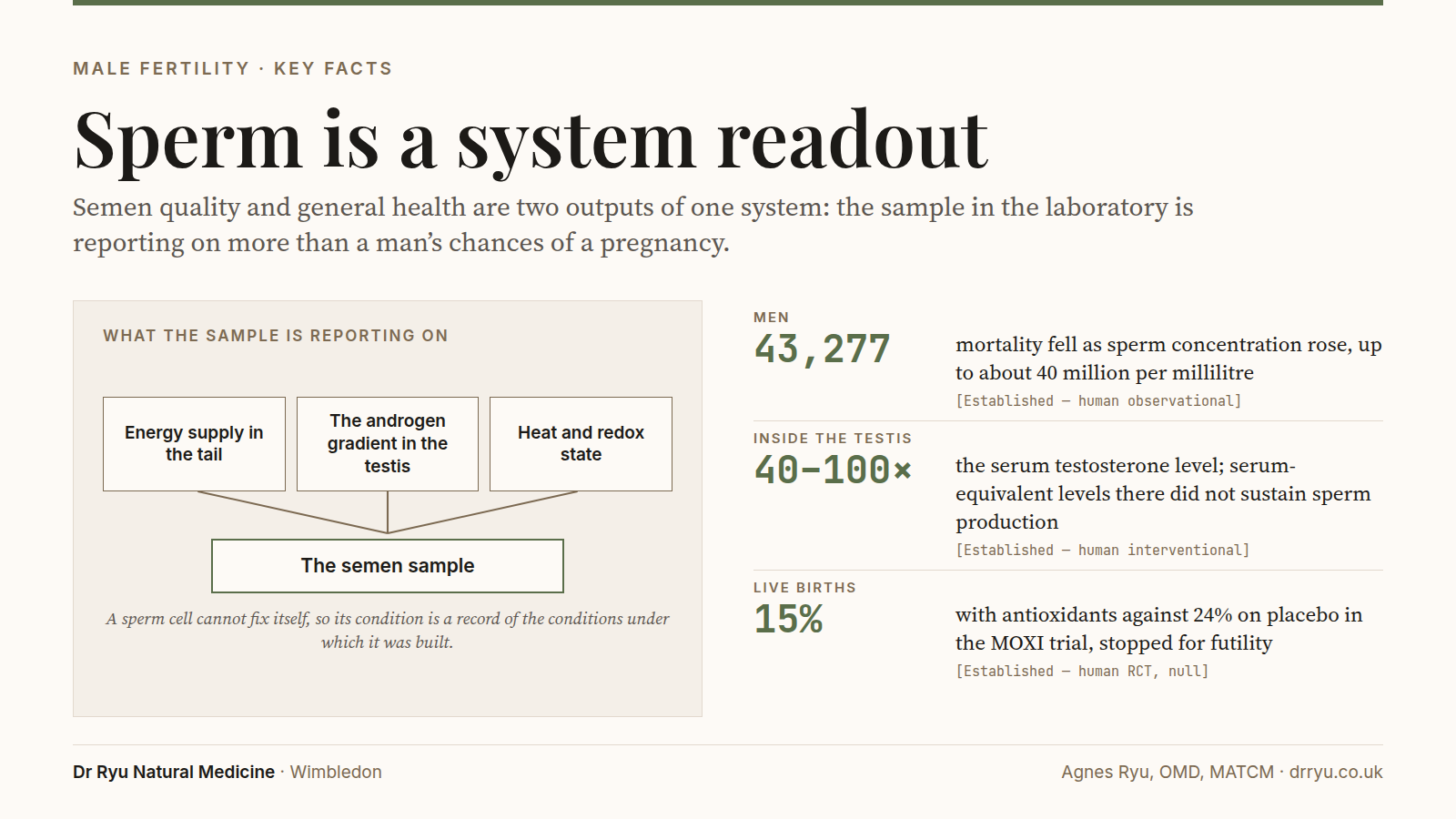
A Danish cohort followed 43,277 men who had given a semen sample at a fertility laboratory, some of them for up to 38 years. The finding was not about fertility. As sperm concentration rose, all-cause mortality fell — the relationship holding up to around 40 million per millilitre, after which the curve flattened. Motility, morphology and volume moved in the same direction. And the association held in men with children and in men without, so fatherhood, and the way fathers live, cannot explain it on its own [Established — human observational].1
A second cohort, 9,387 men attending for infertility evaluation, scored each man’s medical comorbidity formally. The heavier the comorbidity burden, the poorer every parameter measured: volume, concentration, motility, total count and morphology [Established — human observational].2
Neither study says that good sperm cause a long life. Both are observational, and neither shows which is cause and which is effect. What they say is that something sits upstream of both — that semen quality and general health are two outputs of one system, and that the sample in the laboratory is reporting on more than a man’s chances of a pregnancy.
This article is about the mechanism underneath that: why the readout works, what it is measuring, and what follows for how a man ought to be assessed.
What making a sperm cell costs
Spermatogenesis is among the highest-throughput manufacturing processes in the adult male body, and the product is unlike any other cell it makes.
A mature spermatozoon has been stripped. Most of its cytoplasm is discarded during maturation, and with the cytoplasm goes most of the enzymatic defence and most of the repair capacity a somatic cell takes for granted. Its DNA is compacted to a density no other human cell achieves, with the histones largely replaced by protamines and the structure locked by disulphide bonds formed during epididymal transit [Established — review].3 What is left is a nucleus, a mitochondrial midpiece and a tail: a delivery vehicle built for one journey, with no facility for maintenance en route.
That design has a consequence which is easy to miss. A sperm cell cannot fix itself, so its condition is a record of the conditions under which it was built — chromatin integrity, membrane composition, the enzymatic content of the tail, all determined upstream in a tissue supplied by the man’s circulation.
The energetics make the point sharply. It would be reasonable to assume the mitochondria in the midpiece power the tail. In mice with the sperm-specific glycolytic enzyme GAPDHS deleted, progressive motility was abolished and ATP fell to about a tenth of normal — while mitochondrial oxygen consumption in those same cells was unchanged [Established — animal].4 Most of the ATP driving the flagellum is generated by glycolysis along the fibrous sheath of the tail itself, and the mitochondria do not substitute for it.
So motility is not a vague index of vigour. It is a specific report on a specific local ATP supply, in a cell that cannot build more machinery once it has left.
The androgen microenvironment
The second thing the sample reports on is an endocrine gradient that almost nobody measures, because it cannot be measured without a needle in the testis.
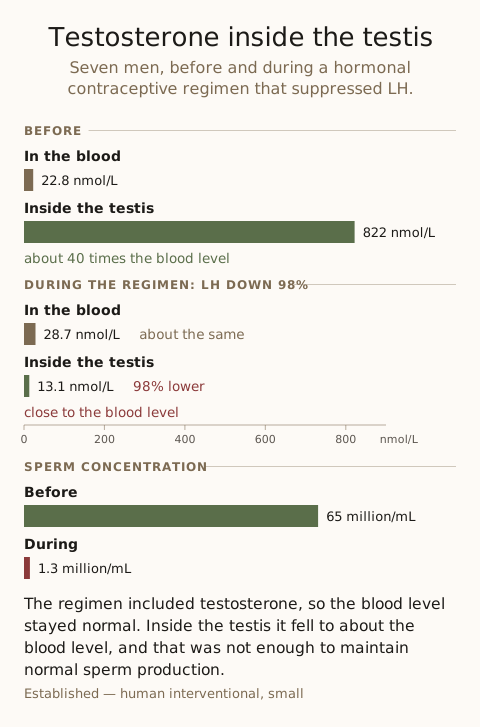
Testosterone inside the testis runs far above the serum concentration: about a hundred times higher in one series of normal men [Established — review],5 and about forty times higher in a study of seven men in which direct aspiration measured 822 ± 136 nmol/L against 22.8 ± 1.9 nmol/L in serum. When a hormonal contraceptive regimen suppressed luteinising hormone in those men, the intratesticular concentration fell by 98 per cent and sperm concentration fell from 65 ± 15 to 1.3 ± 1.3 million per millilitre — and the crucial detail is that the intratesticular level remaining was close to a normal serum level [Established — human interventional, small].6 Serum-equivalent concentrations inside the testis are not sufficient for spermatogenesis.
Two consequences follow, and neither is small.
The first is interpretive. A serum testosterone in the reference range says comparatively little about the concentration that matters, because the germinal epithelium responds to the gradient, not to the circulating number. What a serum panel can tell you is whether the axis driving that gradient is intact — which is why luteinising hormone, follicle-stimulating hormone and oestradiol are read together with testosterone rather than after it.
The second is practical. Exogenous testosterone raises the serum concentration and suppresses luteinising hormone; when luteinising hormone falls, the Leydig cells stop generating the local one. The gradient collapses. This is established well enough that testosterone has been studied as a male contraceptive [Established — human interventional].6
Testosterone use: sperm production pauses, and recovery is slow
A man is prescribed or supplied testosterone for fatigue or low mood, his serum reading normalises, he feels better, and its effect on sperm production is easy to overlook [Clinical Heuristic]. Months later the couple is investigating infertility and the therapy is not mentioned, because it does not feel like a fertility drug. While he takes it, the signal that drives the testis is suppressed: sperm production pauses and the testes shrink [Established — review].7 After stopping, sperm counts in contraceptive trials of healthy men recovered in a median of about three and a half months, and in all of them within two years [Established — pooled analysis].8 In men who had used testosterone before trying to conceive, recovery was slower with age and with longer use, and three in ten had not reached a total motile count of 5 million a year after stopping, despite treatment to restart the axis [Emerging — human observational, retrospective].9 Not every man recovers fully. If you are taking testosterone in any form — prescribed, over the counter, or from a gym — say so at the first appointment.
The medicine I most often find behind a change in semen
In my clinic, it is a 5α-reductase inhibitor: finasteride, taken for hair loss, or finasteride or dutasteride, taken for an enlarged prostate [Clinical Heuristic]. These drugs block the enzyme that converts testosterone into dihydrotestosterone. In a year-long randomised trial of 99 healthy men taking the prostate doses, total sperm count had fallen at 26 weeks by 29% with dutasteride and 34% with finasteride. By 52 weeks, and 24 weeks after stopping, the fall was smaller and no longer statistically significant, while motility was 6 to 12% lower with both drugs, during treatment and at follow-up [Established — human RCT, small].10 Among 27 men seen for infertility who were taking finasteride, at a mean dose of about 1 mg a day, the hair-loss dose, sperm counts rose an average of 11.6-fold after it was stopped [Emerging — human observational, small].11 The UK medicines regulator has separately warned that finasteride’s sexual side effects, such as lower libido and erectile difficulty, have in some men persisted after stopping, and that depression has been reported [Established — regulatory safety update].12 If you take one, say so at the first appointment.
Where metabolism enters
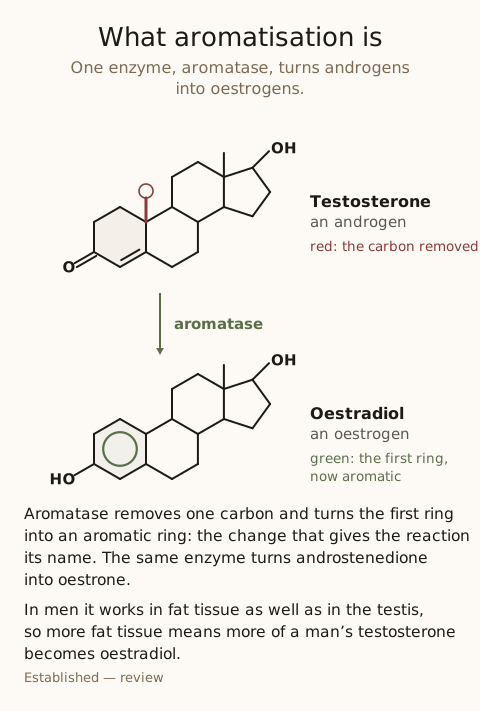
Adipose tissue is not inert storage; it expresses aromatase, and aromatase converts testosterone to oestradiol [Established — review].13
Oestradiol feeds back at the hypothalamus and pituitary and suppresses luteinising hormone. Less luteinising hormone means less Leydig cell output, and less Leydig cell output means a smaller intratesticular gradient. The loop closes on itself [Established — review].13
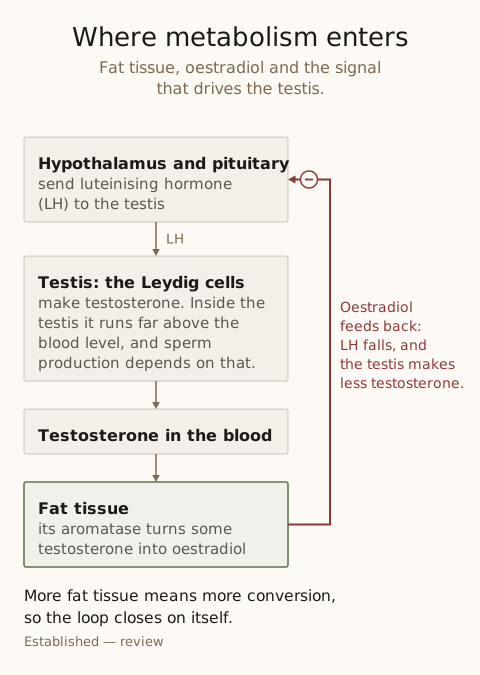
The loop has been tested, not only inferred. In six men with obesity-associated hypogonadotropic hypogonadism, six weeks of an aromatase inhibitor lowered oestradiol and raised luteinising hormone and testosterone in every one of them [Emerging — human interventional, small].14 That obese men make more oestrogen, in proportion to their weight, was measured in the 1970s [Established — human observational].15
I treat that as an endocrine finding rather than a lifestyle observation, and the distinction matters. A named enzyme, a measurable substrate-to-product ratio and a reversible intervention describe a mechanism. “Weight affects hormones” describes nothing and can be acted on by nobody.
Insulin belongs in the same paragraph. Hyperinsulinaemia lowers hepatic production of sex hormone binding globulin — when insulin was suppressed with a drug in a small study of six women, SHBG rose by about a third — which changes the relationship between total and free testosterone and makes a single total figure harder to read [Established — human interventional, small].16 It also travels with the inflammatory and vascular picture the comorbidity cohort was, in effect, scoring. The full mechanism is in Insulin Resistance and Infertility; the point here is that it reaches the testis by more than one route.
Heat, and what moves first
Testicular temperature is one of the few variables here that a man can change within a week, and the human data on it contains a detail that reorganises how I read a sperm assay.
In a small experimental study, five men kept their testes about two degrees warmer, held in the inguinal position by specially designed underwear for about fifteen hours a day. Sperm DNA fragmentation rose by day 20, when motility had also begun to fall; the total sperm count did not fall until day 34. Every measure returned to baseline 73 days after the heating stopped [Emerging — human interventional, small].17
The chromatin changed before the count did. That is a finding about sequence, and its consequence is uncomfortable: the earliest change is one that a routine semen analysis does not report. A man under a thermal load — occupational, recreational, or the venous congestion of a varicocele — can have a sperm count that still looks unremarkable while the chromatin has already begun to change.
Oxidation is a signal before it is a wound
This section is the most likely to contradict something a reader has been told, so the physiology comes before the trials.
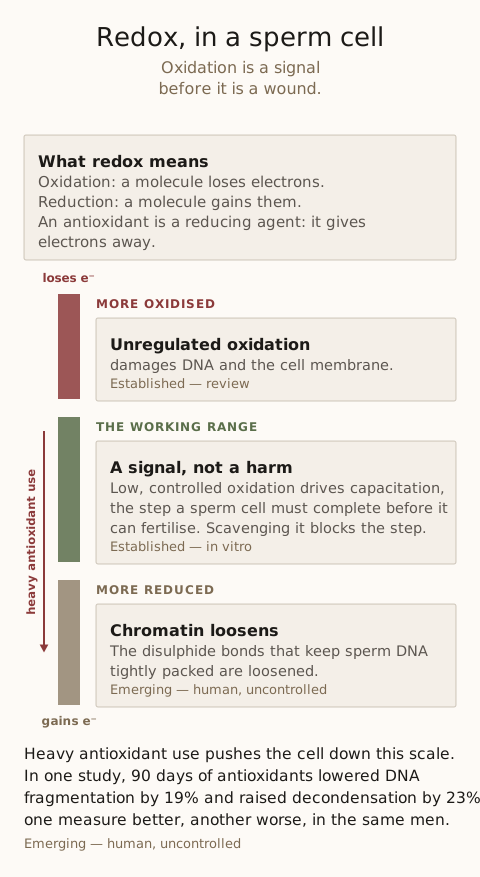
Reactive oxygen species are not only damaging agents in sperm. At low, controlled concentrations they are the upstream regulators of capacitation — the maturation step, occurring in the female tract, that a sperm cell must complete before it can fertilise anything. Superoxide and hydrogen peroxide drive the tyrosine phosphorylation cascade capacitation consists of, and adding the enzymes that scavenge them — superoxide dismutase, catalase — inhibits the process [Established — in vitro].181920
A sperm cell in a fully quenched environment does not fertilise. Oxidation is a control signal that becomes a wound when it is unregulated, which is a different thing from a poison whose dose you want at zero.
Now the trials. The MOXI randomised trial gave a commercially available antioxidant formulation to men with male-factor infertility and was stopped early for futility: no difference in morphology, motility or DNA fragmentation, and live birth of 15 per cent against 24 per cent on placebo [Established — human RCT, null].21 That last figure was not the trial’s powered comparison and should not be read as evidence of harm, but it is emphatically not evidence of benefit.
The Cochrane review is larger and no more encouraging on inspection. It gathered 90 randomised trials and 10,303 men, but only 12 of those trials, with 1,283 men, reported live birth: a pooled odds ratio of 1.43, with a certainty rating of very low. When trials at high risk of bias were removed in sensitivity analysis, there was no evidence of increased live birth [Established — systematic review, null].22 An effect that disappears when the weakest studies are excluded is not a finding; it is the shape of the evidence base.
And then the result quoted least, which matters most to the man arriving with a carrier bag of bottles. Ninety days of oral antioxidant vitamins, taken with zinc and selenium, reduced sperm DNA fragmentation by 19 per cent — and increased sperm decondensation by 23 per cent [Emerging — human, uncontrolled].23 Mature sperm chromatin is held closed by disulphide bonds, and a sustained reducing environment loosens what is supposed to be locked. One index improved while another deteriorated, in the same men, from the same intervention.
The distinction this article rests on
Reduction is an intervention with a direction, and the direction can be wrong. Antioxidant supplementation is not the removal of a harm; it is a shift in redox state, applied to a cell that uses redox state as a signalling mechanism and to chromatin that is held shut by an oxidised bond. That is the mechanistic reason a heavy, unmeasured antioxidant regimen is not automatically on the right side of the argument — and it is consistent with what the trials found [Theoretical].
Why a man’s metabolic state belongs in the assessment
Put the sections together. Motility depends on a local ATP supply. The germinal epithelium depends on an androgen gradient generated by an axis that adipose aromatase can suppress and that insulin makes harder to read. The chromatin responds to thermal load and to redox state, and in the heating study it changed before the count did. Behind each of those sit systemic conditions — glucose and insulin handling, adipose aromatase, the gonadal axis — that can be measured in a man’s blood, unlike the intratesticular gradient itself.
So when a couple presents and the male investigation has consisted of a single semen analysis, the next question is about the systems that supplied the sample, not only about the sample. What he already holds — earlier analyses, blood results, his history — is read first. Where the answer would change the plan, the measurements that follow from the mechanisms above are glucose and insulin handling and the gonadal axis, read as an axis. What a panel contains is set out on the CardioMetabolic Testing and functional lab testing pages rather than here.
The comorbidity cohort is the empirical warrant: in 9,387 men, semen parameters tracked formally scored medical comorbidity.2 The association is already in the literature, and the mechanisms above are why it is there. One trial points the same way: in 56 men with obesity, an eight-week diet that took off an average of 16.5 kg raised sperm concentration and count by 40 to 50 per cent, and the gain held for a year in the men who kept the weight off but not in those who regained it; motility did not change [Emerging — human interventional, uncontrolled].24 This is an argument about what to measure, not a claim that correcting a marker produces a pregnancy.
Key takeaways
- Two large cohorts linked poorer semen quality to higher mortality (43,277 men) and to heavier medical comorbidity (9,387 men), associations that cannot show which is cause and which is effect [Established — human observational].
- A mature sperm cell has shed most of its cytoplasm and cannot repair itself, and in mice its progressive motility depended on glycolysis in the tail rather than on the midpiece mitochondria [Established — animal].
- Testosterone inside the testis runs 40 to 100 times the serum level, a serum-equivalent concentration there did not sustain sperm production, and exogenous testosterone suppresses the gradient [Established — human interventional].
- In a study of five men, mild testicular heating raised sperm DNA fragmentation within 20 days, before the sperm count fell [Emerging — human interventional, small].
- Antioxidant supplementation for male infertility did not improve semen parameters, DNA fragmentation or live birth in the MOXI trial, and the Cochrane live-birth signal disappeared once trials at high risk of bias were excluded [Established — human RCT and systematic review, null].
Frequently asked questions
My semen analysis came back normal — is there anything further worth looking at?
Possibly. A standard analysis counts and grades sperm; it does not report the state of the chromatin, and in a small heating study the chromatin changed before the sperm count fell.
I’m on testosterone replacement. Does that affect this?
Substantially, and it is one of the first things I ask about. Exogenous testosterone suppresses luteinising hormone, and the intratesticular concentration that spermatogenesis requires depends on it. Bring the details, including anything obtained without a prescription — and do not alter or stop a prescribed therapy other than through whoever prescribed it.
Can hair-loss or prostate medication affect sperm?
It can. Finasteride, taken for hair loss, and finasteride or dutasteride, taken for an enlarged prostate, block 5α-reductase, the enzyme that converts testosterone into dihydrotestosterone. In a trial of healthy men taking the prostate doses, total sperm count had fallen by around 30% at 26 weeks, and among men seen for infertility who were taking finasteride, counts rose substantially once it was stopped.
Should I be taking antioxidant supplements for sperm quality?
The trial evidence does not support routine supplementation, and one study found that oral antioxidant vitamins reduced DNA fragmentation while increasing sperm decondensation in the same men. If you are already taking several, bring the labels — knowing the total dose you are on is more useful than adding to it.
Why would a man’s metabolic blood tests matter for fertility?
Because the tissue that makes sperm is supplied by the circulation those markers describe, and the concentration that governs the process cannot itself be sampled. Measuring upstream is the available route to why the sample looks as it does.
How long after a change would anything show in a sample?
Longer than most people expect: what is in the ejaculate reflects a window that closed weeks earlier, which is also why a sample taken during or shortly after an illness is not representative. In the heating study above, every measure took 73 days to return to baseline after the heating stopped.17
References
-
Jensen TK, Jacobsen R, Christensen K, Nielsen NC, Bostofte E. Good semen quality and life expectancy: a cohort study of 43,277 men. Am J Epidemiol. 2009;170(5):559–565. doi:10.1093/aje/kwp168. PMID: 19635736. [Established — human observational] ↩︎
-
Eisenberg ML, Li S, Behr B, Reijo Pera R, Cullen MR. Relationship between semen production and medical comorbidity. Fertil Steril. 2015;103(1):66–71. doi:10.1016/j.fertnstert.2014.10.017. PMID: 25497466. [Established — human observational] ↩︎↩︎
-
Oliva R. Protamines and male infertility. Hum Reprod Update. 2006;12(4):417–435. doi:10.1093/humupd/dml009. PMID: 16581810. [Established — review] ↩︎
-
Miki K, Qu W, Goulding EH, Willis WD, Bunch DO, Strader LF, et al. Glyceraldehyde 3-phosphate dehydrogenase-S, a sperm-specific glycolytic enzyme, is required for sperm motility and male fertility. Proc Natl Acad Sci U S A. 2004;101(47):16501–16506. doi:10.1073/pnas.0407708101. PMID: 15546993. [Established — animal] ↩︎
-
Jarow JP, Zirkin BR. The androgen microenvironment of the human testis and hormonal control of spermatogenesis. Ann N Y Acad Sci. 2005;1061:208–220. doi:10.1196/annals.1336.023. PMID: 16467270. [Established — review] ↩︎
-
Coviello AD, Bremner WJ, Matsumoto AM, Herbst KL, Amory JK, Anawalt BD, et al. Intratesticular testosterone concentrations comparable with serum levels are not sufficient to maintain normal sperm production in men receiving a hormonal contraceptive regimen. J Androl. 2004;25(6):931–938. doi:10.1002/j.1939-4640.2004.tb03164.x. PMID: 15477366. [Established — human interventional, small] ↩︎↩︎
-
Patel AS, Leong JY, Ramos L, Ramasamy R. Testosterone is a contraceptive and should not be used in men who desire fertility. World J Mens Health. 2019;37(1):45–54. doi:10.5534/wjmh.180036. PMID: 30350483. [Established — review] ↩︎
-
Liu PY, Swerdloff RS, Christenson PD, Handelsman DJ, Wang C; Hormonal Male Contraception Summit Group. Rate, extent, and modifiers of spermatogenic recovery after hormonal male contraception: an integrated analysis. Lancet. 2006;367(9520):1412–1420. doi:10.1016/S0140-6736(06)68614-5. PMID: 16650651. [Established — pooled analysis] ↩︎
-
Kohn TP, Louis MR, Pickett SM, Lindgren MC, Kohn JR, Pastuszak AW, et al. Age and duration of testosterone therapy predict time to return of sperm count after human chorionic gonadotropin therapy. Fertil Steril. 2017;107(2):351–357.e1. doi:10.1016/j.fertnstert.2016.10.004. PMID: 27855957. [Emerging — human observational, retrospective] ↩︎
-
Amory JK, Wang C, Swerdloff RS, Anawalt BD, Matsumoto AM, Bremner WJ, et al. The effect of 5α-reductase inhibition with dutasteride and finasteride on semen parameters and serum hormones in healthy men. J Clin Endocrinol Metab. 2007;92(5):1659–1665. doi:10.1210/jc.2006-2203. PMID: 17299062. [Established — human RCT, small] ↩︎
-
Samplaski MK, Lo K, Grober E, Jarvi K. Finasteride use in the male infertility population: effects on semen and hormone parameters. Fertil Steril. 2013;100(6):1542–1546. doi:10.1016/j.fertnstert.2013.07.2000. PMID: 24012200. [Emerging — human observational, small] ↩︎
-
Medicines and Healthcare products Regulatory Agency. Finasteride: reminder of the risk of psychiatric side effects and of sexual side effects (which may persist after discontinuation of treatment). Drug Safety Update. 29 April 2024. https://www.gov.uk/drug-safety-update/finasteride-reminder-of-the-risk-psychiatric-side-effects-and-of-sexual-side-effects-which-may-persist-after-discontinuation-of-treatment [Established — regulatory safety update] ↩︎
-
Genchi VA, Rossi E, Lauriola C, D’Oria R, Palma G, Borrelli A, et al. Adipose tissue dysfunction and obesity-related male hypogonadism. Int J Mol Sci. 2022;23(15):8194. doi:10.3390/ijms23158194. PMID: 35897769. [Established — review] ↩︎↩︎
-
Zumoff B, Miller LK, Strain GW. Reversal of the hypogonadotropic hypogonadism of obese men by administration of the aromatase inhibitor testolactone. Metabolism. 2003;52(9):1126–1128. doi:10.1016/S0026-0495(03)00186-0. PMID: 14506617. [Emerging — human interventional, small] ↩︎
-
Schneider G, Kirschner MA, Berkowitz R, Ertel NH. Increased estrogen production in obese men. J Clin Endocrinol Metab. 1979;48(4):633–638. doi:10.1210/jcem-48-4-633. PMID: 429508. [Established — human observational] ↩︎
-
Nestler JE, Powers LP, Matt DW, Steingold KA, Plymate SR, Rittmaster RS, et al. A direct effect of hyperinsulinemia on serum sex hormone-binding globulin levels in obese women with the polycystic ovary syndrome. J Clin Endocrinol Metab. 1991;72(1):83–89. doi:10.1210/jcem-72-1-83. PMID: 1898744. [Established — human interventional, small] ↩︎
-
Ahmad G, Moinard N, Esquerré-Lamare C, Mieusset R, Bujan L. Mild induced testicular and epididymal hyperthermia alters sperm chromatin integrity in men. Fertil Steril. 2012;97(3):546–553. doi:10.1016/j.fertnstert.2011.12.025. PMID: 22265039. [Emerging — human interventional, small] ↩︎↩︎
-
Leclerc P, de Lamirande E, Gagnon C. Regulation of protein-tyrosine phosphorylation and human sperm capacitation by reactive oxygen derivatives. Free Radic Biol Med. 1997;22(4):643–656. doi:10.1016/S0891-5849(96)00379-6. PMID: 9013127. [Established — in vitro] ↩︎
-
de Lamirande E, Gagnon C. Capacitation-associated production of superoxide anion by human spermatozoa. Free Radic Biol Med. 1995;18(3):487–495. doi:10.1016/0891-5849(94)00169-K. PMID: 9101239. [Established — in vitro] ↩︎
-
Aitken RJ. Reactive oxygen species as mediators of sperm capacitation and pathological damage. Mol Reprod Dev. 2017;84(10):1039–1052. doi:10.1002/mrd.22871. PMID: 28749007. [Established — review] ↩︎
-
Steiner AZ, Hansen KR, Barnhart KT, Cedars MI, Legro RS, Diamond MP, et al. The effect of antioxidants on male factor infertility: the Males, Antioxidants, and Infertility (MOXI) randomized clinical trial. Fertil Steril. 2020;113(3):552–560.e3. doi:10.1016/j.fertnstert.2019.11.008. PMID: 32111479. [Established — human RCT, null] ↩︎
-
de Ligny W, Smits RM, Mackenzie-Proctor R, Jordan V, Fleischer K, de Bruin JP, et al. Antioxidants for male subfertility. Cochrane Database Syst Rev. 2022;5(5):CD007411. doi:10.1002/14651858.CD007411.pub5. PMID: 35506389. [Established — systematic review, null] ↩︎
-
Ménézo YJR, Hazout A, Panteix G, Robert F, Rollet J, Cohen-Bacrie P, et al. Antioxidants to reduce sperm DNA fragmentation: an unexpected adverse effect. Reprod Biomed Online. 2007;14(4):418–421. doi:10.1016/S1472-6483(10)60887-5. PMID: 17425820. [Emerging — human, uncontrolled] ↩︎
-
Andersen E, Juhl CR, Kjøller ET, Lundgren JR, Janus C, Dehestani Y, et al. Sperm count is increased by diet-induced weight loss and maintained by exercise or GLP-1 analogue treatment: a randomized controlled trial. Hum Reprod. 2022;37(7):1414–1422. doi:10.1093/humrep/deac096. PMID: 35580859. [Emerging — human interventional, uncontrolled] ↩︎
Related reading
- Fertility as system consequence — the readout principle this article applies to the male side
- Insulin resistance and infertility — the metabolic route, in full
- The mitochondrion — where energy meets hormones — where energy production and endocrine regulation meet
- CardioMetabolic testing — the blood markers this article argues belong in a man’s assessment