Insulin has a reputation problem. Most people meet it as the blood sugar hormone — something to worry about only on the road to diabetes. That framing does insulin an injustice, and it hides the part that matters for fertility.
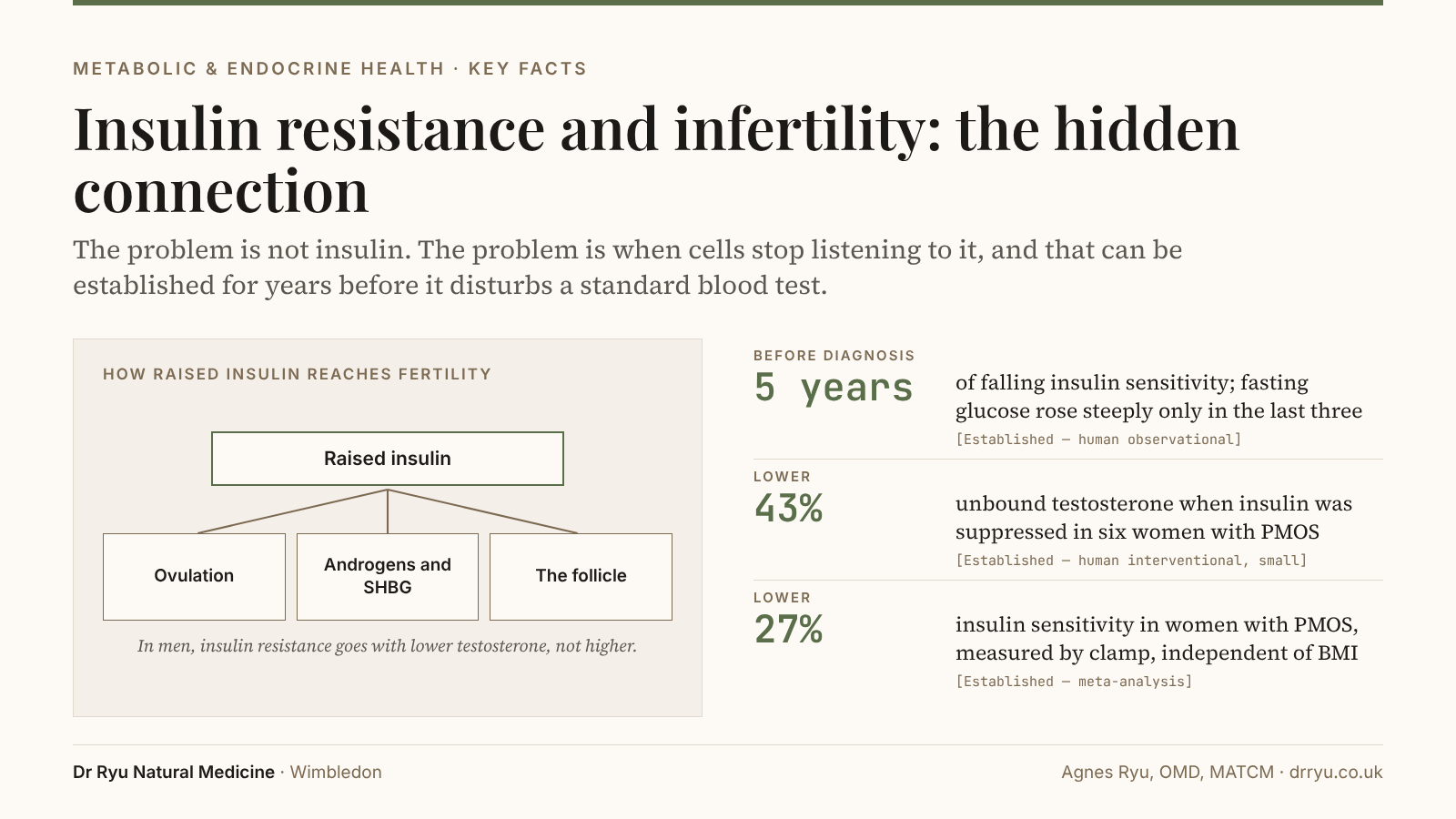
Insulin is one of the body’s principal growth and nourishment signals. It is what tells a cell that fuel has arrived and it is safe to build. Reproduction depends on that signal being heard clearly. The problem is not insulin. The problem is when cells stop listening to it. That state, insulin resistance, is common in the metabolic picture behind difficulty conceiving, above all in PMOS (polyendocrine metabolic ovarian syndrome, the name adopted in 2026 for what was called PCOS),1 and it is easy to miss: it can be established for years before it disturbs a standard blood test.
This article explains what insulin resistance is, how it reaches fertility, and why it is worth investigating even when routine results come back normal.
What insulin resistance actually is
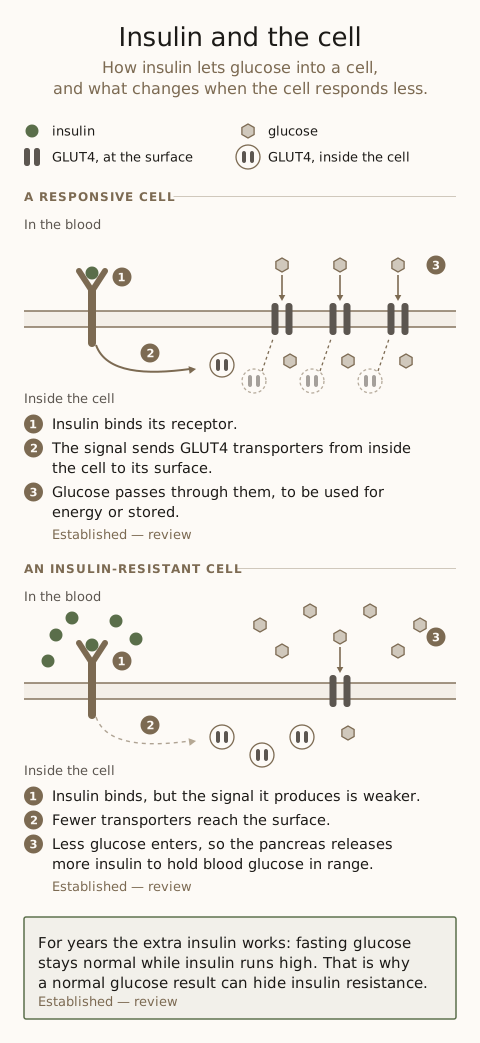
Insulin’s job is to move glucose out of the bloodstream and into cells, where it is used to produce energy. In muscle and fat cells it binds a receptor on the cell surface, and the signal sends glucose transporters, called GLUT4, from inside the cell to its surface, where they let glucose in [Established — review].2 When cells become less responsive to that signal, fewer transporters reach the surface, and the body compensates in the obvious way: it makes more insulin [Established — review].23 For a time this works. Blood sugar stays in range — which is exactly why a standard fasting glucose can look unremarkable while insulin resistance is already well established underneath it.
What has changed is not the amount of glucose in the blood. It is the volume the body has to shout at to get the same message across. The result is a state of chronically raised insulin, and insulin at that level is not a neutral bystander in reproduction.
How raised insulin reaches fertility
Chronically elevated insulin influences reproduction along several routes at once.
- Ovulation. Raised insulin disturbs the hormonal signalling that governs ovulation, and can contribute to irregular or absent cycles [Established — review].3
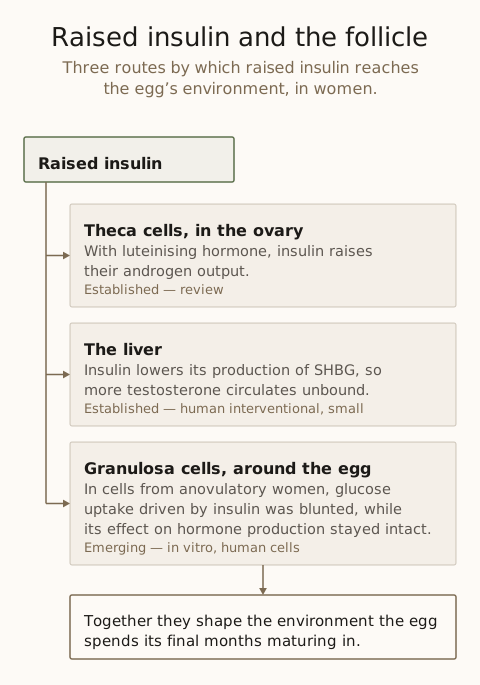
- Androgens and SHBG, in women. Insulin acts with luteinising hormone on the ovary’s theca cells and raises their androgen output, a central part of the PMOS picture [Established — review].3 It also lowers the liver’s production of sex hormone-binding globulin (SHBG), the protein that carries testosterone in the blood: when insulin was suppressed for ten days in six women with PMOS, SHBG rose by about a third and unbound testosterone fell by 43% [Established — human interventional, small].4 More of the testosterone in circulation is then free to act.
- Testosterone, in men. Here the direction is different: insulin resistance goes with lower testosterone. In a clamp study of 21 men, the less insulin-sensitive the man, the less testosterone his testes made in response to stimulation [Emerging — human observational, small].5 Adipose tissue adds a second route: its aromatase converts testosterone to oestradiol, and with excess adiposity that conversion, and the signals adipose tissue releases, weigh on the axis that drives sperm production [Established — review].6 The male side is set out in Sperm Is a System Readout.
- The environment the egg matures in. Insulin acts in the ovary through its own receptor system [Established — review],7 and the granulosa cells that surround the egg take up glucose under its control. In cells from anovulatory women with polycystic ovaries, that uptake was blunted while insulin’s effect on hormone production stayed intact [Emerging — in vitro, human cells].8 The follicle is not sealed off from the body’s metabolic state. The egg spends its final months maturing inside whatever terrain the rest of the body is running.
- Inflammation. Insulin resistance travels with low-grade inflammation, and the two reinforce one another rather than acting separately [Established — review].9 How inflammation reaches reproductive tissue is set out in Fertility as System Consequence.
The point that matters clinically is that all of this can be underway while someone is being told their results are normal. The routine test is not the test that finds it.
Insulin resistance and PMOS
Insulin resistance and PMOS are closely linked, and not only through weight. Across studies using the reference clamp method, insulin sensitivity in women with PMOS was about 27% lower than in women without it, independent of body mass index, and a higher BMI widened the gap [Established — meta-analysis].10 For many people with PMOS, the insulin picture is the fertility picture.
But the connection is not confined to PMOS. Insulin resistance is relevant to fertility in people with no such diagnosis at all, which is a good reason to look for it more widely than the label suggests.
Clinical note
A PMOS diagnosis pulls attention towards the ovaries. The metabolic question is what is driving the picture, and insulin regulation is frequently a large part of the answer [Clinical Heuristic]. See PCOS is now PMOS for the full argument.
Why it is so often missed
The reason is structural, not clinical carelessness: the standard tests are not built to catch it early. Fasting glucose, and HbA1c, which tracks average glucose, move only once the compensation begins to fail. In 6,538 British civil servants followed for a median of almost ten years, insulin sensitivity in those who went on to develop diabetes fell steeply over the five years before diagnosis, while fasting glucose climbed steeply only in the last three [Established — human observational].11 The glucose markers are measures of the failure, not of the process.
Clinical note — why a normal fasting glucose can mislead
A normal fasting glucose is often taken as the all-clear. It is the number the body works hardest to defend: as cells respond less to insulin, the pancreas releases more of it, and the extra insulin holds glucose in range for as long as the pancreas can keep up [Established — review].3 Reading glucose alone is like judging a car on a hill by its speedometer: the speed holds steady while the engine works harder and harder.
Fasting insulin, read alongside fasting glucose, shows the compensation while glucose is still in range. It is the measurement that bears on this question, and I use it, with the results you already hold, where the answer would change the plan. The cardiometabolic panel itself is described on CardioMetabolic Testing.
Why pregnancy needs insulin to work well
Here is the part that gets lost when insulin is cast as the villain.
Pregnancy is itself an insulin-resistant state — a physiological insulin resistance, and a deliberate one. From the second trimester, placental hormones progressively blunt the mother’s response to her own insulin [Established — review].12 That is not a malfunction. It is how the body diverts glucose away from maternal tissue and towards the growing fetus. A healthy pregnancy runs on a controlled, purposeful insulin resistance that the mother’s system is expected to absorb.
Which tells you what preconception is for. To absorb that shift, a body has to start from a position of genuine insulin sensitivity — cells that respond crisply to the signal, and metabolic reserve to spare. Someone who is already insulin resistant before conception is being asked to add a physiological insulin-resistant state on top of a pathological one [Theoretical]. The association is measurable. In the CARDIA study, among women with no family history of diabetes, those whose fasting insulin was above 20 μU/mL before pregnancy had more than twice the odds of gestational diabetes [Established — human observational],13 and insulin resistance measured in mid-pregnancy is associated with pre-eclampsia [Emerging — human observational].14
What this means in practice
The preconception goal is not to suppress insulin. It is to restore the body’s ability to hear it — so that the profound metabolic shift pregnancy demands has room to happen. Insulin sensitivity, nutritional repletion, and steady energy production are the reserve a pregnancy draws on [Clinical Heuristic].
What addressing it involves
Where insulin resistance is identified, it becomes one of the things treatment is built around — through the metabolic, nutritional, and lifestyle elements of care, directed at your specific picture rather than a generic plan. This sits inside the wider work described on the hormone optimisation and natural fertility pages.
Addressing insulin resistance during the preconception period is one part of a wider picture, but it is often the part that was never measured.
Key takeaways
- Insulin moves glucose into muscle and fat cells by sending GLUT4 transporters to the cell surface; when cells respond less, the pancreas releases more insulin to hold glucose in range [Established — review].
- Insulin resistance can be established for years while fasting glucose stays normal: in the Whitehall II cohort, insulin sensitivity fell steeply over the five years before a diabetes diagnosis, while glucose rose steeply only in the last three [Established — human observational].
- Insulin raises androgen output from the ovary’s theca cells and lowers the liver’s production of SHBG, so more testosterone circulates unbound [Established — review].
- In men, insulin resistance goes with lower testosterone, not higher [Established — review].
- Among women with no family history of diabetes, those with raised fasting insulin before pregnancy had more than twice the odds of gestational diabetes in the CARDIA study [Established — human observational].
Frequently asked questions
Can insulin resistance cause infertility?
Insulin resistance is associated with disturbances to ovulation, steroid hormone ratios, and the metabolic environment relevant to fertility, and is a recognised factor in PMOS (polyendocrine metabolic ovarian syndrome). It is rarely the whole story on its own, but it can be a significant and under-investigated part of the picture.
I was told my blood sugar is normal — could I still have insulin resistance?
Possibly. Fasting glucose and HbA1c can remain normal while insulin resistance is already present, because the body compensates by producing more insulin to hold blood sugar in range. Measuring insulin itself, alongside related markers, gives an earlier picture.
Is insulin resistance only relevant if I have PCOS or PMOS?
No. The link is strongest there, but insulin resistance is relevant to fertility in people with no such diagnosis, men included, in whom it goes with lower testosterone. That is why it is worth looking for more broadly.
Isn’t insulin resistance normal in pregnancy?
Yes — and that is the point. Pregnancy induces a controlled insulin-resistant state so glucose reaches the fetus. Entering pregnancy already insulin resistant means adding that physiological demand on top of an existing one: raised insulin before pregnancy is associated with a higher risk of gestational diabetes, and insulin resistance in mid-pregnancy with pre-eclampsia.
How is insulin resistance measured?
Most simply by fasting insulin read alongside fasting glucose, from which an index such as HOMA-IR can be calculated; glucose on its own misses the compensation. Whether it is measured for a given person is decided from their history and the results they already hold, where the answer would change the plan. The CardioMetabolic Testing page describes the panel.
References
-
Teede HJ, Bahri Khomami M, Morman R, Laven JSE, Joham AE, Costello MF, et al. Polyendocrine metabolic ovarian syndrome, the new name for polycystic ovary syndrome: a multistep global consensus process. Lancet. 2026;407(10545):2329–2339. doi:10.1016/S0140-6736(26)00717-8. PMID: 42119588. [Established — consensus statement] ↩︎
-
Petersen MC, Shulman GI. Mechanisms of insulin action and insulin resistance. Physiol Rev. 2018;98(4):2133–2223. doi:10.1152/physrev.00063.2017. PMID: 30067154. [Established — review] ↩︎↩︎
-
Diamanti-Kandarakis E, Dunaif A. Insulin resistance and the polycystic ovary syndrome revisited: an update on mechanisms and implications. Endocr Rev. 2012;33(6):981–1030. doi:10.1210/er.2011-1034. PMID: 23065822. [Established — review] ↩︎↩︎↩︎↩︎
-
Nestler JE, Powers LP, Matt DW, Steingold KA, Plymate SR, Rittmaster RS, et al. A direct effect of hyperinsulinemia on serum sex hormone-binding globulin levels in obese women with the polycystic ovary syndrome. J Clin Endocrinol Metab. 1991;72(1):83–89. doi:10.1210/jcem-72-1-83. PMID: 1898744. [Established — human interventional, small] ↩︎
-
Pitteloud N, Hardin M, Dwyer AA, Valassi E, Yialamas M, Elahi D, et al. Increasing insulin resistance is associated with a decrease in Leydig cell testosterone secretion in men. J Clin Endocrinol Metab. 2005;90(5):2636–2641. doi:10.1210/jc.2004-2190. PMID: 15713702. [Emerging — human observational, small] ↩︎
-
Genchi VA, Rossi E, Lauriola C, D’Oria R, Palma G, Borrelli A, et al. Adipose tissue dysfunction and obesity-related male hypogonadism. Int J Mol Sci. 2022;23(15):8194. doi:10.3390/ijms23158194. PMID: 35897769. [Established — review] ↩︎
-
Poretsky L, Cataldo NA, Rosenwaks Z, Giudice LC. The insulin-related ovarian regulatory system in health and disease. Endocr Rev. 1999;20(4):535–582. doi:10.1210/edrv.20.4.0374. PMID: 10453357. [Established — review] ↩︎
-
Rice S, Christoforidis N, Gadd C, Nikolaou D, Seyani L, Donaldson A, et al. Impaired insulin-dependent glucose metabolism in granulosa-lutein cells from anovulatory women with polycystic ovaries. Hum Reprod. 2005;20(2):373–381. doi:10.1093/humrep/deh609. PMID: 15539436. [Emerging — in vitro, human cells] ↩︎
-
Shoelson SE, Lee J, Goldfine AB. Inflammation and insulin resistance. J Clin Invest. 2006;116(7):1793–1801. doi:10.1172/JCI29069. PMID: 16823477. [Established — review] ↩︎
-
Cassar S, Misso ML, Hopkins WG, Shaw CS, Teede HJ, Stepto NK. Insulin resistance in polycystic ovary syndrome: a systematic review and meta-analysis of euglycaemic-hyperinsulinaemic clamp studies. Hum Reprod. 2016;31(11):2619–2631. doi:10.1093/humrep/dew243. PMID: 27907900. [Established — meta-analysis] ↩︎
-
Tabák AG, Jokela M, Akbaraly TN, Brunner EJ, Kivimäki M, Witte DR. Trajectories of glycaemia, insulin sensitivity, and insulin secretion before diagnosis of type 2 diabetes: an analysis from the Whitehall II study. Lancet. 2009;373(9682):2215–2221. doi:10.1016/S0140-6736(09)60619-X. PMID: 19515410. [Established — human observational] ↩︎
-
Barbour LA, McCurdy CE, Hernandez TL, Kirwan JP, Catalano PM, Friedman JE. Cellular mechanisms for insulin resistance in normal pregnancy and gestational diabetes. Diabetes Care. 2007;30(Suppl 2):S112–S119. doi:10.2337/dc07-s202. PMID: 17596458. [Established — review] ↩︎
-
Gunderson EP, Quesenberry CP, Jacobs DR, Feng J, Lewis CE, Sidney S. Longitudinal study of prepregnancy cardiometabolic risk factors and subsequent risk of gestational diabetes mellitus: the CARDIA study. Am J Epidemiol. 2010;172(10):1131–1143. doi:10.1093/aje/kwq267. PMID: 20929958. [Established — human observational] ↩︎
-
Hauth JC, Clifton RG, Roberts JM, Myatt L, Spong CY, Leveno KJ, et al. Maternal insulin resistance and preeclampsia. Am J Obstet Gynecol. 2011;204(4):327.e1–327.e6. doi:10.1016/j.ajog.2011.02.024. PMID: 21458622. [Emerging — human observational] ↩︎
Related reading
- The metabolic-bioenergetic approach to fertility — the framework this article sits inside
- PCOS is now PMOS — where insulin resistance is most visible
- Metabolic fertility testing — why the wider metabolic picture is measured, and when
- Sperm is a system readout — the same metabolic argument on the male side