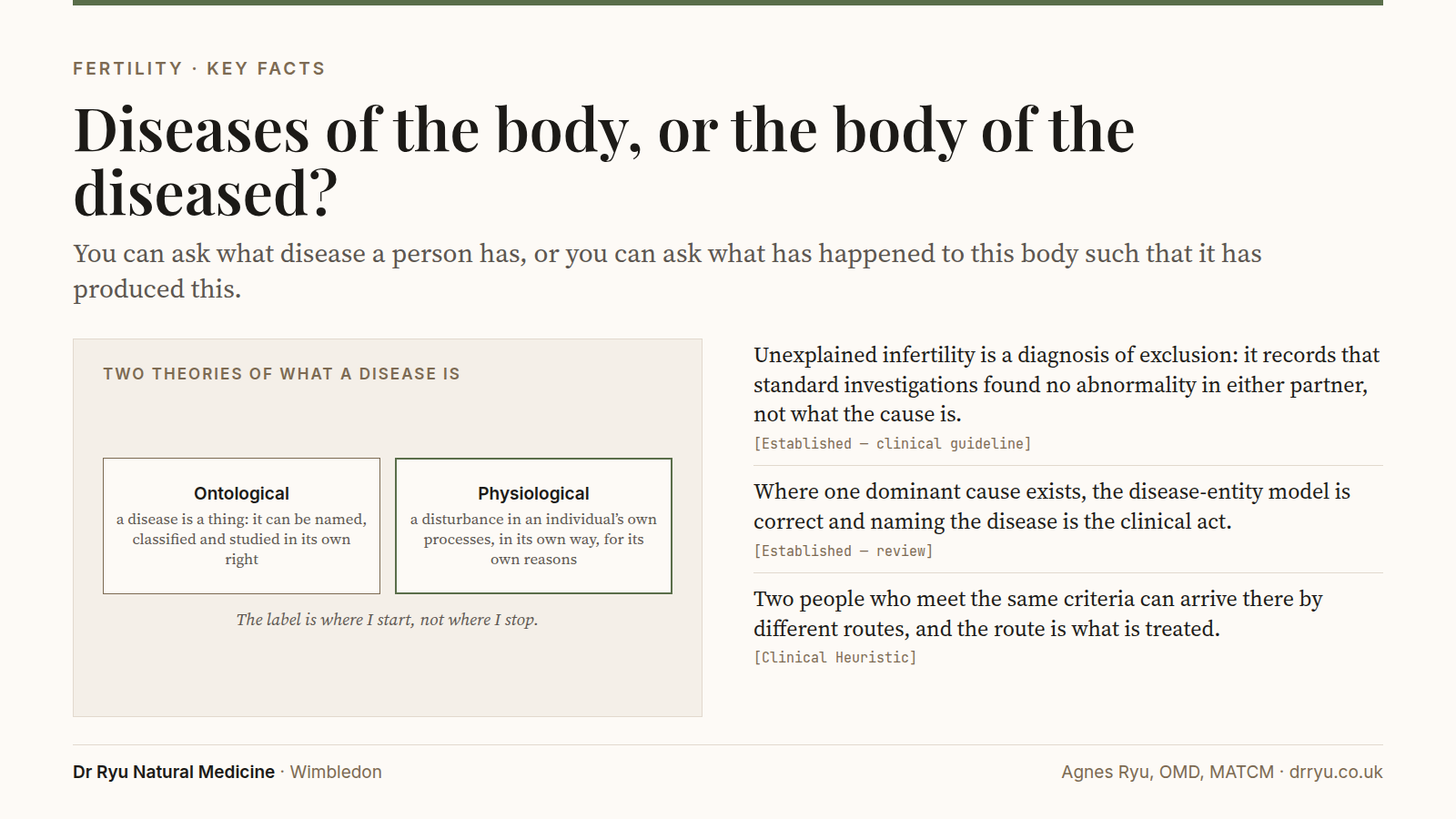
There are two ways to look at a person who is unwell. You can ask what disease do they have? — and set about naming it, classifying it, and matching it to the treatment that belongs to that name. Or you can ask what has happened to this body such that it has produced this? — and set about understanding the particular person in front of you.
These sound like the same question asked twice. They are not. They are two different theories of what a disease actually is, they lead to different clinical actions, and the argument between them is roughly two and a half thousand years old. Most of medicine’s confusions about chronic illness live in the gap between them.
Two theories of what a disease is
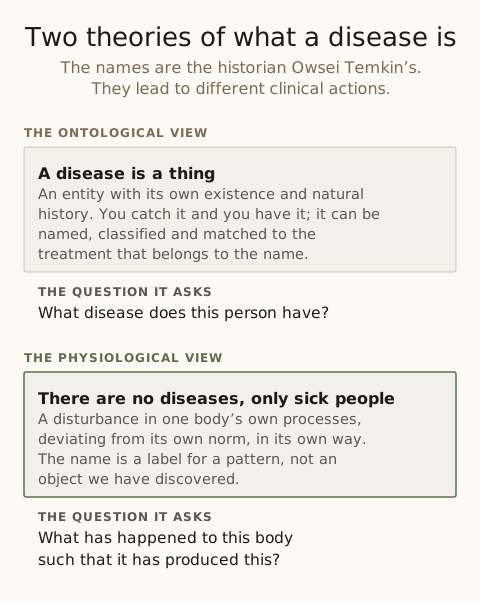
The historian of medicine Owsei Temkin gave the two positions their clearest names.1
The ontological view holds that a disease is a thing — an entity with its own existence, its own natural history, its own essence. It exists independently of the person who has it, rather as a species exists independently of any individual animal. On this view, you catch a disease; you have one; it can be named, classified, and studied in its own right. The person is the stage on which the disease performs.
The physiological view holds that there are no diseases, only sick people. What we call a disease is a disturbance in an individual’s own processes — a body deviating from its own norm, in its own way, for its own reasons. The name is a convenient label for a pattern we recognise, not an object we have discovered. Georges Canguilhem pushed this furthest: the pathological is not simply a quantitative deviation from a population average, because each organism sets its own norms.2
The tension is as old as medicine. The Hippocratic writings are emphatically individuating: they attend to constitution, environment, season, diet, temperament — the whole configuration of the particular patient.1 Yet by the seventeenth century, Thomas Sydenham — a physician so admired he was called the English Hippocrates — was arguing something close to the opposite: that diseases should be reduced to definite species, described with the same rigour that botanists bring to plants.3 That programme was extraordinarily productive. It gave us classification, then pathology, then germ theory, then the entire architecture of modern diagnosis.4
The distinction is not academic. It determines what you do next.
What the classical framework formalised
The classical medical texts made a distinctive contribution here: they built the individuating view into the clinical method as a formal procedure — a required step before treatment, not an optional courtesy. The Shanghan Lun (傷寒論), compiled around 200 CE, already tells the physician facing an illness that earlier treatment has turned from its usual course to observe the pulse and the signs, identify what has gone wrong, and treat according to what is found (觀其脈證,知犯何逆,隨證治之).5 In the 1950s and 1960s that procedure was given its modern name and made the organising principle of how the method is taught.67
The method is called 辨證論治 — pattern differentiation determining treatment. The object of clinical attention is not the disease name but the 證 (zheng): the configuration this particular body is presenting now — its tensions, its deficits, its compensations, read through examination and touch.
From that follow two principles stated plainly enough to be uncomfortable:
- 同病異治 — same disease, different treatments. Two people carrying the same diagnostic label may require entirely different interventions, because their underlying configurations differ.
- 異病同治 — different diseases, same treatment. Two people with different labels may need the same intervention, because the configuration beneath them is the same.
What I am not saying
I am not claiming that the classical framework anticipated modern biology, and I am not translating its vocabulary into biological terms. Qi is not ATP. Meridians are not fascia. That kind of analogical bridging is intellectually cheap and I avoid it — it replaces one metaphor with a more impressive-sounding one and calls the result mechanism.
The claim is narrower and, I think, stronger: the classical tradition recorded an empirical observation — that identically-named illnesses reliably demand different treatments in different people — and formalised a clinical procedure for acting on it [Clinical Heuristic]. That observation is separable from the metaphysics used to explain it. The observation survives the framework. This is the same position I take in How Does Acupuncture Work: the database earned by centuries of consequence-based observation is worth keeping; the interpretive vocabulary layered over it can be revised without discarding what it recorded.
Where the disease-entity model is exactly right
The individuating view is not a licence to dismiss diagnosis. That would be its own kind of foolishness, and it is worth being blunt about it.
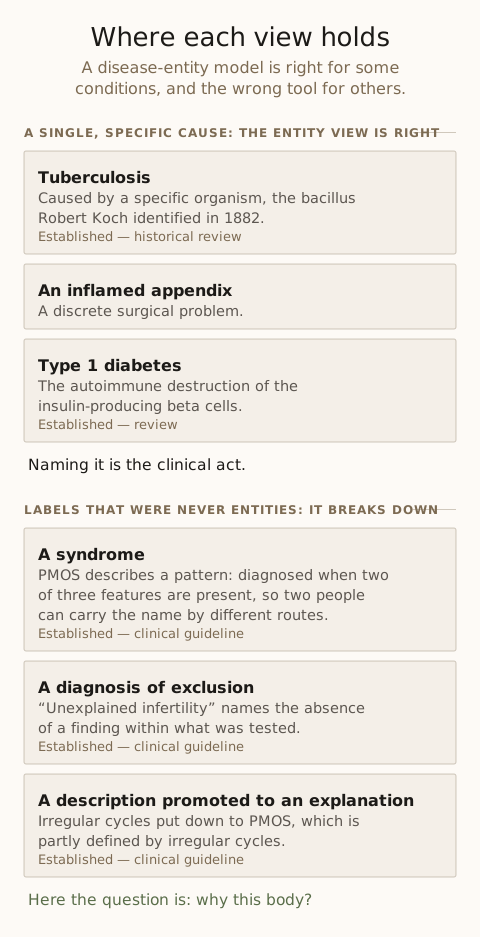
When there is a single, dominant, specific cause, the ontological model is not merely useful — it is correct, and it is one of the great achievements of the human mind. Tuberculosis really is caused by a specific organism, the bacillus Robert Koch identified in 1882 [Established — historical review].8 An inflamed appendix really is a discrete surgical problem. Type 1 diabetes really is the autoimmune destruction of a specific cell population, the insulin-producing beta cells [Established — review].9 In these cases the disease genuinely does behave like an entity: it has a cause, a course, and a treatment that follows from the name. Naming it is the clinical act. Germ theory saved more lives than any philosophy of individuation ever will.
I want no part of a position that pretends otherwise. If you have appendicitis, you need a surgeon, and no amount of attention to your particular terrain will substitute.
Where it breaks down
The error is not in the model. The error is in applying it universally — and specifically, in applying it to conditions that were never disease entities in the first place.
Look closely at the labels that dominate chronic and reproductive medicine, and notice what kind of objects they are:
- Syndromes — clusters of signs that tend to travel together. A syndrome is a description of a pattern, not an account of a cause. PMOS (polyendocrine metabolic ovarian syndrome, the name an international consensus gave PCOS in 2026)10 is a syndrome: in adults it is diagnosed when two of three features are present, so two people can carry the same name with different features, reached by quite different routes [Established — clinical guideline].11
- Diagnoses of exclusion — “unexplained infertility” is the purest example. It does not name a mechanism. It names the absence of a finding within the boundaries of what was tested. The ESHRE guideline defines it in just those terms: a diagnosis made when “standard” investigations find no abnormality in either partner, with no agreed standard yet for what those investigations should include [Established — clinical guideline].12 It is a statement about our investigation, not about your body — and it is routinely handed over as though it were a property of the patient.
- Descriptions promoted to explanations — the label gets used as though it accounted for the pattern it merely names. Why are her cycles irregular? Because she has PMOS. But PMOS is partly defined by irregular cycles [Established — clinical guideline].11 Nothing has been explained. The circle has simply been closed with a Latin-sounding word, and the closing of it feels like an answer.
These are the conditions where the disease-entity model quietly fails and nobody announces it. The name arrives, the protocol follows, and the question of why this body never gets asked.
Modern medicine is rediscovering the individual
Mainstream medicine has been arriving at the same problem from its own direction, with its own evidence, and calling it different names.
Stratification. Asthma is the clearest example: once a single disease, it is now understood as a set of distinct endotypes — different underlying mechanisms producing a shared clinical picture, responding to different treatments [Emerging — consensus statement].13 The label was hiding several diseases.
Precision and phenotyping. The whole architecture of precision medicine is an admission that the population average is a poor guide to the individual in front of you. Judged by their published numbers needed to treat, for every person each of the ten highest-grossing drugs in the United States helps, it fails to improve the condition of between 3 and 24 others: the argument for one-person, or N-of-1, trials [Emerging — commentary].14 Pharmacogenomics makes the same admission at the level of genes: inherited variants in about 20 genes now change the choice or dose of about 80 medicines [Established — review].15
Renaming. The renaming of PMOS in 2026 is a case of the field noticing that the old name pointed at the wrong thing — a morphological finding on a scan — while much of the substance of the condition sits in endocrine and metabolic regulation.10 Renaming is what happens when a discipline realises its label was describing the shadow rather than the object.
Read together, these are all versions of the same movement: from what disease is this? toward what kind of body is this, and what is it doing? Medicine is not abandoning classification. It is discovering that classification is the beginning of the question, not the end of it.
Why this is how I practise
My work sits with fertility, endocrine regulation and metabolic function — which is to say, almost entirely in the territory where the disease-entity model is at its weakest. Fertility difficulty is not a disease. It is a readout: the visible consequence of whether the whole system is operating above the threshold that reproduction requires [Theoretical]. Fertility as System Consequence sets out that argument in full. Two women meeting identical criteria can arrive there by entirely different routes, and the route is the thing that must be treated [Clinical Heuristic].
So the label is where I start, not where I stop. It tells me what to call the pattern. The consultation tells me why the pattern is there — and why is the only thing worth treating. That is what I mean when I say I attend to the body of the diseased rather than the diseases of the body. It is not a rejection of diagnosis. It is a refusal to let the diagnosis do the thinking.
If you want to see how this works in a first appointment, I’ve written about how I approach a first consultation. If you want to know how I came to think this way, that’s how my practice found fertility. And the specific application to reproduction is set out in the metabolic-bioenergetic approach to fertility.
Key takeaways
- Unexplained infertility is a diagnosis of exclusion: it records that standard investigations found no abnormality in either partner, not what the cause is [Established — clinical guideline].
- Where one dominant cause exists, such as a single organism, an inflamed appendix or the autoimmune loss of insulin-producing cells, the disease-entity model is correct and naming the disease is the clinical act [Established — review].
- Asthma, once treated as one disease, is now divided into endotypes, subtypes defined by distinct mechanisms, so that treatment can be matched to mechanism [Emerging — consensus statement].
- The tension between treating the named disease and treating the individual is as old as medicine: it runs from the individuating Hippocratic writings to Sydenham’s seventeenth-century programme of classifying diseases as species [Established — history of medicine].
- A diagnostic label is where assessment starts, not where it stops: two people who meet the same criteria can arrive there by different routes, and the route is what is treated [Clinical Heuristic].
Frequently asked questions
Are you saying diagnosis doesn’t matter?
No — the opposite. Diagnosis matters enormously, and where a condition has a single specific cause, the diagnostic name is the clinical answer. What I’m arguing is narrower: many conditions in chronic, endocrine and reproductive medicine are syndromes or diagnoses of exclusion, not disease entities. For those, the name describes a pattern without explaining it, and treating the name rather than the person is a category error.
Is this idea borrowed from the classical medical texts?
Not only. The same tension runs through the history of medicine as a whole: the Hippocratic writings are strongly individuating, while Sydenham, in the seventeenth century, set out to classify diseases as species. The classical texts, from the Shanghan Lun onwards, made reading the individual pattern an explicit step before treatment, and twentieth-century teaching made it the organising principle of the method.
Why does it matter which view you take?
Because it changes what happens next. If a disease is an entity, the right action is to identify it and apply the treatment attached to its name. If illness is an individual disturbance, the right action is to work out why this body produced this pattern, and to treat that. The first can be done from a label alone. The second requires a consultation.
Doesn’t modern medicine already do this?
Increasingly, yes — through stratification, endotypes, phenotyping, and precision approaches, all of which acknowledge that a shared label can conceal different mechanisms. That’s part of why I don’t frame this as an alternative to conventional medicine. It’s a question conventional medicine is actively asking itself.
References
-
Temkin O. The scientific approach to disease: specific entity and individual sickness. In: Crombie AC, editor. Scientific Change. London: Heinemann; 1963. p. 629–647. [History of medicine] ↩︎↩︎
-
Canguilhem G. The Normal and the Pathological. Fawcett CR, translator. New York: Zone Books; 1989. First published in French in 1943; expanded edition 1966. [Philosophy of medicine] ↩︎
-
Sydenham T. Preface to the third edition of Observationes medicae (1676). In: The Works of Thomas Sydenham, M.D. Vol 1. Latham RG, translator. London: Sydenham Society; 1848. [Primary source] ↩︎
-
Rosenberg CE. The tyranny of diagnosis: specific entities and individual experience. Milbank Q. 2002;80(2):237–260. doi:10.1111/1468-0009.t01-1-00003. PMID: 12101872. [History of medicine] ↩︎
-
Zhang Zhongjing. Shanghan Lun (c. 200 CE), line 16 in the standard numbering. English translation: Liu G. Discussion of Cold Damage (Shang Han Lun): Commentaries and Clinical Applications. London: Singing Dragon; 2015. [Primary source] ↩︎
-
Karchmer EI. The excitations and suppressions of the times: locating the emotions in the liver in modern Chinese medicine. Cult Med Psychiatry. 2013;37(1):8–29. doi:10.1007/s11013-012-9289-4. PMID: 23371371. [History of medicine] ↩︎
-
Scheid V. Chinese Medicine in Contemporary China: Plurality and Synthesis. Durham (NC): Duke University Press; 2002. Chapter 7, Bianzheng lunzhi: the emergent pivot of contemporary Chinese medicine. doi:10.1215/9780822383710. [History of medicine] ↩︎
-
Sakula A. Robert Koch: centenary of the discovery of the tubercle bacillus, 1882. Thorax. 1982;37(4):246–251. doi:10.1136/thx.37.4.246. PMID: 6180494. [Established — historical review] ↩︎
-
Atkinson MA, Eisenbarth GS, Michels AW. Type 1 diabetes. Lancet. 2014;383(9911):69–82. doi:10.1016/S0140-6736(13)60591-7. PMID: 23890997. [Established — review] ↩︎
-
Teede HJ, Bahri Khomami M, Morman R, Laven JSE, Joham AE, Costello MF, et al. Polyendocrine metabolic ovarian syndrome, the new name for polycystic ovary syndrome: a multistep global consensus process. Lancet. 2026;407(10545):2329–2339. doi:10.1016/S0140-6736(26)00717-8. PMID: 42119588. [Established — consensus statement] ↩︎↩︎
-
Teede HJ, Tay CT, Laven J, Dokras A, Moran LJ, Piltonen TT, et al. Recommendations from the 2023 International Evidence-based Guideline for the Assessment and Management of Polycystic Ovary Syndrome. Hum Reprod. 2023;38(9):1655–1679. doi:10.1093/humrep/dead156. PMID: 37580037. [Established — clinical guideline] ↩︎↩︎
-
ESHRE Guideline Group on Unexplained Infertility; Romualdi D, Ata B, Bhattacharya S, Bosch E, Costello M, Gersak K, et al. Evidence-based guideline: unexplained infertility. Hum Reprod. 2023;38(10):1881–1890. doi:10.1093/humrep/dead150. PMID: 37599566. [Established — clinical guideline] ↩︎
-
Lötvall J, Akdis CA, Bacharier LB, Bjermer L, Casale TB, Custovic A, et al. Asthma endotypes: a new approach to classification of disease entities within the asthma syndrome. J Allergy Clin Immunol. 2011;127(2):355–360. doi:10.1016/j.jaci.2010.11.037. PMID: 21281866. [Emerging — consensus statement] ↩︎
-
Schork NJ. Personalized medicine: time for one-person trials. Nature. 2015;520(7549):609–611. doi:10.1038/520609a. PMID: 25925459. [Emerging — commentary] ↩︎
-
Relling MV, Evans WE. Pharmacogenomics in the clinic. Nature. 2015;526(7573):343–350. doi:10.1038/nature15817. PMID: 26469045. [Established — review] ↩︎
Related reading
- Fertility as system consequence — the readout argument in full
- The metabolic-bioenergetic approach to fertility — the framework an individual reading works within
- How does acupuncture work — the same position on the classical record, applied to acupuncture
- PCOS is now PMOS — a renaming that changed what the label points at
- Fertility acupuncture: what the evidence shows — what happens when an individualised treatment is tested as a fixed protocol