If you have been through fertility investigation, you have probably had your hormones tested. FSH, LH, oestradiol, AMH, perhaps a thyroid screen — measured, compared against a reference range, and reported as normal or not.
Those panels are useful, but they answer a narrow question: are these specific hormones within range on the day they were measured? Metabolic fertility testing asks a wider one: what is the metabolic and energetic environment those hormones are operating in, and is it supporting fertility or quietly working against it?
This article explains what that testing looks at, how it differs from a standard panel, and when it is worth doing. As with all functional testing, the point is not to test everything. It is to make the right underlying systems visible.
What a standard hormone panel does and does not tell you
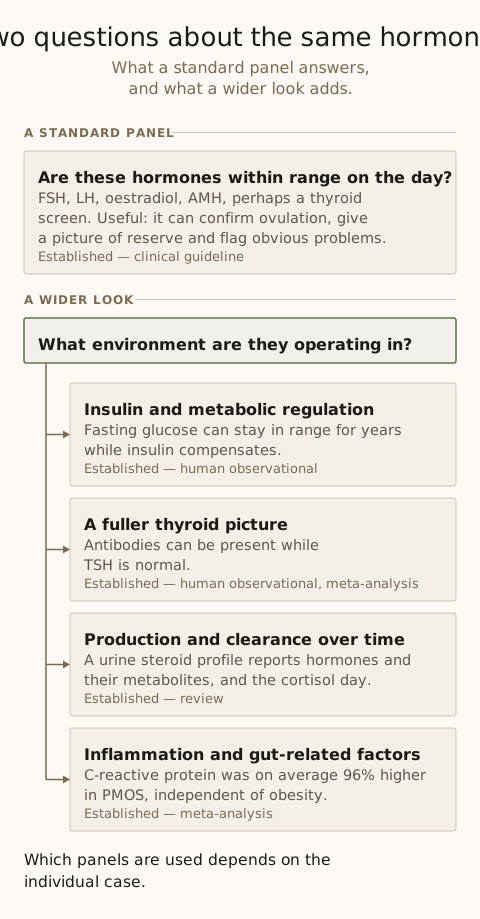
A standard fertility hormone panel measures reproductive hormones at a point in time and checks them against population ranges. This is genuinely informative. It can confirm whether you are ovulating, give a picture of ovarian reserve, and flag obvious hormonal problems.
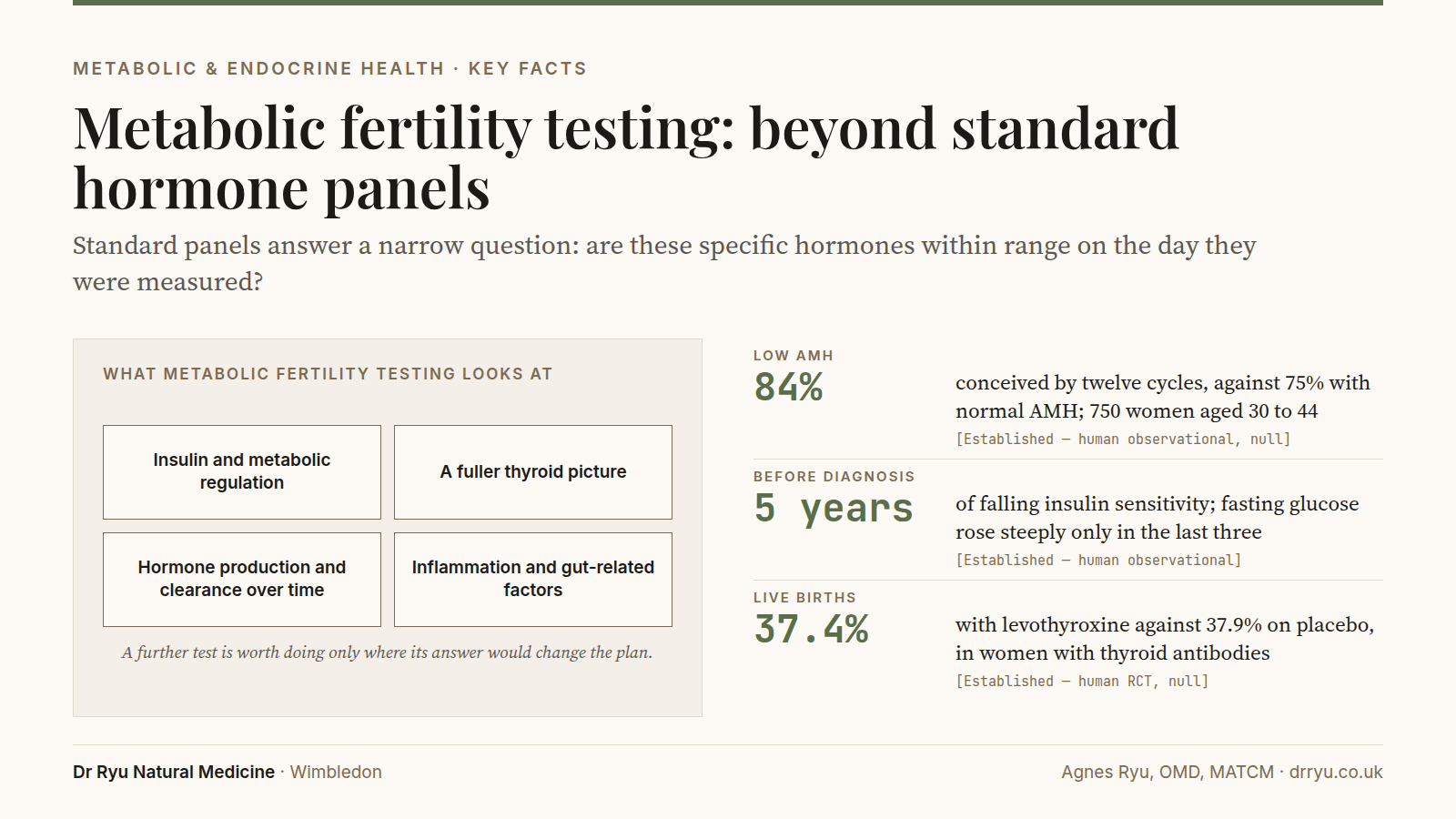
A mid-luteal progesterone is the test NICE recommends for confirming ovulation [Established — clinical guideline].1 A reserve marker such as AMH answers a narrower question: NICE now advises against using it to predict conception without treatment, and recommends it instead for predicting how the ovaries will respond to stimulation in IVF [Established — clinical guideline].1 In 750 women aged 30 to 44 who had been trying to conceive for three months or less, those with low AMH had no lower chance of conceiving: 84% by twelve cycles, against 75% for women with normal values, a difference that was not significant [Established — human observational, null].2
What it does not do is explain the environment those hormones are produced in.
Two people with identical FSH and AMH results can have very different metabolic terrain — different insulin regulation, thyroid activity, and inflammatory background — and that terrain can matter as much as the reproductive numbers themselves [Clinical Heuristic]. A standard panel also gives a single snapshot, where some hormone patterns are only meaningful seen across a cycle or alongside their metabolites.
Clinical note
“Within the population reference range” and “in the range that changes the decision for your fertility now” are answers to two different questions. Most standard panels only ever answer the first.
What metabolic fertility testing looks at
Metabolic fertility testing widens the lens to the systems reproduction is downstream of. Which panels are used depends on the individual case, but they generally fall into four areas.
Insulin and metabolic regulation
In fertility, insulin resistance is best documented in PMOS — polyendocrine metabolic ovarian syndrome, the name an international consensus gave in 2026 to what was called PCOS [Established — consensus statement].3 Clamp studies, the most exact measure of insulin action, find insulin sensitivity in women with the condition about 27% lower than in women without it, independent of body weight [Established — meta-analysis].4 It is not confined to PMOS. A fasting glucose can stay in range for years while insulin compensates: in 6,538 British civil servants, insulin sensitivity fell steeply in the five years before type 2 diabetes was diagnosed, while fasting glucose rose steeply only in the last three [Established — human observational].5 Measuring insulin alongside glucose shows that compensation earlier; the cardiometabolic testing page sets out what that panel covers. The mechanism is set out in Insulin Resistance and Infertility.
A fuller thyroid picture
Thyroid function bears on cycle regularity, ovulation and early pregnancy, and thyroid autoimmunity is present in 5 to 20% of unselected pregnant women [Established — review].6 NICE advises testing thyroid function in people with fertility problems only where there are symptoms of thyroid disease [Established — clinical guideline],1 and a thyroid screen usually means TSH. TSH reports how hard the pituitary is driving the gland, which is how an underactive or overactive thyroid, including its mild subclinical forms, is detected; it does not show thyroid autoimmunity. Antibodies against thyroid peroxidase can be present while TSH is normal, and in women with normal thyroid function they are associated with miscarriage and preterm birth [Established — human observational, meta-analysis].7 Two small early trials pooled in the same review suggested that levothyroxine lowered that risk; the TABLET trial, which randomised 952 such women before conception, found no difference in live births: 37.4% against 37.9% on placebo [Established — human RCT, null].8 The thyroid markers, and what each one shows, are set out on the thyroid testing page, and the full argument in The Overlooked Gland — Thyroid Hormone and Fertility.
Hormone production and clearance over time
Where a blood panel gives a single-moment snapshot, a urine steroid profile reports sex hormones and their metabolites — showing not only hormone levels but how they are being produced, routed and cleared [Established — review].9 The daily cortisol pattern, including its rise in the first 30 to 45 minutes after waking, is a measurable signal in its own right [Established — consensus statement].10 Both are particularly useful where stress physiology or adrenal function may be part of the picture [Clinical Heuristic], and they are why the steroid network has to be read as a network: see Steroidogenesis — One Cholesterol Molecule, Every Hormone. What each profile reports is on the steroid hormone testing page.
Inflammation and gut-related factors
Chronic inflammation and gut function influence hormone signalling and metabolic regulation, both of which feed into fertility. One marker shows how specific this can be: across 31 studies, C-reactive protein was on average 96% higher in women with PMOS than in controls, independent of obesity [Established — meta-analysis].11 Testing in this area can be relevant where digestive symptoms, unexplained inflammation, or stubborn hormonal patterns are present [Clinical Heuristic]; the gut side is set out on the gut testing page.
How testing is selected — not ordered off a list
Metabolic fertility testing is only useful when it is targeted. Which panels make sense depends entirely on your history, your symptoms, and any previous results.
In my clinic, what you already hold is read first, in the context of your whole history and its trend over time, and a further test is suggested only where its answer would change the plan. When one is, it is ordered through accredited laboratories and — most importantly — interpreted alongside everything else known about your case. A result in isolation is data. A result read against your history is information.
The specific panels used, and what each one covers, are on the functional lab testing page.
When metabolic fertility testing is worth doing
This kind of testing tends to be most useful when:
- Standard investigations have come back normal but conception is not happening — the “unexplained” case
- There is a metabolic history: PMOS, insulin resistance, thyroid problems, or weight that does not respond as expected
- IVF cycles have not succeeded and no cause has been identified
- Symptoms suggest the reproductive and metabolic pictures are connected
- You want a fuller account of why, rather than another in-range result with no explanation attached
It is not necessary for everyone, and it is not a first step before basic investigation. It is the next question to ask when the standard answers have run out [Clinical Heuristic].
What testing does and does not do
Testing is not treatment, and no test predicts an outcome. Its value lies in what it makes visible, and therefore addressable.
Key takeaways
- A standard fertility panel answers whether specific reproductive hormones sit in range on one day; it does not describe the metabolic terrain those hormones operate in [Clinical Heuristic].
- In 750 women aged 30 to 44 who had been trying to conceive for three months or less, low AMH did not lower the chance of conceiving naturally [Established — human observational, null].
- Insulin sensitivity falls for years before fasting glucose rises, so a normal fasting glucose does not rule out insulin resistance [Established — human observational].
- TSH does not show thyroid autoimmunity, and in the TABLET trial levothyroxine for women with thyroid antibodies and normal thyroid function did not raise live births [Established — human RCT, null].
- A further test is worth doing only where its answer would change the plan, and its result is read against the whole history rather than on its own [Clinical Heuristic].
Frequently asked questions
What is metabolic fertility testing?
It is functional lab testing that looks beyond standard reproductive hormones at the metabolic and energetic environment fertility depends on — insulin and metabolic regulation, a fuller thyroid picture, hormone production and clearance over time, and inflammatory or gut-related factors. Panels are selected on your individual history and interpreted alongside your full clinical picture.
How is it different from the hormone tests my GP or clinic ran?
Standard panels measure specific reproductive hormones against population ranges at a point in time, which is useful but narrow. Metabolic testing widens the lens to the systems those hormones operate within — terrain that standard panels are not designed to assess. It is complementary to conventional investigation, not a replacement for it.
Do I need a consultation before testing?
Yes. Testing is part of a consultation, not a standalone service. Your previous results are reviewed first, in the context of your whole history and its trend over time, and a further test is suggested only where its answer would change the plan.
Are these tests available on the NHS?
Some markers overlap with NHS testing, but several of the functional panels used here go beyond routine NHS protocols and are private tests. They are used to build a fuller picture alongside any NHS investigations you have already had.
Will testing tell me why I am not conceiving?
Sometimes it makes a contributing factor visible that standard investigation did not look for. What it can do is replace an in-range result with a mechanism worth acting on.
References
-
National Institute for Health and Care Excellence. Fertility problems: assessment and treatment (NG257). Published 31 March 2026. Recommendations 1.18.3, 1.18.4, 1.18.7 and 1.18.12. https://www.nice.org.uk/guidance/ng257 [Established — clinical guideline] ↩︎↩︎↩︎
-
Steiner AZ, Pritchard D, Stanczyk FZ, Kesner JS, Meadows JW, Herring AH, et al. Association between biomarkers of ovarian reserve and infertility among older women of reproductive age. JAMA. 2017;318(14):1367–1376. doi:10.1001/jama.2017.14588. PMID: 29049585. [Established — human observational, null] ↩︎
-
Teede HJ, Bahri Khomami M, Morman R, Laven JSE, Joham AE, Costello MF, et al. Polyendocrine metabolic ovarian syndrome, the new name for polycystic ovary syndrome: a multistep global consensus process. Lancet. 2026;407(10545):2329–2339. doi:10.1016/S0140-6736(26)00717-8. PMID: 42119588. [Established — consensus statement] ↩︎
-
Cassar S, Misso ML, Hopkins WG, Shaw CS, Teede HJ, Stepto NK. Insulin resistance in polycystic ovary syndrome: a systematic review and meta-analysis of euglycaemic-hyperinsulinaemic clamp studies. Hum Reprod. 2016;31(11):2619–2631. doi:10.1093/humrep/dew243. PMID: 27907900. [Established — meta-analysis] ↩︎
-
Tabák AG, Jokela M, Akbaraly TN, Brunner EJ, Kivimäki M, Witte DR. Trajectories of glycaemia, insulin sensitivity, and insulin secretion before diagnosis of type 2 diabetes: an analysis from the Whitehall II study. Lancet. 2009;373(9682):2215–2221. doi:10.1016/S0140-6736(09)60619-X. PMID: 19515410. [Established — human observational] ↩︎
-
Krassas GE, Poppe K, Glinoer D. Thyroid function and human reproductive health. Endocr Rev. 2010;31(5):702–755. doi:10.1210/er.2009-0041. PMID: 20573783. [Established — review] ↩︎
-
Thangaratinam S, Tan A, Knox E, Kilby MD, Franklyn J, Coomarasamy A. Association between thyroid autoantibodies and miscarriage and preterm birth: meta-analysis of evidence. BMJ. 2011;342:d2616. doi:10.1136/bmj.d2616. PMID: 21558126. [Established — human observational, meta-analysis] ↩︎
-
Dhillon-Smith RK, Middleton LJ, Sunner KK, Cheed V, Baker K, Farrell-Carver S, et al. Levothyroxine in women with thyroid peroxidase antibodies before conception. N Engl J Med. 2019;380(14):1316–1325. doi:10.1056/NEJMoa1812537. PMID: 30907987. [Established — human RCT, null] ↩︎
-
Storbeck KH, Schiffer L, Baranowski ES, Chortis V, Prete A, Barnard L, et al. Steroid metabolome analysis in disorders of adrenal steroid biosynthesis and metabolism. Endocr Rev. 2019;40(6):1605–1625. doi:10.1210/er.2018-00262. PMID: 31294783. [Established — review] ↩︎
-
Stalder T, Kirschbaum C, Kudielka BM, Adam EK, Pruessner JC, Wüst S, et al. Assessment of the cortisol awakening response: expert consensus guidelines. Psychoneuroendocrinology. 2016;63:414–432. doi:10.1016/j.psyneuen.2015.10.010. PMID: 26563991. [Established — consensus statement] ↩︎
-
Escobar-Morreale HF, Luque-Ramírez M, González F. Circulating inflammatory markers in polycystic ovary syndrome: a systematic review and metaanalysis. Fertil Steril. 2011;95(3):1048–1058.e2. doi:10.1016/j.fertnstert.2010.11.036. PMID: 21168133. [Established — meta-analysis] ↩︎
Related reading
- The Metabolic-Bioenergetic Approach to Fertility — the framework this testing serves
- Insulin Resistance and Infertility — the insulin mechanism in full
- The Overlooked Gland — Thyroid Hormone and Fertility — thyroid function, antibodies and the null trials
- Steroidogenesis — One Cholesterol Molecule, Every Hormone — why metabolites carry information that levels do not