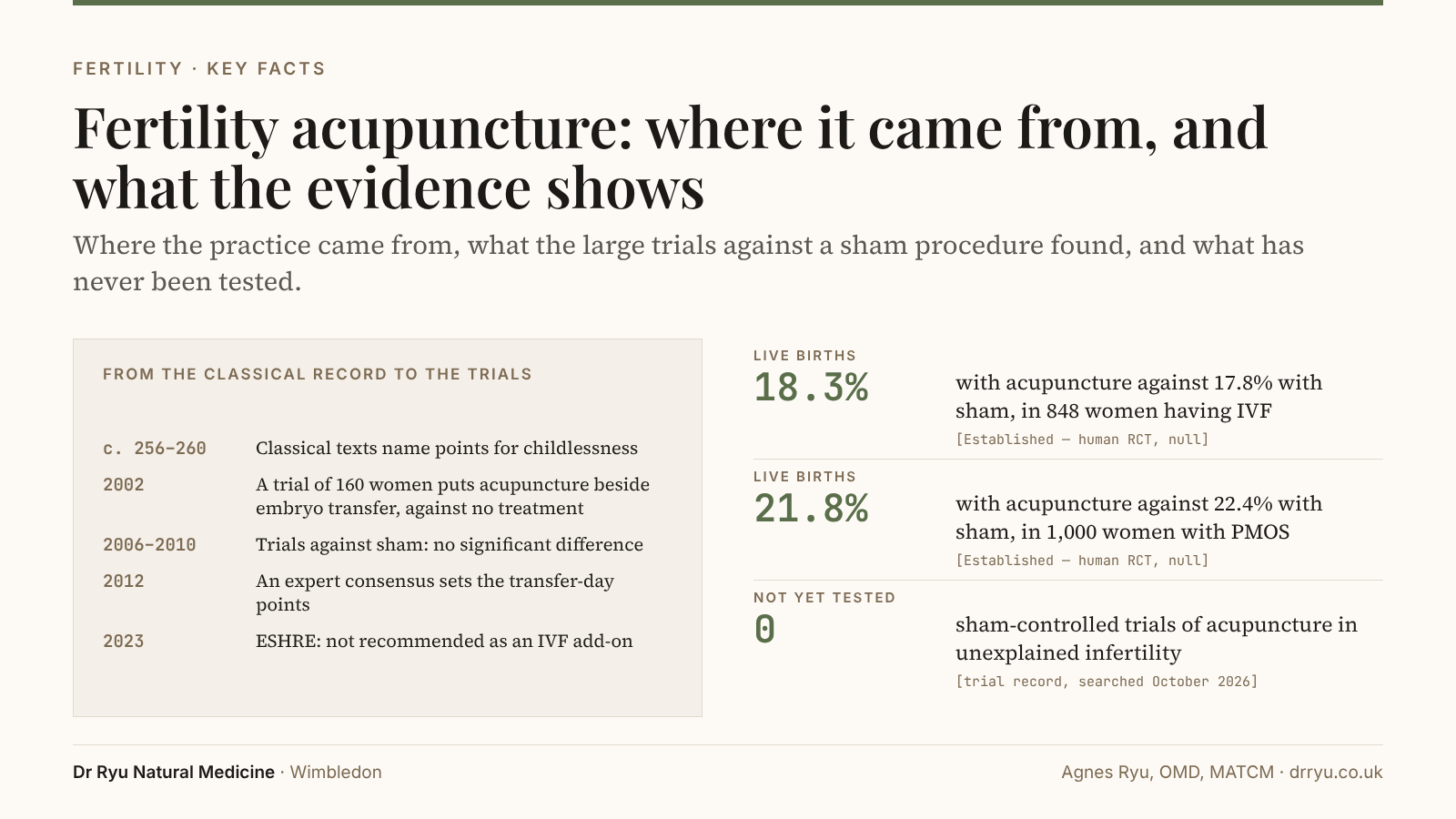
Can acupuncture help with fertility? The question has been tested only in part. In the two largest trials that compared it with a sham procedure, live births did not differ: 18.3% against 17.8% in 848 women having IVF,1 and 21.8% against 22.4% in 1,000 women with PMOS, polyendocrine metabolic ovarian syndrome, the condition formerly called PCOS.2 Both trials tested protocols set largely in advance, against a sham procedure that itself touches or pierces the skin, and much of what people ask about, from natural conception to egg quality, has hardly been studied. A trial that finds no difference has not shown that there is no effect, only that it found none of the size it could detect.
This one also goes further back, and further in. It covers what the classical record says about childlessness, and how a German trial of 160 women in 2002 made acupuncture on the day of embryo transfer a fixture beside IVF clinics. It sets out how the protocols were built and then tested, the limits of that testing, and what was found for ovulation, eggs, the lining of the womb, stress, period pain and sperm. It asks whether the negative results are real and gives my own reading of them, and it ends with what is proposed as mechanism, what is known in pregnancy, and how I use acupuncture in my own fertility work.
Where fertility acupuncture came from
The classical record
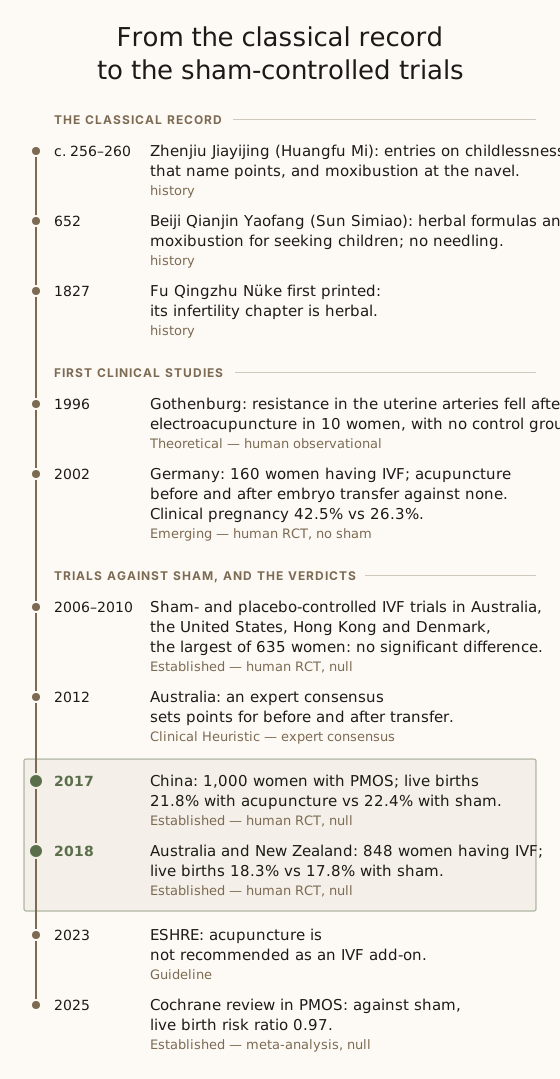
Childlessness is one of the oldest subjects in the Chinese medical literature. Volume 12 of the Zhenjiu Jiayijing (針灸甲乙經), compiled by Huangfu Mi around 256–260 CE, has eleven entries on childlessness. Most name a point that “governs” the complaint, among them CV4, KI2, KI1 and SP5, without saying whether the needle or warmth is to be used; three specify the needle, and one gives moxibustion at the navel.3 Four centuries later, the section on seeking children in Sun Simiao’s Beiji Qianjin Yaofang (備急千金要方, 652) gives herbal formulas and moxibustion at named points, with no acupuncture.4 By then, a study of the period’s medical texts finds, herbal prescriptions for conception had become abundant.5 The best-known later text on women’s medicine, Fu Qingzhu Nüke (傅青主女科), first printed in 1827, treats infertility in ten patterns, each with a herbal formula and none with a needle.6
These texts recorded generations of clinical practice in the language available to their authors. They were not trials, and they had no access to what physiology now measures, so I report them here as history rather than as evidence. They also correct an assumption: in the texts that devote a section to childlessness, herbal prescriptions take most of the space, and acupuncture and moxibustion are the smaller part.
From the clinic to the trial
The modern story begins in Gothenburg. In 1996, Elisabet Stener-Victorin’s group measured blood flow in the uterine arteries of ten women before and after a course of electroacupuncture and found that the resistance to flow had fallen; there was no control group.7 [Theoretical — human observational] In 1999 the same group randomised 150 women having egg collection to electroacupuncture or to an opioid painkiller for pain relief during the procedure,8 and in 2000 it reported ovulation in 24 women with PMOS given electroacupuncture, again without a control group.9
The paper that changed practice came from Germany in 2002. Paulus and colleagues randomised 160 women having IVF to acupuncture for about 25 minutes before and after embryo transfer, or to none. Clinical pregnancy was 42.5% against 26.3%.10 [Emerging — human RCT, no sham] With no sham control, the trial could not separate the needles from the visit, the attention and the expectation that come with them. It arrived as IVF was expanding fast, and within a few years acupuncture on the day of transfer was being offered beside IVF clinics in many countries. The same year, a review in Fertility and Sterility from New York set out the hypotheses that might explain such an effect, at a time when only one IVF trial existed.11
Australia built the largest body of trials. Caroline Smith’s group ran a sham-controlled trial in 2006,12 convened the expert consensus that defined a protocol in 2012,13 and led the largest trial to date, published in 2018.1 Jane Lyttleton’s textbook, Treatment of Infertility with Chinese Medicine (2004), gave practitioners in the English-speaking world a working method.14
In China, Han Ji-Sheng’s group at Peking University had shown that the frequency of electrical stimulation changes which of the body’s opioid peptides are released.15 It applied electrical stimulation through skin electrodes to IVF: a trial of 309 women in 2011,16 and in 2017 a consensus whose authors included people from a company that makes the stimulation devices.17 In Korea, local governments began funding infertility programmes of acupuncture, moxibustion and herbal prescriptions in the late 2000s. Their published reports are uncontrolled: they describe what was given, but cannot show what caused any pregnancy.1819
How the protocols were built
The transfer-day protocol came from the 2002 trial: a session of about 25 minutes immediately before embryo transfer and another immediately after, at the IVF clinic.10 In 2006 a Danish trial of 273 women tested the same day’s treatment against no acupuncture and against the same treatment plus a second session two days later. Ongoing pregnancy was 36% with acupuncture on the day of transfer against 22% without, and the second session added nothing measurable.20 [Emerging — human RCT, no sham] A German trial of 225 women the same year moved treatment into the luteal phase after transfer and compared it with acupuncture at points chosen as irrelevant to fertility: clinical pregnancy was 33.6% against 15.6%.21 [Emerging — human RCT]
In 2012 an Australian expert panel agreed a protocol by consensus, for use in trials.13
- Before transfer: SP8, SP10, LR3, ST29 and CV4, with one of HT7, PC6 or Yintang.
- After transfer: GV20, KI3, ST36, SP6 and PC6, with the ear points Shenmen and Zigong.
The logic is local points on the lower abdomen before transfer and distal points away from it afterwards, as a precaution. The panel noted that its consensus could not settle concerns about points such as SP6 in the days before implantation. [Clinical Heuristic — expert consensus] The 2018 trial gave three sessions: one between days 6 and 8 of ovarian stimulation, one before transfer and one after it.1
Practice developed differently in China and Korea. There, acupuncture for infertility is more often a course across several cycles than a session tied to a transfer, often given with herbal prescriptions and moxibustion. In Chinese hospital IVF units, electrical stimulation through skin electrodes is common, with the frequency of the current treated as a variable in its own right.17 Korea’s national clinical practice guideline for female infertility was first issued in 2010 and has been revised since.22
| Where | Model | Typical schedule | What the trials compared it with |
|---|---|---|---|
| Germany and Scandinavia | Sessions on the day of transfer | About 25 minutes before and after transfer | No acupuncture; acupuncture at other points; placebo needles |
| Australia | A consensus protocol | During stimulation, then before and after transfer | Non-penetrating sham needles |
| China | Courses across cycles; electrical stimulation | Two or three sessions a week | No treatment; mock stimulation; shallow needle insertion |
| Korea | Courses with herbal prescriptions and moxibustion | Over several months | Mostly uncontrolled programme reports |
How it was tested, and the limits of trial design
A trial of acupuncture is only as informative as what it compares acupuncture with. The trials of fertility acupuncture used five kinds of control:
- no treatment;
- lying quietly for the same time;
- a non-penetrating sham needle that touches the skin and retracts;
- acupuncture at points chosen as irrelevant to fertility;
- for electrical stimulation, electrodes with the current switched off.
Why a sham is hard to build. A sham has to look and feel like acupuncture without being acupuncture, and that is harder than it sounds. A needle that only presses on the skin, or pierces it shallowly at a point thought irrelevant, still stimulates receptors in the skin, and those signals reach the brain; physiologists who have studied this argue that minimal and sham acupuncture are therefore not inert controls.23 [Theoretical — review] Large trials have repeatedly found real acupuncture better than usual care but not clearly better than sham. That is either evidence that the site and depth of the needle matter little, or evidence that the sham is itself a stimulus, and acupuncture research has not settled which.24 [Established — review]
The choice decides the result. Pooled against no treatment, the trials of acupuncture around embryo transfer show higher clinical pregnancy with acupuncture: risk ratio 1.32 (95% confidence interval 1.07 to 1.62).25 [Established — meta-analysis] When only the trials with a sham procedure are pooled, the difference disappears. For live birth the risk ratio is 0.87 (0.75 to 1.01), rated high certainty.26 [Established — meta-analysis, null]
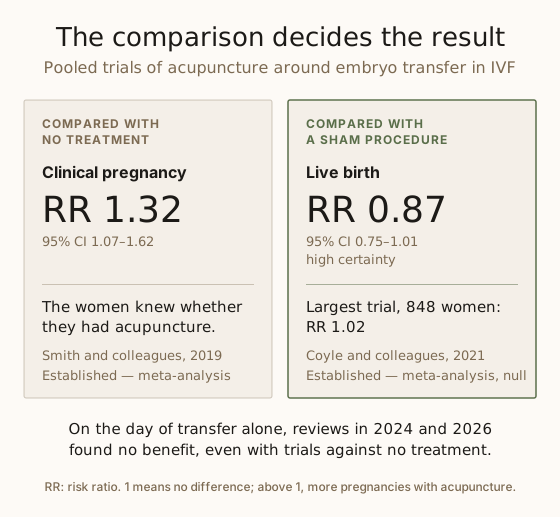
There are three ways to read that gap:
- The procedure itself. The visit, the time lying still, the attention and the expectation may have effects that a sham shares.
- Bias in the smaller trials. Trials against no treatment cannot be blinded, and they may overstate the effect, as unblinded trials tend to.
- Chance.
In IVF, the trials that compared the placebo device with usual care found no difference between those two either.26 That makes a large effect of the procedure alone less likely: here the sham behaved much like no treatment, and the question turns to the active arm — what was given, to whom, and by whom, which I come back to below. In period pain, by contrast, sham acupuncture on its own reduced pain by about one standard deviation.27 [Emerging — meta-analysis]
Two more details shape the results. One review found larger effects in trials whose control groups had low pregnancy rates: risk ratio 1.53, against 0.90 where those rates were higher.28 That is a statistical pattern, not a mechanism. [Emerging — meta-analysis; contested] And clinical pregnancy is not live birth: a difference in the first can vanish by the second.
So a null result against sham means that the needle’s specific action, at those points and that depth, added nothing that the trials could measure. It does not show that the procedure does nothing. It does not show that it does. [contested, reframed]
What the trials found in IVF
| Trial | Women | Compared with | Result | Evidence |
|---|---|---|---|---|
| Paulus, Germany, 200210 | 160 | No acupuncture | Clinical pregnancy 42.5% vs 26.3% | Emerging — human RCT, no sham |
| Westergaard, Denmark, 200620 | 273 | No acupuncture | Ongoing pregnancy 36% vs 22%; a second session added nothing | Emerging — human RCT, no sham |
| Dieterle, Germany, 200621 | 225 | Acupuncture at non-fertility points | Clinical pregnancy 33.6% vs 15.6% | Emerging — human RCT |
| Smith, Australia, 200612 | 228 | Non-penetrating sham | Pregnancy 31% vs 23%, not significant | Established — human RCT, null |
| Domar, United States, 200929 | 150 | Lying quietly | No difference in pregnancy; women felt more relaxed | Emerging — human RCT, null |
| So, Hong Kong, 200930 | 370 | Placebo needle | Pregnancy 43.8% vs 55.1%: higher with placebo | Established — human RCT, null |
| Andersen, Denmark, 201031 | 635 | Placebo needle | Live birth 25% vs 30%, not significant | Established — human RCT, null |
| Zhang, China, 201116 | 309 | Mock electrical stimulation | Clinical pregnancy 50.0% (two sessions) and 42.7% (one) vs 29.3% | Emerging — human RCT |
| Smith, Australia and New Zealand, 20181 | 848 | Non-penetrating sham | Live birth 18.3% vs 17.8% | Established — human RCT, null |
The reviews agree on the shape.
- Cochrane, 2013 (still its current version): no clear effect on live birth, odds ratio 1.22 (0.87 to 1.70), low quality.32
- Sham-only pooling: the figure above.
- A 2025 review of transfer-day acupuncture: higher clinical pregnancy against no treatment; no difference against sham; no effect on live birth.33
Two reviews looked at timing.
- 38 trials against sham or no treatment found higher clinical pregnancy when acupuncture was given during ovarian stimulation in fresh cycles (risk ratio 1.33) and before frozen embryo transfer (1.71). It found no benefit when acupuncture was given before stimulation or on the day of transfer.34
- 42 trials and 9,390 women found a clinical pregnancy risk ratio of 1.25 but an uncertain effect on live birth (1.14, 0.98 to 1.32), all at very low certainty. Its authors treat their timing findings as exploratory.35 [Emerging — meta-analysis, very low certainty]
The guideline bodies read the same evidence.
- ESHRE, in its 2023 recommendations on IVF add-ons: “Acupuncture, Chinese and herbal medicine and other complementary therapies are not recommended.”36
- NICE, in its fertility guideline updated in March 2026, keeps its recommendation that people be told the effectiveness of complementary therapies for fertility problems “has not been properly evaluated”.37
Miscarriage needs its own line. The sham-controlled trials found no significant difference, risk ratio 1.23 (0.89 to 1.71), high certainty, though that interval does not rule out an increase.26 A 2025 review that combined sham and no-treatment controls found more early miscarriages with acupuncture: risk ratio 1.51 (1.10 to 2.08).38 [Emerging — meta-analysis] Neither settles the question. Both are reasons for care after transfer, in how treatment is given as much as in which points are chosen, which I come back to below [Clinical Heuristic].
Beyond IVF
Ovulation and PMOS
The largest trial of acupuncture in any fertility setting tested it in PMOS. PCOSAct randomised 1,000 women at 21 sites in China to active or control acupuncture, each with clomiphene or a placebo tablet, for up to four cycles.
- Active acupuncture: deep needle insertion with manual and low-frequency electrical stimulation.
- Control acupuncture: shallow needles with no stimulation and a mock current.
- Live births: 21.8% with active acupuncture against 22.4% with control acupuncture. Clomiphene, by contrast, almost doubled them: 28.7% against 15.4%.
- Side effects: diarrhoea and bruising were more common with active acupuncture.2 [Established — human RCT, null]
The authors concluded that their finding does not support acupuncture as an infertility treatment in these women.
The smaller trials point the same way.
- Against sham, ovulation was 0.37 against 0.40 a month in 84 women.39 [Established — human RCT, null]
- The Cochrane review, updated in October 2025, found no difference from sham in live birth, risk ratio 0.97 (0.76 to 1.23), or in ovulation.40 [Established — systematic review, null]
- The positive result most often cited, more ovulations with electroacupuncture, came from a trial of 32 women whose control group met a physiotherapist and had no sham.41 [Emerging — human RCT; contested]
- The nervous system changed in a small trial. Muscle sympathetic nerve activity, which runs high in PMOS, fell with low-frequency electroacupuncture in 20 women.42 [Emerging — human RCT, surrogate]
- Insulin sensitivity, the metabolic core of PMOS, improved no more with acupuncture than with sham in 342 women, and metformin improved it more than acupuncture did.43 [Emerging — human RCT, null]
Trying to conceive without IVF
For the question many people ask first, whether acupuncture helps natural conception, there has been very little research:
- there is no sham-controlled trial in unexplained infertility;
- there is no randomised trial of acupuncture with intrauterine insemination;
- a 2019 review pooled 22 trials of acupuncture for women not having IVF. All came from China and none had a sham control. It found higher pregnancy rates, with signs of publication bias.44 [Emerging — meta-analysis; contested]
That is a gap in the research, not a finding. Trials of acupuncture are hard to design and hard to fund: a convincing sham is difficult to build, treatment fitted to each person is difficult to standardise, and no company stands to profit from the result. Why that matters is set out under Are the negative results real?, below.
Eggs and ovarian reserve
Here too there has been little research: two trials, both from China and both published in 2026, and one review of earlier trials.
- Poor responders. A trial at nine hospitals in China randomised 140 women whose ovaries respond poorly to stimulation to 36 sessions of acupuncture before stimulation, or to IVF alone. The median number of eggs collected was two in each group. Among the secondary outcomes, basal FSH was lower and more of the fertilised eggs divided with acupuncture; clinical pregnancy (34.3% against 21.4%) and live birth (21.4% against 15.7%) did not differ significantly.45 [Emerging — human RCT, null for the primary outcome]
- Low ovarian reserve. In a single-centre trial of 120 women, 12 weeks of acupuncture raised the antral follicle count by about one follicle more than sham; by 24 weeks the difference was no longer significant. AMH rose and FSH fell in both groups, with no difference between them.46 [Emerging — human RCT]
- Pooled trials suggest about one more egg collected, with no difference in pregnancy.47 [Emerging — meta-analysis]
Studies this few cannot settle the question either way. They leave it open.
There is a further difficulty with the question itself. What presents as an egg-quality problem does not always start in the ovary: blood glucose and insulin regulation, thyroid function and prolactin all bear on ovulation and on the follicle [Established — review], as insulin resistance and infertility and thyroid hormone and fertility explain. A trial that groups these women under one label measures an average across different problems.
The lining of the womb
Trials of electrical stimulation through the skin have looked at the endometrium:
- Against mock stimulation: 68 women having frozen embryo transfer showed higher endometrial HOXA10, a marker associated with receptivity.48 [Emerging — human RCT, surrogate]
- A trial of 739 older women, with no sham control: clinical pregnancy was 55.1% against 46.7%, with no difference in live birth.49 [Emerging — human RCT] Markers of receptivity (pinopodes, LIF, integrin αvβ3) rose in that trial’s laboratory sub-study. They have also been studied in rats.50 [Theoretical — animal]
- Thin endometrium, against sham: in 92 women having frozen transfer, clinical pregnancy was 55.3% against 31.1% with acupuncture.51 [Emerging — human RCT; contested] Its registry number suggests registration in 2026, which may have followed the trial. That weakens confidence in it.
Stress, inflammation and blood flow
Fertility treatment is stressful, and stress physiology touches reproduction, so these were natural things to measure:
- Real against placebo: in a double-blind trial of 370 women, cortisol and anxiety fell to the same extent with both.30
- A cohort study: cortisol and prolactin ran higher on some days in women having acupuncture.52 [Theoretical — human observational]
- The 2018 trial: anxiety after transfer was 1.1 points lower with acupuncture than with sham on the trial’s anxiety scale (95% confidence interval −2.2 to −0.1), a small difference.53 [Emerging — human RCT, secondary outcome]
- PMOS: a sham-controlled trial of electroacupuncture found no difference between groups in markers of glucose and lipid metabolism.54
- Blood flow: in two trials without a sham control, resistance in the uterine arteries fell in the groups having electroacupuncture. Pregnancy did not differ where it was measured.5556 [Emerging — human RCT, surrogate]
Period pain
Painful periods are often part of the fertility picture.
- The Cochrane review of 2016 found the comparison with sham inconclusive, and its one trial at low risk of bias found no difference. Comparisons with anti-inflammatory painkillers favoured acupuncture but were of low quality.57 [Emerging — systematic review; contested]
- Sham alone reduced period pain substantially in the later review mentioned above. That is why trials without a sham arm say little here.27
Men
Fewer trials have studied men:
- Against placebo acupuncture, 57 men with severely reduced sperm count and motility showed improved motility but unchanged concentration.58 [Emerging — human RCT]
- Pooled trials have not shown a reliable effect on semen quality against placebo.59 [Emerging — meta-analysis, null]
What the trials tested, and what they could not
Are the negative results real?
They are real results. The large trials were well run, and they found no difference between the groups they compared. But what a negative result means is narrower than it sounds.
No difference found is not the same as no effect. A trial can detect only a difference of the size it was built to detect. Two of Britain’s best-known medical statisticians put the principle in the title of a paper in 1995: “Absence of evidence is not evidence of absence.”60 [Established — statistical principle] The largest IVF trial shows what that means in numbers: its result is compatible with anything from 4.9 fewer to 5.8 more live births in every 100 women given acupuncture.1 That rules out a large benefit from that protocol, against that sham. It cannot rule out a smaller one, and it says nothing about care given differently.
Beyond the arithmetic, this is my reading, as a clinician, of where the trials were narrow.
People with fertility problems are not one population. Women come to IVF at different ages and for different reasons: blocked tubes, a male factor, ovulatory disorders such as PMOS, endometriosis, or no cause found. Some causes lie outside the reproductive system altogether: blood glucose and insulin regulation, thyroid function, prolactin and the stress response all bear on fertility, as fertility as system consequence sets out. And a couple is two people: a male factor contributes in about half of couples,61 [Established — review] yet in these trials only the woman was treated. People also come with different baseline physiology: different stress responses, circulation, tissue tension and metabolic state. A trial that gives one protocol to all of them measures an average across very different bodies [Clinical Heuristic]. Randomisation makes the groups alike, so the comparison is fair. It does not make one protocol right for every person in them, and if a treatment helps some patients and not others, the average across all of them can hide it [Established — statistical principle]. As noted above, trials whose control groups had low pregnancy rates showed larger effects;28 that is at least consistent with an effect that depends on who is treated, and where [Emerging — meta-analysis; contested].
The protocols were fixed in advance. The trials applied points agreed before the first patient was seen. The largest allowed some individual choice of points in its first session, but its two sessions on the day of transfer used a fixed set of points, with a choice of one point from three before transfer.62 In practice I adjust acupuncture to the person in front of me, in real time, from what the examination finds: baseline physiology and pathology decide how I treat, and the first question is what has priority in that particular system [Clinical Heuristic].
The control may not have been inert. As set out above, a sham that touches or pierces the skin may itself be a stimulus. In IVF it behaved much like no treatment, so the question rests on the active arm.
The craft is not what a protocol trial measures. A protocol can specify points. It cannot specify the hands-on skill of reading tissue and the nervous system, or the judgement of when to stop. Nor is acupuncture one uniform treatment: training, technique and skill vary widely from one practitioner to the next, so a trial measures the practitioners it recruited as much as the method it wrote down. Live birth, the outcome these trials were built around, is also far downstream of anything a session acts on directly [Clinical Heuristic].
The same standard, applied elsewhere. Testing a treatment against a convincing sham is the right standard, and a demanding one, and much of medicine has never been put to it. Surgical operations are rarely tested against a sham operation: a 2014 review found 53 such trials, and in 27 of them the sham did as well as the surgery.63 [Established — systematic review] The best-known case is keyhole surgery for arthritis of the knee. In a trial of 180 patients published in 2002, those given a sham operation, with skin incisions only, did as well as those whose knee was washed out or cleaned up, at every point over two years; on an objective test of walking and stair-climbing, the patients whose knee was cleaned up did worse, at two weeks and at one year.64 [Established — human RCT] In 2017 an international guideline panel recommended strongly against the operation for nearly all patients with degenerative knee disease, at a time when it was still performed more than two million times a year worldwide.65 [Established — clinical guideline] Across a random sample of Cochrane reviews, 87 of 1,567 treatments compared with placebo or no treatment, about one in eighteen, had high-quality evidence of benefit.66 [Established — systematic review] That is not an argument that acupuncture works. It is an argument for reading every null result, in every field, for exactly what it tested.
Why some questions have no trials. What gets tested depends on who pays. Influential randomised trials are, in the words of one of the best-known researchers on research methods, “largely done by and for the benefit of the industry”,67 and trials sponsored by a manufacturer report results favourable to its product more often than trials funded in other ways.68 [Established — systematic review] A needle technique is not a product that can be sold, so manual acupuncture has no sponsor of that kind, and the questions patients ask most, about natural conception and egg quality, are rarely put to a large trial [Theoretical].
No individualised treatment in trial settings
One large trial tested individualised acupuncture directly, though in back pain rather than fertility. It is the most direct evidence against my reading, so it deserves a careful account. In the United States, 638 adults with long-standing low back pain were each given one of four things:
- acupuncture prescribed for them individually;
- a standard set of eight points used for back pain;
- a sham, in which a toothpick in a needle guide tube was pressed against the same eight points without piercing the skin;
- their usual medical care.
The three acupuncture groups had ten sessions over seven weeks.69
What it found.
- All three acupuncture groups did better than usual care, by a margin that matters in daily life. After eight weeks, about 60 in every 100 people in the three acupuncture groups had a clinically meaningful improvement in function, against 39 in 100 with usual care, and fewer were taking painkillers. Part of that difference was still there a year later [Established — human RCT].
- The three acupuncture groups did equally well. Points chosen for the individual did no better than the standard set, and needles did no better than the toothpick [Established — human RCT, null].
What it implies.
- The sham was not inert. Touching the skin at the points, within a treatment, did as much as needle insertion. A trial that uses such a sham as its placebo can make a real effect look like no effect, and the trial’s own authors questioned whether sham treatments truly serve as inactive controls.69
- The individualised treatment was individualised on paper. One acupuncturist examined each person and wrote the prescription. A second acupuncturist, who interacted with the participant as little as possible, gave the treatment. Participants wore eye masks, the number and length of sessions were fixed in advance, and needles were the only tool allowed. The authors list these limits themselves.69 What was tested was an individual list of points, not treatment adjusted by hand, in real time, as the tissue responds.
- So the trial weighs against one claim and leaves another open. It argues against the idea that the choice of points matters much in back pain, and I take that seriously. It does not test the practice I describe, and no large fertility trial has tested it either.
What would test it is a trial built differently: experienced practitioners treating each person from an examination, people grouped by the cause of their infertility, and outcomes measured where the needle acts (the tissue, the circulation, the autonomic nervous system) as well as at live birth [Theoretical].
What is proposed as mechanism
The general mechanism is set out in How does acupuncture work? A needle injects nothing: it is a mechanical and sensory input, and the responses measured so far are in connective tissue, in local tissue chemistry and in the nervous system [Theoretical — human experimental and animal].
Three hypotheses specific to reproduction have been tested:
- Ovarian blood flow. In anaesthetised rats, blood flow in the ovary changed with the site and frequency of electrical stimulation, through a reflex carried by the sympathetic nerves.70 [Theoretical — animal]
- Sympathetic activity. In women with PMOS, muscle sympathetic nerve activity fell.42 [Emerging — human RCT, surrogate]
- Neuropeptides. Different frequencies of electrical stimulation release different neuropeptides, a finding from pain research.15 [Theoretical — review]
A review by the group that did much of this work sets out the reproductive pathways, mostly from animal studies.71
What I aim to change when I treat
In my own work the aims are more specific, and each can be felt under the hand and, in part, measured [Clinical Heuristic]:
- Guarding. Easing guarding (muscles held tight to protect an area) and trigger points (tender knots in the muscle) in the abdomen, the back and the pelvis.
- The autonomic nervous system. Regulating it as a whole system. The aim is to lower a fight-or-flight (sympathetic) tone that has stayed high for too long, and to raise the tone of the vagus nerve, the main nerve of the rest-and-digest (parasympathetic) system. The vagus reaches the heart, the lungs and most of the gut, so a change in its tone is felt across many organs at once: a whole-system effect rather than a local one [Established — physiology]. This matters for the pelvis because sympathetic nerves narrow the vessels that supply it. In rats, blood flow in the ovary changes through a reflex carried by the sympathetic nerves,70 and the Gothenburg group attributed the fall in uterine artery resistance it measured to a central fall in sympathetic activity.7 In women with PMOS, low-frequency electroacupuncture lowered high sympathetic nerve activity, as above.42 [Emerging — human RCT, surrogate; Theoretical — animal] In my experience, a body that has settled into a rest-and-digest state also responds more readily to treatment [Clinical Heuristic].
- Blood flow to and through the pelvic organs, at three levels. When it is the priority, I often prescribe movements to do daily, alongside treatment [Clinical Heuristic]. The arterial and microvascular changes below were measured with Doppler ultrasound, in small trials:
- Arterial inflow: the delivery of blood to the uterus, the endometrium and the ovaries, above all where resistance to flow is abnormally high. In ten infertile women with high resistance in the uterine arteries, the resistance fell after a course of electroacupuncture and was still lower 10 to 14 days later, in a study without a control group;7 in a small randomised trial without a sham, resistance fell with electroacupuncture before egg collection.55 [Emerging — human, surrogate, no sham control] In women with period pain, treatment at SP6, on the inner lower leg, lowered resistance in the uterine arteries within minutes in one trial,72 but electroacupuncture at the same point did not change it in another.73 [Emerging — human RCT, surrogate; mixed]
- The microcirculation: the smallest vessels, where the vessel lining regulates flow and oxygen and nutrients reach the endometrium and the ovarian tissue. In 80 women with repeated implantation failure, the vascular index of the endometrium and of one ovary was higher straight after a session of electroacupuncture than in women waiting for treatment.56 [Emerging — human RCT, surrogate, no sham control]
- Venous outflow: blood returning from the uterus and the ovaries through the veins. The veins of the pelvis and the legs are connected, which is why treatment along the inner leg is part of how I approach it [Clinical Heuristic]. Doppler ultrasound can measure blood flow in the pelvic veins, but no study has yet measured it after acupuncture.
These are changes where the needle acts. No trial has yet linked them to more live births, and none has been designed to: that is the trial described above.
During pregnancy and after
Many women who conceive ask whether to continue. The evidence varies by complaint, and most of it is of low or moderate certainty.
- Nausea and vomiting.
- The Cochrane review found no significant benefit from acupuncture.74
- In the largest sham-controlled trial, 352 women in China, a nausea score fell by 0.7 points more with acupuncture: a small difference, whose clinical importance the authors called uncertain.75
- The World Health Organization’s 2016 antenatal guideline lists acupuncture, with ginger, chamomile and vitamin B6, among options for nausea in early pregnancy.76
- Pelvic girdle pain. Acupuncture added to standard care reduced evening pain in 386 women,77 but did no better than a non-penetrating sham in 115.78 [Established — human RCT, null against sham] A Cochrane review found moderate-quality evidence, from single studies, that acupuncture added to usual care reduced pelvic pain.79 The World Health Organization’s antenatal guideline lists acupuncture, with physiotherapy and support belts, among the options for low back and pelvic pain in pregnancy.76
- Breech presentation. Moxibustion, warming with burning mugwort near a point on the little toe, reduced the number of babies not lying head-down at birth: risk ratio 0.87 (0.78 to 0.99), moderate certainty. It did not change the caesarean rate.80 [Established — systematic review] A trial in China in 1998 had found 75.4% head-down at birth against 62.3%.81
- Labour pain. Against sham, pain scores did not differ, though fewer women used pain-relieving drugs.82
- Depression in pregnancy. In one trial of 150 women, more responded to acupuncture designed for depression (63.0%) than to control acupuncture (37.5%).83 A Cochrane review judged the evidence inconclusive.84
On safety:
- Adverse events. A review of trials in pregnancy found them in 1.9% of women, all mild or moderate.85
- Preterm birth. In a Korean cohort of 20,799 pregnant women, it was not significantly more common after acupuncture: odds ratio 1.23 (0.98 to 1.54).86 [Emerging — human observational]
- The “forbidden points”. The points classically avoided in pregnancy have little objective evidence of harm behind them,87 but the evidence is not strong enough to support using them before 37 weeks.88
How I came to fertility acupuncture, and how I practise it
I began my career wanting mechanism, not ritual — bedside to bench, and bench back to bedside. That movement is still the shape of my medicine.
I came to acupuncture through the nervous system. My early clinical years were in a stroke unit and then in stroke rehabilitation, where the question was always how a signal at the periphery reaches the brain and comes back changed. The classical books recorded what acupuncture did across generations. They did not tell me how. Answering that took me in three directions:
- into the autonomic nervous system;
- into structural and myofascial work, from Cyriax’s orthopaedic medicine to structural integration;
- into biochemistry, through my years as a research biochemist.
Over the years one pattern kept appearing in different clothes. When energy runs short, sympathetic activity stays high, tissue stays guarded, and pain and inflammation follow. Fertility is another place where it shows. [Clinical Heuristic]
Fertility was not my original focus. What drew me to it was what I saw in the clinic, and the question it raised: when a body under strain changes course, what is acting, and through which system? I went back to the literature to find what could be measured, and that question still shapes how I use acupuncture. It is also why this article starts from the trials rather than from my case notes. I tell that story in Bedside to Bench, Bench to Bedside — How My Practice Found Fertility.
In practice that means four things.
Assessment comes first. The history, the results a patient brings and a hands-on examination decide how I approach and treat, where I place priority, and whether acupuncture is the right input at all for that particular person.
The crux of hands-on acupuncture is the assessment of the individual and the interaction in real time. Each person is a unique, dynamic system. I read the body’s patterns, its signals and its responses, and I interact with them. Under my hands, tension eases and tight tissue loosens [Clinical Heuristic]. That exchange, in real time, is where I find acupuncture a unique and very useful tool, and it is exactly what a protocol leaves out. A list of acupuncture points agreed in advance treats an average patient, and nobody is the average patient.
The technique is a craft, developed over three decades. I have been fortunate in my teachers, in the East and in the West, and my hands-on technique, and the sensitivity it depends on, grew out of their teaching and thirty years of study and practice. As I learned to read the body more finely and to work with its responses, my technique became gentler. Gentle treatment lets the body relax more completely: during a session the guarding pattern in the tissue drops, and the person settles from what I read as a guarded, fight-or-flight state into a rest-and-digest one. Over a course of treatment I see changes in how easily the person relaxes and in the tension they carry, which I read as the autonomic nervous system regulating itself better [Clinical Heuristic]. In mice, a stronger stimulus recruits a different pathway rather than more of the same one, as How does acupuncture work? explains, so intensity is a clinical choice, not a matter of more being better [Theoretical — animal].
Acupuncture is one input among several, in a systems approach. It sits inside the metabolic and endocrine work described in fertility as system consequence and the metabolic-bioenergetic approach to fertility: energy production, insulin regulation, thyroid function and inflammation. A change on the treatment table does not hold if the body lacks the energy to keep it [Clinical Heuristic].
What sessions are for differs by stage.
- Trying to conceive naturally: alongside the metabolic work, for comfort and relaxation, and for the tension and tight areas of tissue I find on examination.
- Around IVF: for comfort and relaxation, during stimulation and on the days of egg collection and embryo transfer. After transfer I continue to use abdominal points where local circulation and tension call for them, treated shallowly and gently, in the superficial tissue of the abdominal wall [Clinical Heuristic].
- In pregnancy: for comfort and relaxation, alongside the care of a midwife.
- After birth: for comfort and relaxation.
Neither the largest trials nor the combined results of the trials against a sham procedure have shown that acupuncture raises the chance of a live birth, and I make no such claim. But a null result answers the question a trial asked — a fixed protocol, tested against a sham, measured by live birth — and it does not decide what acupuncture is for in practice. What I offer is care chosen after assessment and done well. How a course is arranged is described on fertility acupuncture and IVF support.
Key takeaways
- The classical texts recorded acupuncture and moxibustion for childlessness from the third century, and acupuncture on the day of embryo transfer spread after a 2002 German trial of 160 women that had no sham control [Established — historical sources and trial record].
- In the two largest trials against a sham procedure, live births did not differ: 18.3% against 17.8% in 848 women having IVF, and 21.8% against 22.4% in 1,000 women with PMOS [Established — human RCT, null].
- Pooled IVF trials show higher pregnancy rates with acupuncture against no treatment but not against a sham procedure, and a sham that touches or pierces the skin may not be an inactive control [Established — meta-analysis; Theoretical — review].
- Natural conception, egg quality and ovarian reserve have had very few trials, and a trial that finds no difference has not shown that there is no effect [Established — statistical principle].
- Agnes Ryu treats each person from an assessment and adjusts the treatment during the session. The large fertility trials tested sets of points largely fixed in advance, and treatment adjusted to the individual has not yet been tested in a large fertility trial [Clinical Heuristic].
Frequently asked questions
Can acupuncture help with fertility?
The largest trials asked one narrow question: whether a protocol of acupuncture, set largely in advance, raises live births compared with a sham procedure. They found no difference: 18.3% against 17.8% in 848 women having IVF, and 21.8% against 22.4% in 1,000 women with PMOS (polyendocrine metabolic ovarian syndrome, formerly PCOS).12 Smaller trials have measured changes in blood flow to the uterus, in sympathetic nerve activity and in anxiety after embryo transfer. None of these has yet been linked to more live births, and treatment adjusted to the individual has not been tested in a large fertility trial.
Does acupuncture improve IVF success rates?
It depends on the comparison. Pooled against no treatment, trials of acupuncture around embryo transfer show higher clinical pregnancy rates (risk ratio 1.32).25 Pooled against a sham procedure, they show no difference in live births (0.87, 0.75 to 1.01).26 Unblinded trials may overstate an effect, and a sham may not be inert, so the gap can be read either way. ESHRE does not recommend acupuncture as an IVF add-on,36 and NICE says the effectiveness of complementary therapies for fertility problems has not been properly evaluated.37
Why did the largest trials find no difference?
Several explanations fit, and the trials cannot separate them. There may be no effect on live birth. The sham procedures, which touch or pierce the skin, may themselves be active. One protocol was given to people whose infertility had very different causes, which can hide an effect that some of them have. And live birth is far downstream of what a session acts on. The largest IVF trial rules out a large benefit from its protocol, but not a smaller one: its result runs from 4.9 fewer to 5.8 more live births in every 100 women.1
Is sham acupuncture a true placebo?
Not necessarily. A sham needle that presses on the skin, or pierces it shallowly at a point thought irrelevant, still stimulates sensory nerves, and physiologists have argued that this makes it an unreliable placebo.23 In a large back-pain trial, a toothpick pressed on the skin did as well as real needles, and both did better than usual care.69 In the IVF trials, though, the sham behaved much like no treatment.26
Is there a standard acupuncture protocol for fertility?
Trials used fixed protocols, agreed by expert consensus or carried over from the first trials, because a fixed protocol can be repeated and matched with a sham.13 In my practice there is no universal protocol: the history, the results a patient brings and an examination by hand decide where and how I treat, and the treatment is adjusted during the session. Treatment of that kind has not been tested in a large fertility trial.
Has acupuncture been studied for natural conception and egg quality?
Very little. There is no sham-controlled trial in unexplained infertility and no randomised trial with intrauterine insemination. Two trials published in 2026 looked at women with a poor response to stimulation or a low ovarian reserve: in the first, the number of eggs collected was the same with and without acupuncture; in the second, acupuncture raised the antral follicle count by about one follicle more than sham at 12 weeks, a difference no longer significant by 24.4546 Studies this few leave the question open.
Is acupuncture safe after embryo transfer and in early pregnancy?
In trials in pregnancy, adverse events were reported in 1.9% of women, all mild or moderate.85 Miscarriage did not differ significantly in the sham-controlled IVF trials (risk ratio 1.23, 0.89 to 1.71), though one 2025 review with mixed controls found more early miscarriages with acupuncture (1.51).2638 After transfer I use abdominal points where local circulation and tension call for them, treated shallowly and gently, in the superficial tissue of the abdominal wall.
References
-
Smith CA, de Lacey S, Chapman M, Ratcliffe J, Norman RJ, Johnson NP, et al. Effect of acupuncture vs sham acupuncture on live births among women undergoing in vitro fertilization: a randomized clinical trial. JAMA. 2018;319(19):1990–1998. doi:10.1001/jama.2018.5336. PMID: 29800212. [Established — human RCT, null] ↩︎↩︎↩︎↩︎↩︎↩︎↩︎
-
Wu XK, Stener-Victorin E, Kuang HY, Ma HL, Gao JS, Xie LZ, et al. Effect of acupuncture and clomiphene in Chinese women with polycystic ovary syndrome: a randomized clinical trial. JAMA. 2017;317(24):2502–2514. doi:10.1001/jama.2017.7217. PMID: 28655015. [Established — human RCT, null] ↩︎↩︎↩︎
-
Huangfu Mi. Zhenjiu Jiayijing 針灸甲乙經, volume 12, chapter on miscellaneous diseases of women (婦人雜病). Siku Quanshu (Wenyuange) edition, Kanseki Repository KR3e0005. Compiled c. 256–260 CE (date from secondary sources). [history — primary text] ↩︎
-
Sun Simiao. Beiji Qianjin Yaofang 備急千金要方, volume 2, on seeking children (求子第一). Siku Quanshu (Wenyuange) edition, Kanseki Repository KR3e0013. 652 CE. [history — primary text] ↩︎
-
Lee Jen-der 李貞德. 漢唐之間求子醫方試探──兼論婦科濫觴與性別論述 [Prescriptions for seeking children from the Han to the Tang]. Bulletin of the Institute of History and Philology, Academia Sinica. 1997;68(2):283–367. [history — scholarly secondary source] ↩︎
-
Fu Shan (attributed). Fu Qingzhu Nüke 傅青主女科, volume 1, on conception (種子). First printed 1827. [history — primary text] ↩︎
-
Stener-Victorin E, Waldenström U, Andersson SA, Wikland M. Reduction of blood flow impedance in the uterine arteries of infertile women with electro-acupuncture. Hum Reprod. 1996;11(6):1314–1317. doi:10.1093/oxfordjournals.humrep.a019378. PMID: 8671446. [Theoretical — human observational] ↩︎↩︎↩︎
-
Stener-Victorin E, Waldenström U, Nilsson L, Wikland M, Janson PO. A prospective randomized study of electro-acupuncture versus alfentanil as anaesthesia during oocyte aspiration in in-vitro fertilization. Hum Reprod. 1999;14(10):2480–2484. doi:10.1093/humrep/14.10.2480. PMID: 10527973. [Emerging — human RCT] ↩︎
-
Stener-Victorin E, Waldenström U, Tägnfors U, Lundeberg T, Lindstedt G, Janson PO. Effects of electro-acupuncture on anovulation in women with polycystic ovary syndrome. Acta Obstet Gynecol Scand. 2000;79(3):180–188. PMID: 10716298. [Theoretical — human observational] ↩︎
-
Paulus WE, Zhang M, Strehler E, El-Danasouri I, Sterzik K. Influence of acupuncture on the pregnancy rate in patients who undergo assisted reproduction therapy. Fertil Steril. 2002;77(4):721–724. doi:10.1016/s0015-0282(01)03273-3. PMID: 11937123. [Emerging — human RCT, no sham] ↩︎↩︎↩︎
-
Chang R, Chung PH, Rosenwaks Z. Role of acupuncture in the treatment of female infertility. Fertil Steril. 2002;78(6):1149–1153. doi:10.1016/s0015-0282(02)04348-0. PMID: 12477502. [Theoretical — narrative review] ↩︎
-
Smith C, Coyle M, Norman RJ. Influence of acupuncture stimulation on pregnancy rates for women undergoing embryo transfer. Fertil Steril. 2006;85(5):1352–1358. doi:10.1016/j.fertnstert.2005.12.015. PMID: 16600225. [Established — human RCT, null] ↩︎↩︎
-
Smith C, Grant S, Lyttleton J, Cochrane S. Using a Delphi consensus process to develop an acupuncture treatment protocol by consensus for women undergoing Assisted Reproductive Technology (ART) treatment. BMC Complement Altern Med. 2012;12:88. doi:10.1186/1472-6882-12-88. PMID: 22769059. [Clinical Heuristic — expert consensus] ↩︎↩︎↩︎
-
Lyttleton J. Treatment of Infertility with Chinese Medicine. Edinburgh: Churchill Livingstone; 2004. Second edition 2013. [practice textbook] ↩︎
-
Han JS. Acupuncture and endorphins. Neurosci Lett. 2004;361(1–3):258–261. doi:10.1016/j.neulet.2003.12.019. PMID: 15135942. [Theoretical — review] ↩︎↩︎
-
Zhang R, Feng XJ, Guan Q, Cui W, Zheng Y, Sun W, et al. Increase of success rate for women undergoing embryo transfer by transcutaneous electrical acupoint stimulation: a prospective randomized placebo-controlled study. Fertil Steril. 2011;96(4):912–916. doi:10.1016/j.fertnstert.2011.07.1093. PMID: 21862001. [Emerging — human RCT] ↩︎↩︎
-
Qu F, Li R, Sun W, Lin G, Zhang R, Yang J, et al. Use of electroacupuncture and transcutaneous electrical acupoint stimulation in reproductive medicine: a group consensus. J Zhejiang Univ Sci B. 2017;18(3):186–193. doi:10.1631/jzus.B1600437. PMID: 28271655. [Clinical Heuristic — expert consensus; authors include employees of a device maker] ↩︎↩︎
-
Kim KH, Jang S, Lee JA, Go HY, Jung J, Park S, et al. Characteristics and outcomes of female infertility treatment programs using traditional medicine in Korea: a multisite analysis. J Altern Complement Med. 2018;24(6):570–577. doi:10.1089/acm.2016.0384. PMID: 29565635. [Clinical Heuristic — uncontrolled programme reports] ↩︎
-
Choi SJ, Kim DI. Utilization of traditional herbal medicine formulas for unexplained female infertility in Korea: a retrospective study. BMC Complement Med Ther. 2023;23(1):369. doi:10.1186/s12906-023-04192-5. PMID: 37858191. [Clinical Heuristic — uncontrolled programme data] ↩︎
-
Westergaard LG, Mao Q, Krogslund M, Sandrini S, Lenz S, Grinsted J. Acupuncture on the day of embryo transfer significantly improves the reproductive outcome in infertile women: a prospective, randomized trial. Fertil Steril. 2006;85(5):1341–1346. doi:10.1016/j.fertnstert.2005.08.070. PMID: 16600232. [Emerging — human RCT, no sham] ↩︎↩︎
-
Dieterle S, Ying G, Hatzmann W, Neuer A. Effect of acupuncture on the outcome of in vitro fertilization and intracytoplasmic sperm injection: a randomized, prospective, controlled clinical study. Fertil Steril. 2006;85(5):1347–1351. doi:10.1016/j.fertnstert.2005.09.062. PMID: 16616748. [Emerging — human RCT] ↩︎↩︎
-
Jung HJ, Kim DI, Choi SJ, Hwang SI, Yoon YJ, Park JK. A survey on Korean Medicine doctors’ recognition and treatment for developing Korean Medicine clinical practice guideline of female infertility. J Korean Med. 2022;43(3):122–138. doi:10.13048/jkm.22035. [guideline history] ↩︎
-
Lund I, Näslund J, Lundeberg T. Minimal acupuncture is not a valid placebo control in randomised controlled trials of acupuncture: a physiologist’s perspective. Chin Med. 2009;4:1. doi:10.1186/1749-8546-4-1. PMCID: PMC2644695. [Theoretical — review] ↩︎↩︎
-
Langevin HM, Wayne PM, Macpherson H, Schnyer R, Milley RM, Napadow V, et al. Paradoxes in acupuncture research: strategies for moving forward. Evid Based Complement Alternat Med. 2011;2011:180805. doi:10.1155/2011/180805. PMID: 20976074. [Established — review] ↩︎
-
Smith CA, Armour M, Shewamene Z, Tan HY, Norman RJ, Johnson NP. Acupuncture performed around the time of embryo transfer: a systematic review and meta-analysis. Reprod Biomed Online. 2019;38(3):364–379. doi:10.1016/j.rbmo.2018.12.038. PMID: 30658892. [Established — meta-analysis] ↩︎↩︎
-
Coyle ME, Stupans I, Abdel-Nour K, Ali H, Kotlyarsky M, Lie P, et al. Acupuncture versus placebo acupuncture for in vitro fertilisation: a systematic review and meta-analysis. Acupunct Med. 2021;39(1):20–29. doi:10.1177/0964528420958711. PMID: 33040570. [Established — meta-analysis, null] ↩︎↩︎↩︎↩︎↩︎↩︎
-
Sun CY, Xiong ZY, Sun CY, et al. Placebo response of sham acupuncture in patients with primary dysmenorrhea: a meta-analysis. J Integr Med. 2023;21(5):455–463. doi:10.1016/j.joim.2023.08.005. PMID: 37620224. [Emerging — meta-analysis] ↩︎↩︎
-
Manheimer E, van der Windt D, Cheng K, Stafford K, Liu J, Tierney J, et al. The effects of acupuncture on rates of clinical pregnancy among women undergoing in vitro fertilization: a systematic review and meta-analysis. Hum Reprod Update. 2013;19(6):696–713. doi:10.1093/humupd/dmt026. PMID: 23814102. [Established — meta-analysis, null] ↩︎↩︎
-
Domar AD, Meshay I, Kelliher J, Alper M, Powers RD. The impact of acupuncture on in vitro fertilization outcome. Fertil Steril. 2009;91(3):723–726. doi:10.1016/j.fertnstert.2008.01.018. PMID: 18314118. [Emerging — human RCT, null] ↩︎
-
So EW, Ng EH, Wong YY, Lau EY, Yeung WS, Ho PC. A randomized double blind comparison of real and placebo acupuncture in IVF treatment. Hum Reprod. 2009;24(2):341–348. doi:10.1093/humrep/den380. PMID: 18940896. [Established — human RCT, null] ↩︎↩︎
-
Andersen D, Løssl K, Nyboe Andersen A, Fürbringer J, Bach H, Simonsen J, et al. Acupuncture on the day of embryo transfer: a randomized controlled trial of 635 patients. Reprod Biomed Online. 2010;21(3):366–372. doi:10.1016/j.rbmo.2010.03.029. PMID: 20638338. [Established — human RCT, null] ↩︎
-
Cheong YC, Dix S, Hung Yu Ng E, Ledger WL, Farquhar C. Acupuncture and assisted reproductive technology. Cochrane Database Syst Rev. 2013;(7):CD006920. doi:10.1002/14651858.CD006920.pub3. PMID: 23888428. [Established — systematic review, null] ↩︎
-
Wang Y, Ji J, Duan N, Yin Y. Acupuncture as an adjunctive therapy on embryo transfer day: a systematic review and meta-analysis of clinical pregnancy and live birth outcomes. Front Reprod Health. 2025;7:1673144. doi:10.3389/frph.2025.1673144. PMID: 41064015. [Established — meta-analysis, null] ↩︎
-
Wang X, Xu HM, Wang QL, Zhu XY, Zeng YM, Huang L, et al. The timing and dose effect of acupuncture on pregnancy outcomes for infertile women undergoing in vitro fertilization and embryo transfer: a systematic review and meta-analysis. J Integr Complement Med. 2024;30(11):1031–1046. doi:10.1089/jicm.2023.0478. PMID: 38808509. [Emerging — meta-analysis] ↩︎
-
Wei J, Wang Y, Zhang K, Shen Z, Li J, Guan H, et al. Timing and dose of acupuncture as adjuncts to assisted reproduction: a meta-analysis and model-based network meta-analysis. Front Endocrinol (Lausanne). 2026;17:1880225. doi:10.3389/fendo.2026.1880225. PMID: 42494870. [Emerging — meta-analysis, very low certainty] ↩︎
-
ESHRE Add-ons working group; Lundin K, Bentzen JG, Bozdag G, Ebner T, Harper J, Le Clef N, et al. Good practice recommendations on add-ons in reproductive medicine. Hum Reprod. 2023;38(11):2062–2104. doi:10.1093/humrep/dead184. PMID: 37747409. [Established — clinical guideline] ↩︎↩︎
-
National Institute for Health and Care Excellence. Fertility problems: assessment and treatment. NICE guideline NG257, 31 March 2026 (replaces CG156), recommendation 1.14.1. [Established — clinical guideline] ↩︎↩︎
-
Fu QW, Zhu SM, Chen J, Liu YQ, Liang CH, Song LJ, et al. Acupuncture for women undergoing in vitro fertilization: an updated systematic review and meta-analysis with trial sequential analysis. Int J Nurs Stud. 2025;168:105097. doi:10.1016/j.ijnurstu.2025.105097. PMID: 40412094. [Emerging — meta-analysis] ↩︎↩︎
-
Pastore LM, Williams CD, Jenkins J, Patrie JT. True and sham acupuncture produced similar frequency of ovulation and improved LH to FSH ratios in women with polycystic ovary syndrome. J Clin Endocrinol Metab. 2011;96(10):3143–3150. doi:10.1210/jc.2011-1126. PMID: 21816787. [Established — human RCT, null] ↩︎
-
Zhang GS, Lim ECN, Cheng NCL, Lim CED. Acupuncture for polycystic ovary syndrome. Cochrane Database Syst Rev. 2025;10(10):CD007689. doi:10.1002/14651858.CD007689.pub5. PMID: 41147529. [Established — systematic review, null] ↩︎
-
Johansson J, Redman L, Veldhuis PP, Sazonova A, Labrie F, Holm G, et al. Acupuncture for ovulation induction in polycystic ovary syndrome: a randomized controlled trial. Am J Physiol Endocrinol Metab. 2013;304(9):E934–E943. doi:10.1152/ajpendo.00039.2013. PMID: 23482444. [Emerging — human RCT; contested] ↩︎
-
Stener-Victorin E, Jedel E, Janson PO, Sverrisdottir YB. Low-frequency electroacupuncture and physical exercise decrease high muscle sympathetic nerve activity in polycystic ovary syndrome. Am J Physiol Regul Integr Comp Physiol. 2009;297(2):R387–R395. doi:10.1152/ajpregu.00197.2009. PMID: 19494176. [Emerging — human RCT, surrogate] ↩︎↩︎↩︎
-
Wen Q, Hu M, Lai M, Li J, Hu Z, Quan K, et al. Effect of acupuncture and metformin on insulin sensitivity in women with polycystic ovary syndrome and insulin resistance: a three-armed randomized controlled trial. Hum Reprod. 2022;37(3):542–552. doi:10.1093/humrep/deab272. PMID: 34907435. [Emerging — human RCT, null] ↩︎
-
Yun L, Liqun W, Shuqi Y, Chunxiao W, Liming L, Wei Y. Acupuncture for infertile women without undergoing assisted reproductive techniques (ART): a systematic review and meta-analysis. Medicine (Baltimore). 2019;98(29):e16463. doi:10.1097/MD.0000000000016463. PMID: 31335705. [Emerging — meta-analysis; contested] ↩︎
-
Su C, Wang X, Liu X, Yang L, Su T, Wang H, et al. Effect of acupuncture for poor ovarian response: a multicenter randomized controlled trial. Front Endocrinol (Lausanne). 2026;17:1765527. doi:10.3389/fendo.2026.1765527. PMID: 41837144. [Emerging — human RCT, null for the primary outcome] ↩︎↩︎
-
Wang X, Du P, Yang L, Li J, Hang T, Qi L, et al. Effect of acupuncture for diminished ovarian reserve: a randomized sham-controlled trial. Int J Womens Health. 2026;18:580821. doi:10.2147/IJWH.S580821. PMID: 41982791. [Emerging — human RCT] ↩︎↩︎
-
Wang RR, Su MH, Liu LY, Lai YY, Guo XL, Gan D, et al. Systematic review of acupuncture to improve ovarian function in women with poor ovarian response. Front Endocrinol (Lausanne). 2023;14:1028853. doi:10.3389/fendo.2023.1028853. PMID: 36992800. [Emerging — meta-analysis] ↩︎
-
Shuai Z, Lian F, Li P, Yang W. Effect of transcutaneous electrical acupuncture point stimulation on endometrial receptivity in women undergoing frozen-thawed embryo transfer: a single-blind prospective randomised controlled trial. Acupunct Med. 2015;33(1):9–15. doi:10.1136/acupmed-2014-010572. PMID: 25303950. [Emerging — human RCT, surrogate] ↩︎
-
Feng X, Zhu N, Yang S, Wang L, Sun W, Li R, et al. Transcutaneous electrical acupoint stimulation improves endometrial receptivity resulting in improved IVF-ET pregnancy outcomes in older women: a multicenter, randomized, controlled clinical trial. Reprod Biol Endocrinol. 2022;20(1):127. doi:10.1186/s12958-022-00997-0. PMID: 35996188. [Emerging — human RCT] ↩︎
-
Hu R, Huang Y, Song Y, et al. Effect of acupuncture on the opening time of implantation window and endometrial receptivity in controlled ovarian hyperstimulation rats during peri-implantation period. Front Endocrinol (Lausanne). 2023;14:1110266. doi:10.3389/fendo.2023.1110266. PMID: 37008940. [Theoretical — animal] ↩︎
-
Li J, Yang X, Guan Y. Tiao-Jing-Cu-Yun acupuncture combined with estradiol in the treatment of patients with thin endometrium undergoing hormone replacement therapy for frozen embryo transfer: a randomized controlled trial. Front Med (Lausanne). 2026;13:1811023. doi:10.3389/fmed.2026.1811023. PMID: 42254405. [Emerging — human RCT; contested] ↩︎
-
Magarelli PC, Cridennda DK, Cohen M. Changes in serum cortisol and prolactin associated with acupuncture during controlled ovarian hyperstimulation in women undergoing in vitro fertilization-embryo transfer treatment. Fertil Steril. 2009;92(6):1870–1879. doi:10.1016/j.fertnstert.2008.10.067. PMID: 19118825. [Theoretical — human observational] ↩︎
-
Smith CA, de Lacey S, Chapman M, Ratcliffe J, Norman RJ, Johnson NP, et al. The effects of acupuncture on the secondary outcomes of anxiety and quality of life for women undergoing IVF: a randomized controlled trial. Acta Obstet Gynecol Scand. 2019;98(4):460–469. doi:10.1111/aogs.13528. PMID: 30592302. [Emerging — human RCT, secondary outcome] ↩︎
-
Dong HX, Wang Q, Wang Z, Wu XK, Cheng L, Zhou ZM, et al. Impact of low frequency electro-acupuncture on glucose and lipid metabolism in unmarried PCOS women: a randomized controlled trial. Chin J Integr Med. 2021;27(10):737–743. doi:10.1007/s11655-021-3482-z. PMID: 34319506. [Emerging — human RCT, null] ↩︎
-
Ho M, Huang LC, Chang YY, Chen HY, Chang WC, Yang TC, et al. Electroacupuncture reduces uterine artery blood flow impedance in infertile women. Taiwan J Obstet Gynecol. 2009;48(2):148–151. doi:10.1016/S1028-4559(09)60276-X. PMID: 19574177. [Emerging — human RCT, surrogate] ↩︎↩︎
-
Lai YY, Liu LY, Wu YN, Huang L, Zheng XY, Gan D, et al. Immediate effect of electro-acupuncture on endometrial blood flow in patients with recurrent implantation failure: a randomized controlled trial. Chin J Integr Med. 2024;30(4):291–298. doi:10.1007/s11655-024-3758-9. PMID: 38433155. [Emerging — human RCT, surrogate] ↩︎↩︎
-
Smith CA, Armour M, Zhu X, Li X, Lu ZY, Song J. Acupuncture for dysmenorrhoea. Cochrane Database Syst Rev. 2016;4(4):CD007854. doi:10.1002/14651858.CD007854.pub3. PMID: 27087494. [Emerging — systematic review; contested] ↩︎
-
Dieterle S, Li C, Greb R, Bartzsch F, Hatzmann W, Huang D. A prospective randomized placebo-controlled study of the effect of acupuncture in infertile patients with severe oligoasthenozoospermia. Fertil Steril. 2009;92(4):1340–1343. doi:10.1016/j.fertnstert.2009.02.041. PMID: 19394002. [Emerging — human RCT] ↩︎
-
Jia W, Wang C, Yin Y. Acupuncture for oligospermia and asthenozoospermia: a systematic review and meta-analysis. Medicine (Baltimore). 2021;100(48):e27816. doi:10.1097/MD.0000000000027816. PMID: 35049183. [Emerging — meta-analysis, null] ↩︎
-
Altman DG, Bland JM. Absence of evidence is not evidence of absence. BMJ. 1995;311(7003):485. doi:10.1136/bmj.311.7003.485. PMID: 7647644. [Established — statistical principle] ↩︎
-
Agarwal A, Mulgund A, Hamada A, Chyatte MR. A unique view on male infertility around the globe. Reprod Biol Endocrinol. 2015;13:37. doi:10.1186/s12958-015-0032-1. PMID: 25928197. [Established — review] ↩︎
-
Australian New Zealand Clinical Trials Registry. Acupuncture compared to sham acupuncture and standard care to improve live birth rates for women undergoing IVF: a randomised controlled trial. ACTRN12611000226909. Registered 2 March 2011. [trial registration] ↩︎
-
Wartolowska K, Judge A, Hopewell S, Collins GS, Dean BJF, Rombach I, et al. Use of placebo controls in the evaluation of surgery: systematic review. BMJ. 2014;348:g3253. doi:10.1136/bmj.g3253. PMID: 24850821. [Established — systematic review] ↩︎
-
Moseley JB, O’Malley K, Petersen NJ, Menke TJ, Brody BA, Kuykendall DH, et al. A controlled trial of arthroscopic surgery for osteoarthritis of the knee. N Engl J Med. 2002;347(2):81–88. doi:10.1056/NEJMoa013259. PMID: 12110735. [Established — human RCT] ↩︎
-
Siemieniuk RAC, Harris IA, Agoritsas T, Poolman RW, Brignardello-Petersen R, Van de Velde S, et al. Arthroscopic surgery for degenerative knee arthritis and meniscal tears: a clinical practice guideline. BMJ. 2017;357:j1982. doi:10.1136/bmj.j1982. PMID: 28490431. [Established — clinical guideline] ↩︎
-
Howick J, Koletsi D, Ioannidis JPA, Madigan C, Pandis N, Loef M, et al. Most healthcare interventions tested in Cochrane Reviews are not effective according to high quality evidence: a systematic review and meta-analysis. J Clin Epidemiol. 2022;148:160–169. doi:10.1016/j.jclinepi.2022.04.017. PMID: 35447356. [Established — systematic review] ↩︎
-
Ioannidis JPA. Evidence-based medicine has been hijacked: a report to David Sackett. J Clin Epidemiol. 2016;73:82–86. doi:10.1016/j.jclinepi.2016.02.012. PMID: 26934549. [commentary] ↩︎
-
Lundh A, Lexchin J, Mintzes B, Schroll JB, Bero L. Industry sponsorship and research outcome. Cochrane Database Syst Rev. 2017;2(2):MR000033. doi:10.1002/14651858.MR000033.pub3. PMID: 28207928. [Established — systematic review] ↩︎
-
Cherkin DC, Sherman KJ, Avins AL, Erro JH, Ichikawa L, Barlow WE, et al. A randomized trial comparing acupuncture, simulated acupuncture, and usual care for chronic low back pain. Arch Intern Med. 2009;169(9):858–866. doi:10.1001/archinternmed.2009.65. PMID: 19433697. [Established — human RCT, null for individualisation] ↩︎↩︎↩︎↩︎
-
Stener-Victorin E, Fujisawa S, Kurosawa M. Ovarian blood flow responses to electroacupuncture stimulation depend on estrous cycle and on site and frequency of stimulation in anesthetized rats. J Appl Physiol (1985). 2006;101(1):84–91. doi:10.1152/japplphysiol.01593.2005. PMID: 16514000. [Theoretical — animal] ↩︎↩︎
-
Stener-Victorin E, Wu X. Effects and mechanisms of acupuncture in the reproductive system. Auton Neurosci. 2010;157(1–2):46–51. doi:10.1016/j.autneu.2010.03.006. PMID: 20350839. [Theoretical — review] ↩︎
-
Yu YP, Ma LX, Ma YX, Ma YX, Liu YQ, Liu CZ, et al. Immediate effect of acupuncture at Sanyinjiao (SP6) and Xuanzhong (GB39) on uterine arterial blood flow in primary dysmenorrhea. J Altern Complement Med. 2010;16(10):1073–1078. doi:10.1089/acm.2009.0326. PMID: 20932189. [Emerging — human RCT, surrogate] ↩︎
-
Ma YX, Ma LX, Liu XL, Ma YX, Lv K, Wang D, et al. A comparative study on the immediate effects of electroacupuncture at Sanyinjiao (SP6), Xuanzhong (GB39) and a non-meridian point, on menstrual pain and uterine arterial blood flow, in primary dysmenorrhea patients. Pain Med. 2010;11(10):1564–1575. doi:10.1111/j.1526-4637.2010.00949.x. PMID: 21199306. [Emerging — human RCT, null for blood flow] ↩︎
-
Matthews A, Haas DM, O’Mathúna DP, Dowswell T. Interventions for nausea and vomiting in early pregnancy. Cochrane Database Syst Rev. 2015;(9):CD007575. doi:10.1002/14651858.CD007575.pub4. PMID: 26348534. [Established — systematic review] ↩︎
-
Wu XK, Gao JS, Ma HL, et al. Acupuncture and doxylamine-pyridoxine for nausea and vomiting in pregnancy: a randomized, controlled, 2 × 2 factorial trial. Ann Intern Med. 2023;176(7):922–933. doi:10.7326/M22-2974. PMID: 37335994. [Established — human RCT] ↩︎
-
World Health Organization. WHO recommendations on antenatal care for a positive pregnancy experience. Geneva: WHO; 2016. Recommendations D.1 (nausea and vomiting) and D.4 (low back and pelvic pain). [Established — clinical guideline] ↩︎↩︎
-
Elden H, Ladfors L, Olsen MF, Ostgaard HC, Hagberg H. Effects of acupuncture and stabilising exercises as adjunct to standard treatment in pregnant women with pelvic girdle pain: randomised single blind controlled trial. BMJ. 2005;330(7494):761. doi:10.1136/bmj.38397.507014.E0. PMID: 15778231. [Emerging — human RCT] ↩︎
-
Elden H, Fagevik-Olsen M, Ostgaard HC, Stener-Victorin E, Hagberg H. Acupuncture as an adjunct to standard treatment for pelvic girdle pain in pregnant women: randomised double-blinded controlled trial comparing acupuncture with non-penetrating sham acupuncture. BJOG. 2008;115(13):1655–1668. doi:10.1111/j.1471-0528.2008.01904.x. PMID: 18947338. [Established — human RCT, null] ↩︎
-
Liddle SD, Pennick V. Interventions for preventing and treating low-back and pelvic pain during pregnancy. Cochrane Database Syst Rev. 2015;(9):CD001139. doi:10.1002/14651858.CD001139.pub4. PMID: 26422811. [Emerging — systematic review] ↩︎
-
Coyle ME, et al. Cephalic version by moxibustion for breech presentation. Cochrane Database Syst Rev. 2023;5(5):CD003928. doi:10.1002/14651858.CD003928.pub4. PMID: 37158339. [Established — systematic review] ↩︎
-
Cardini F, Weixin H. Moxibustion for correction of breech presentation: a randomized controlled trial. JAMA. 1998;280(18):1580–1584. doi:10.1001/jama.280.18.1580. PMID: 9820259. [Emerging — human RCT] ↩︎
-
Smith CA, Collins CT, Levett KM, et al. Acupuncture or acupressure for pain management during labour. Cochrane Database Syst Rev. 2020;2(2):CD009232. doi:10.1002/14651858.CD009232.pub2. PMID: 32032444. [Emerging — systematic review] ↩︎
-
Manber R, Schnyer RN, Lyell D, et al. Acupuncture for depression during pregnancy: a randomized controlled trial. Obstet Gynecol. 2010;115(3):511–520. doi:10.1097/AOG.0b013e3181cc0816. PMID: 20177281. [Emerging — human RCT] ↩︎
-
Dennis CL, Dowswell T. Interventions (other than pharmacological, psychosocial or psychological) for treating antenatal depression. Cochrane Database Syst Rev. 2013;(7):CD006795. doi:10.1002/14651858.CD006795.pub3. PMID: 23904069. [Emerging — systematic review] ↩︎
-
Park J, Sohn Y, White AR, Lee H. The safety of acupuncture during pregnancy: a systematic review. Acupunct Med. 2014;32(3):257–266. doi:10.1136/acupmed-2013-010480. PMID: 24554789. [Emerging — systematic review] ↩︎↩︎
-
Moon HY, Kim MR, Hwang DS, et al. Safety of acupuncture during pregnancy: a retrospective cohort study in Korea. BJOG. 2020;127(1):79–86. doi:10.1111/1471-0528.15925. PMID: 31483927. [Emerging — human observational] ↩︎
-
Carr DJ. The safety of obstetric acupuncture: forbidden points revisited. Acupunct Med. 2015;33(5):413–419. doi:10.1136/acupmed-2015-010936. PMID: 26362792. [Emerging — review] ↩︎
-
Levett KM, Sutcliffe KL, Betts D. Using forbidden points in pregnancy: adverse outcomes and quality of evidence in randomized controlled trials — a systematic narrative review. Med Acupunct. 2019;31(6):346–360. doi:10.1089/acu.2019.1391. PMID: 31871522. [Emerging — systematic review] ↩︎
Related reading
- How does acupuncture work? — the mechanism beneath the needle
- Fertility as system consequence — why a fertility problem is often not located in the reproductive organs
- PCOS is now PMOS — the condition behind the largest acupuncture trial in fertility